

On this page
A report card rarely tells you whether the book on your child's bed is right for them. You can find out in ten minutes with a short passage, a phone timer and a pencil. This is a rough check for choosing books, not a test or a diagnosis.
Many children read below their class level. In the ASER 2024 national findings, a rural household survey, 23.4% of Class 3 children in government schools could read at least a Class 2 level text. In Class 5, 44.8% of government-school and 59.3% of private-school children could. ASER marks each child at the highest level they reach comfortably, which is the idea behind the home check.
How do I check my child's reading level at home?
Choose an unseen passage of 100 to 150 words from a book at their class level. Count the words.
Time them reading it aloud. Don't correct them. On your copy, tick every word they skip, misread or need you to say. Self-corrections count as right.
Work out accuracy: words read correctly, divided by total words, times 100.
Close the book and ask three questions:
"Tell me what happened, in your own words."
"Why do you think she did that?"
"What does this word mean here?" (point to a word from the passage)
Meera is in Class 3. She reads a 120-word story passage in 2 minutes and misses 6 words. Her accuracy is 114 ÷ 120 = 95%. Her speed is 114 correct words ÷ 2 minutes = 57 words correct per minute. She can retell the main event, but she can't say why the character ran away.
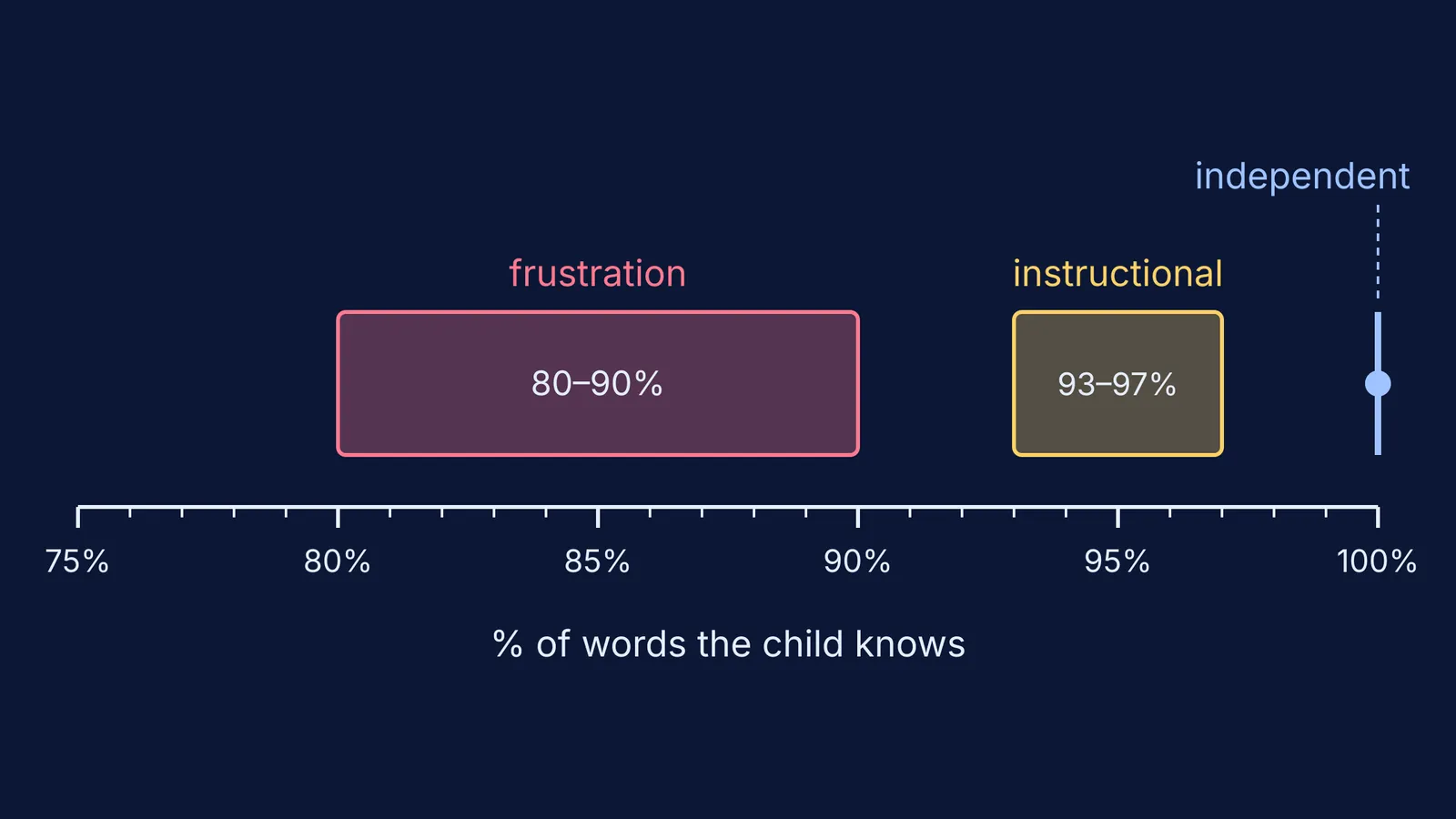
A study by Treptow, Burns and McComas (2007) sorted passages into three levels by the share of words the child knew. Frustration level meant knowing 80-90% of the words, instructional level 93-97%, and independent level 100%. Comprehension was highest at the independent level and lowest at the frustration level, and time on task was better at the instructional level. It followed only three struggling third-grade readers, so treat the bands as a rough guide. Meera's 95% falls roughly in the instructional band: she can read this book with a little help.
The Ministry of Education's NIPUN Bharat learning goals set reading with meaning at 45-60 words per minute for Grade 2 and at least 60 words per minute for Grade 3. At 57, Meera is close. The missed question tells you more: she reads the words but needs practice thinking about why things happen.
What is the five-finger rule for choosing books?
In the version Scholastic describes, the child reads the first page and holds up one finger for each word they don't know or can't pronounce. Zero or one finger means too easy, two or three just right, and four or five too hard, or best read aloud with a buddy. A child who is excited about a harder book can still read it with an adult's help.
What should I do if books feel too easy or too hard?
If books are too easy (almost no mistakes and a quick, confident retell):
Keep the easy books. They build fluency and the habit, and reading for pleasure matters on its own.
Add one "stretch" book you read together, a level up or non-fiction they love.
Ask harder questions: why, what if, and would you have done the same?
If books are too hard (accuracy below about 90%, the study's frustration range, or the retell falls apart):
Don't take away a book they love. Read it together, taking turns by page. With younger children, try dialogic reading.
For reading alone, go down a level until the five-finger count is two or three.
Before they start, go over three or four tricky words.
If the hard book is a science textbook, the problem is often a concept, not the words. The Fermi Concept Library covers every concept in physics, chemistry, biology, mathematics and computing, each with its own lesson, so an older child can fill that gap first.
If books are just right, keep going and repeat the check in two or three months.
When should I talk to the school or a specialist?
Talk to the class teacher if, after a few months of regular reading at the right level, your child still:
reads well below their class level on the home check
guesses words from the first letter or from the picture
reads accurately but can't retell even easy passages
avoids reading or gets very upset when asked to read
A teacher, special educator or paediatrician can assess properly, and it is worth asking about an eye check too. Our guide to dyslexia signs and how assessment works explains the process. If reading worries are causing real distress at home, Tele-MANAS, the government's toll-free mental health helpline, answers 24/7 on 14416.
Try the check this weekend with your child's current book, and note the date, accuracy and speed to compare next term.


