

On this page
For families in the armed forces, nationalised banks and government services, frequent relocations are a fact of life. While these moves build resilience and adaptability in children, they also carry a hidden cost.
Research into student mobility shows that the transition friction of changing schools mid-session affects both academic performance and social well-being. If you are a parent managing a transferable job, understanding this "transfer penalty" is the first step to helping your child overcome it.
What is the real cost of the "transfer penalty"?
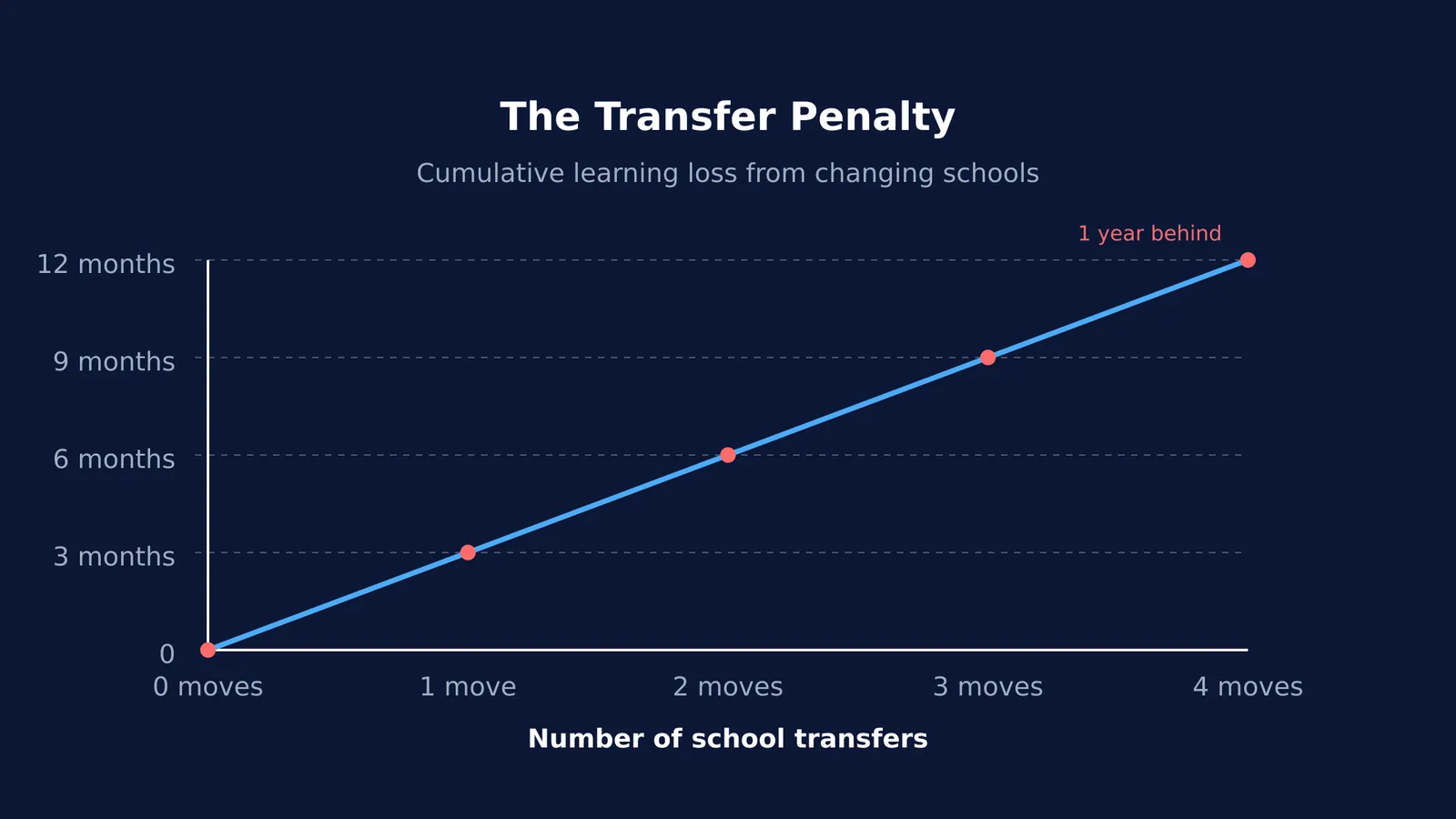
The impact of changing schools is measurable. According to a 2016 review by *Education Week*, students generally lose approximately three months of reading and math learning each time they switch schools. A landmark University of Chicago study cited in the same review examined the records of thousands of students and found that those who had changed schools four or more times by the sixth grade were about one year behind their classmates.
Even when families stick to a uniform curriculum—such as the CBSE syllabus used by Kendriya Vidyalayas (KVs) and Army Public Schools—the gap persists. A mid-session move often means your child arrives at a new school to find the class has already covered chapters that their old school had scheduled for later in the academic year.
This mismatch is particularly damaging in cumulative subjects like mathematics and physics, where missing the foundational lesson on fractions or kinematics makes the subsequent chapters impossible to follow. The frustration of sitting in a classroom without understanding the current topic can quickly erode a student's confidence and lead to a long-term dislike of the subject.
How can you bridge curriculum gaps after a move?
When a child's grades drop after a move, it is rarely due to a lack of effort; it is usually a structural gap. You cannot ask a student to simply "study harder" if they missed the core concept entirely. Before you can help them improve, you must identify exactly what was skipped during the transition.
This is where an AI tutor can help diagnose the exact point of failure. Fermi's AI tutor can work out what you already know and build a plan for the session. Instead of just giving the answer to a homework problem, it holds a line of reasoning, notices where the student is stuck, and writes on a board to explain the missing concept. If your child missed the chapter on chemical bonding during a transfer, the tutor teaches the foundation.
If you know exactly which topics were missed, your child can use the Fermi Concept Library to look up specific ideas in physics, chemistry, biology and mathematics, ensuring they are caught up before the next exam. By addressing these missing pieces immediately, you prevent a single missed chapter from compounding into a larger academic problem.
How can you help your child adjust socially?
Beyond academics, the social reset of being the "new kid" takes a significant emotional toll. Children often experience relocation fatigue, withdrawing from making new friends to protect themselves from future goodbyes. This withdrawal can make them feel isolated and further affect their focus at school.
Empathy over pressure: Acknowledge the difficulty of the move. Let them know it is normal to feel out of place for the first few weeks, and do not rush them into joining multiple clubs or groups immediately.
Maintain old ties: Encourage them to keep in touch with friends from their previous school digitally. A sense of continuity helps buffer the stress of the new environment and provides a safe space to talk.
Build a stable home environment: When the outside world changes, the home must be the constant. Establish a predictable study routine and set up a familiar study space at home that remains the same regardless of which city you live in. Using the same desk setup and schedule provides a comforting anchor.
By proactively mapping out syllabus gaps and providing consistent emotional support, you can help your child turn the challenge of a transferable lifestyle into a long-term advantage in resilience.


