

On this page
It is 11 pm, you are stuck on a rotation problem, and the solution video is one tap away. Watching feels like progress, but the research says the order matters: try first, watch second, redo third.
Why does watching a solution feel like learning when it isn't?
Watching someone solve a problem smoothly makes it feel easy, and easy feels like learning. In a 2013 study, people watched a short video of an instructor explaining a science concept; a fluent, confident instructor made viewers predict they would remember more, but they did not learn more than viewers of a halting instructor (Carpenter, Wilford, Kornell and Mullaney, Psychonomic Bulletin & Review).
In a randomised comparison in large introductory college physics courses, students in active classes learned more than those taught by experienced, highly rated lecturers, but felt they had learned less, partly because active learning takes more effort (Deslauriers and colleagues, PNAS, 2019). People's sense of how fluent something feels in the moment shapes how well they think they are learning, and that can mislead them (Bjork, Dunlosky and Kornell, Annual Review of Psychology, 2013).
Should you try the question before watching the solution?
For most JEE, NEET and board problems, yes. Kornell, Hays and Bjork found that trying to answer a question helps you learn the answer afterwards, even when the attempt fails (Journal of Experimental Psychology: Learning, Memory, and Cognition, 2009).
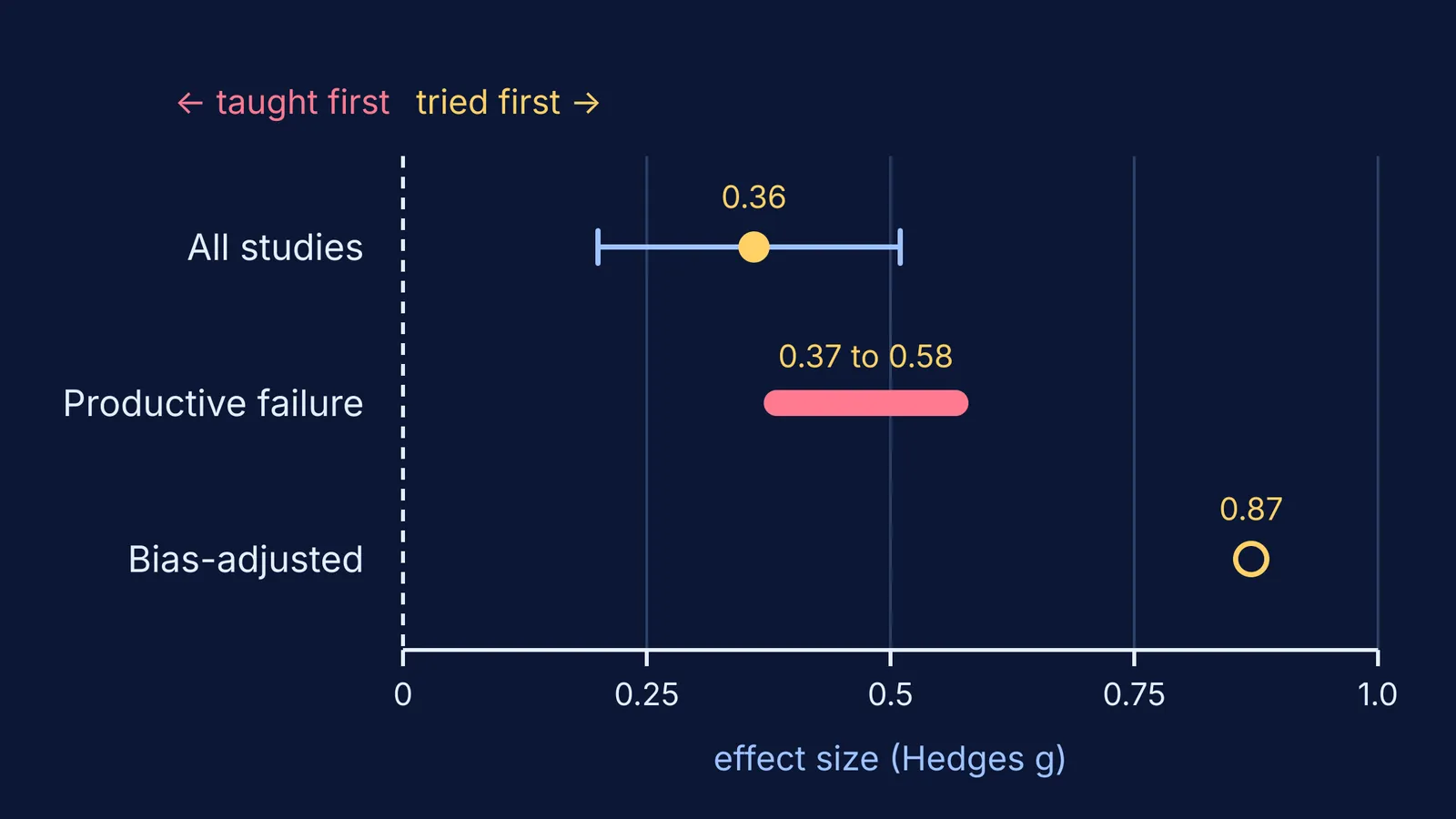
A 2021 meta-analysis of 53 studies with 166 comparisons looked at students learning a new concept. It found a moderate benefit (Hedges' g 0.36) for solving problems first and being taught afterwards, compared with being taught first (Sinha and Kapur, Review of Educational Research). The benefit was larger, 0.37 to 0.58, when the problem-first phase closely followed the design principles of "productive failure". The same review found the opposite for young children in grades 2 to 5, so the evidence fits older students better than young children.
When is it fine to watch first?
Struggle helps only when you have something to struggle with. Methods that help beginners, such as studying worked examples, can lose their value or even hurt once learners know more, which researchers call the expertise reversal effect (Kalyuga, Ayres, Chandler and Sweller, Educational Psychologist, 2003). A new topic alone is no reason to skip the attempt. So:
Watch first if you have set up the problem and still cannot make any start, because you have not met the basic idea yet. Watch a concept explanation, then try a problem.
Watch first if you cannot start because you do not know what a word or symbol means. Look that up, then attempt.
Try first if you have studied the chapter and the problem is one you "should" be able to do. This is most practice.
Try again first for every mock test question you got wrong, before opening the solution.
An attempt-first routine you can use tonight
The aim is to make your attempt, even a failed one, do the work (Kornell, Hays and Bjork, 2009). The timings below are our suggestion; adjust them to the problem.
Set up (2 minutes). Write what is asked, list what is given, and draw the figure.
Attempt (15 minutes). Write everything, including dead ends. No video, no answer key.
Name the block. Write one line: "I am stuck at ___ because ___."
Watch with the pause rule (below).
Write the missing idea in one sentence, in your own words.
If you want a nudge rather than the full answer, Fermi's AI tutor notices where you are stuck and decides whether to explain, ask or show, so the thinking stays yours. That is also why it helps to share your attempt before asking an AI.
How do you redo the problem after watching the solution?
Redoing is where you check that the idea is now yours.
Same day, blank page. Close the video and notes and solve from scratch.
A few days later. Redo it cold. If you stall at the same step, the idea has not stuck yet.
Change one thing. Swap a number, flip a direction, or add friction, and solve the new version.
A worked example: for a block sliding down a rough incline, you drew friction pointing down the slope. The video shows it acting up the slope, against the motion. Your note: "Friction opposes relative motion, so draw the motion first." On the redo, push the block up the slope instead; friction now points down. Get that right without help and you have learned the idea, not just the answer.
To check your steps, the Fermi Problem Library has a step-by-step solver that explains the reasoning rather than printing an answer. Our guides on how to compare your method with the model solution and use AI to understand mistakes, not get answers go further.
Tonight, pick one problem you skipped, give it 15 honest minutes, and only then press play.


