

On this page
AI can explain a hard idea at 11 pm, check your working and find the gap in your reasoning. But some study moments only work if your own brain does the heavy lifting. If AI does that part for you, you feel productive and learn less. Here is when to keep it closed, and when to open it.
Does using AI for practice hurt learning?
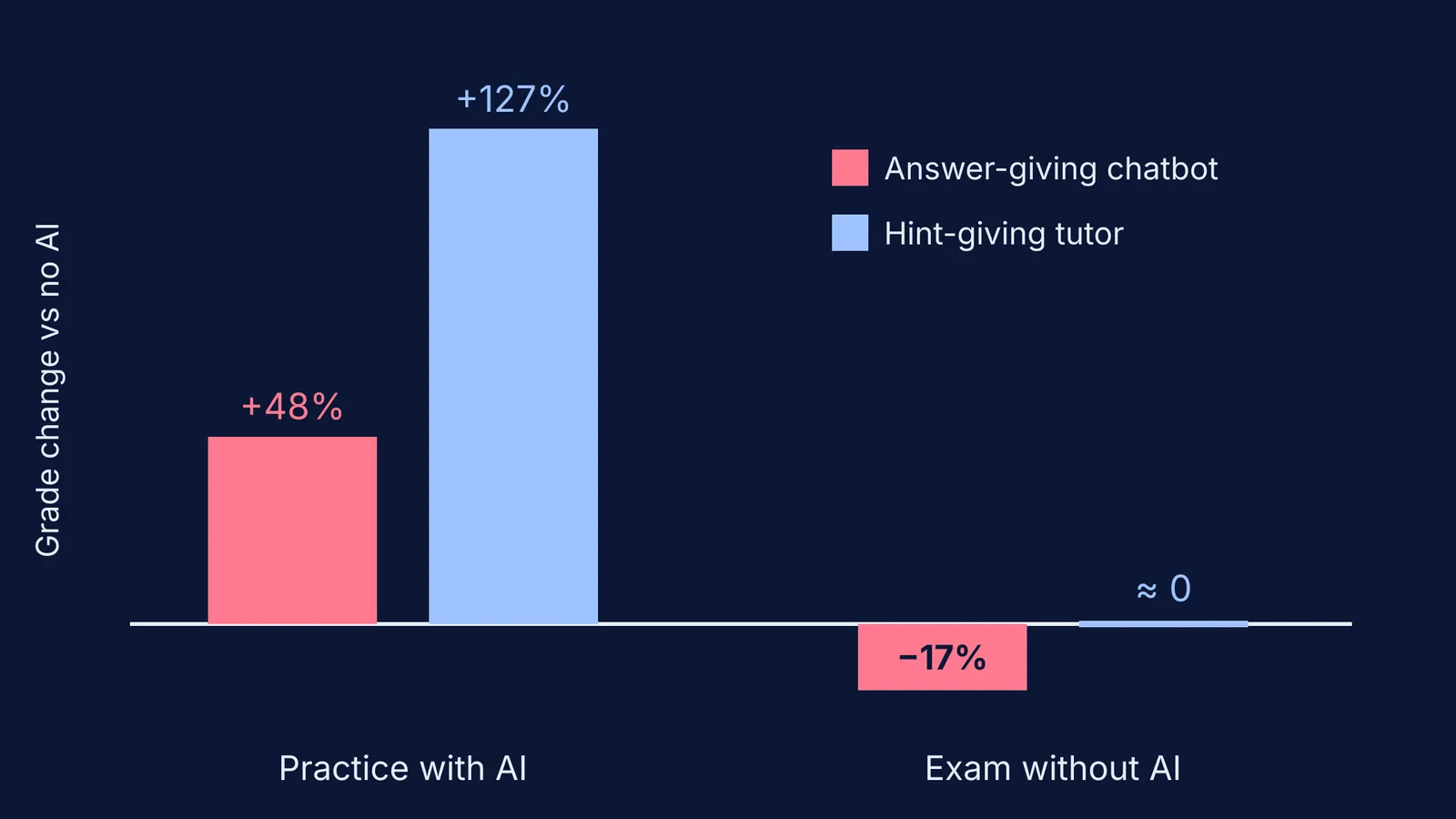
It can, depending on how you use it. In a field experiment at a large high school in Turkey, researchers gave nearly 1,000 students in Classes 9 to 11 access to GPT-4 during maths practice sessions (Bastani et al., PNAS, 2025).
With a standard chat window, practice grades rose by 48%, but on a later exam taken without AI, those students scored 17% lower than students who never had access (PNAS).
The researchers found that students in that group most often simply asked for the answer and copied it, using the chatbot as a crutch (full text, Europe PMC). A second version, prompted to give hints instead of answers, raised practice grades by 127%, and its students did about as well as the control group on the exam without AI (PNAS).
The lesson is not "never use AI". It is that answers handed over too early can replace the thinking that the practice was meant to build.
When should students not use AI for study?
Five moments, each with one rule you can remember.
Your first attempt at a new problem. Rule: write something on paper before you ask anything. A meta-analysis of 53 studies found that, on average, students who tried problems before being taught the method learned more than students taught first, though the youngest primary-school pupils did better when taught first (Sinha and Kapur, Review of Educational Research, 2021). The struggle can prepare your mind for the explanation that follows.
Memory practice. Rule: recall first, check second. In a classic study, students who tested themselves remembered more a week later than students who re-read, even though re-reading made them feel more confident (Roediger and Karpicke, Psychological Science, 2006). Asking AI to "summarise the chapter again" is re-reading. Close the book and the chat, write what you remember, then check.
Timed mock tests. Rule: no AI until you submit. JEE Main, NEET-UG and board exams give you no assistant, so a mock taken with help tells you nothing about the real day. Bring AI in afterwards, during analysis.
The moment you think "I get it". Rule: explain it out loud, without the screen, before you move on. If you cannot explain why the answer works, you have read an explanation, not learnt one.
When you are tired and just want it done. Rule: if you are about to ask for the full solution so you can finish, stop and mark the question for tomorrow instead. That is exactly the copying pattern the PNAS study warned about.
So when does AI actually help?
After your own attempt. That is when an explanation lands on a question you have already wrestled with. Good uses include asking for a single hint rather than the solution, which our guide on using an AI hint ladder for hard problems walks through, and asking AI to find why your method went wrong, covered in use AI to understand mistakes, not get answers.
If you want a tool built for that, Fermi's AI tutor teaches rather than answers: it notices where you are stuck, and decides whether to explain, ask or show. After a mock, the Fermi Problem Library has a step-by-step solver that explains the reasoning rather than printing an answer, so you can compare its method with yours line by line.
How can parents check AI is helping, not replacing, study?
You do not need to read every chat. Ask questions that only real learning can answer.
"Show me a question you got wrong this week. What did you try first?"
"Explain this answer to me without your phone."
"Did you take your last mock without any help?"
If the answers are vague, suggest a few AI-free sessions a week rather than a ban. Our piece on whether to keep days without AI for study has a simple way to set that up.
Start with one change this week: no AI on first attempts. It is the simplest rule to keep, and it protects the thinking your practice is meant to build.


