

On this page
AI can turn your rough notes into a clear parent message in seconds. It cannot know whether Riya actually missed three homeworks or two, how her mother prefers to be addressed, or whether her marks should leave your school's systems at all. That part stays with you. Below: a worked example, and a checklist to run before you press send.
Why do short parent messages matter so much?
Because parents act on specific information. In a field experiment published in the Economics of Education Review, teachers sent weekly one-sentence, individualised messages to parents of high school students in a summer credit recovery programme (Kraft and Rogers, 2015).
Those messages cut the share of students who failed to earn course credit from 15.8% to 9.3%, a 41% reduction, mostly by keeping students from dropping out (abstract, Brown University).
Messages about what a student could improve did better than purely positive ones: an 8.8 percentage-point rise in earning credit, against 4.5 points for positive messages, which was not statistically significant (Journalist's Resource summary).
The lesson for AI drafting: the value is in one specific, honest sentence about this child, not a polished paragraph that could describe anyone. We looked at the wider evidence on whether text messages to parents improve attendance and grades in an earlier post.
What should never go into an AI tool?
India's Digital Personal Data Protection Act, 2023 defines a child as anyone under 18 and requires any organisation processing a child's personal data to obtain verifiable consent from a parent first (DPDP Act, Gazette of India, MeitY). Its provisions come into force in stages, so follow your school's current policy on which tools are approved.
UNESCO's 2023 guidance on generative AI in education calls for data protection and privacy standards and sets an age limit of 13 for AI tools in the classroom. A UNESCO survey of over 450 schools and universities found less than 10% had policies or formal guidance on generative AI (UNESCO, 7 September 2023).
In practice, keep these out of any tool your school has not approved:
Full names, roll numbers, phone numbers and addresses
Exact marks linked to a name
Health, disability, counselling or family circumstances
Anything a parent told you in confidence
Use placeholders such as "Student A" and "[mark]", then fill in the real details yourself in the school's own messaging system.
How do you get a warm, accurate draft from AI?
Start with your own notes, not a blank request. Here is a prompt a Class 9 science teacher might use:
"Write a three-sentence message to the parent of Student A. Facts: homework submitted 4 of 6 times this month; strong answers in class on the motion chapter; struggles to show units in numericals. Tone: warm, plain English, no jargon. Give one thing the parent can do at home. Do not add any facts I have not given you."
A draft back might read: "Student A has shown real understanding of motion in class this month. Homework came in on 4 of 6 days, and numerical answers often miss their units. Could you ask them to read one answer aloud each evening and say the unit?"
Now edit. Swap in the child's name, replace generic praise with the actual moment ("explained why a ball slows down on grass"), and check 4 of 6 against your register. AI can state invented details confidently, so read the draft as you would a student's answer, using this four-point checklist for reading AI answers critically.
For report-card comments, give the tool your evidence and tie each comment to something the child did. Our guide to drafting marking rubrics with AI helps here, because rubric language keeps comments consistent.
If the gap is a concept, point the family to that concept's lesson in the Fermi Concept Library, so the next step is concrete rather than "revise more".
What should you check before you send?
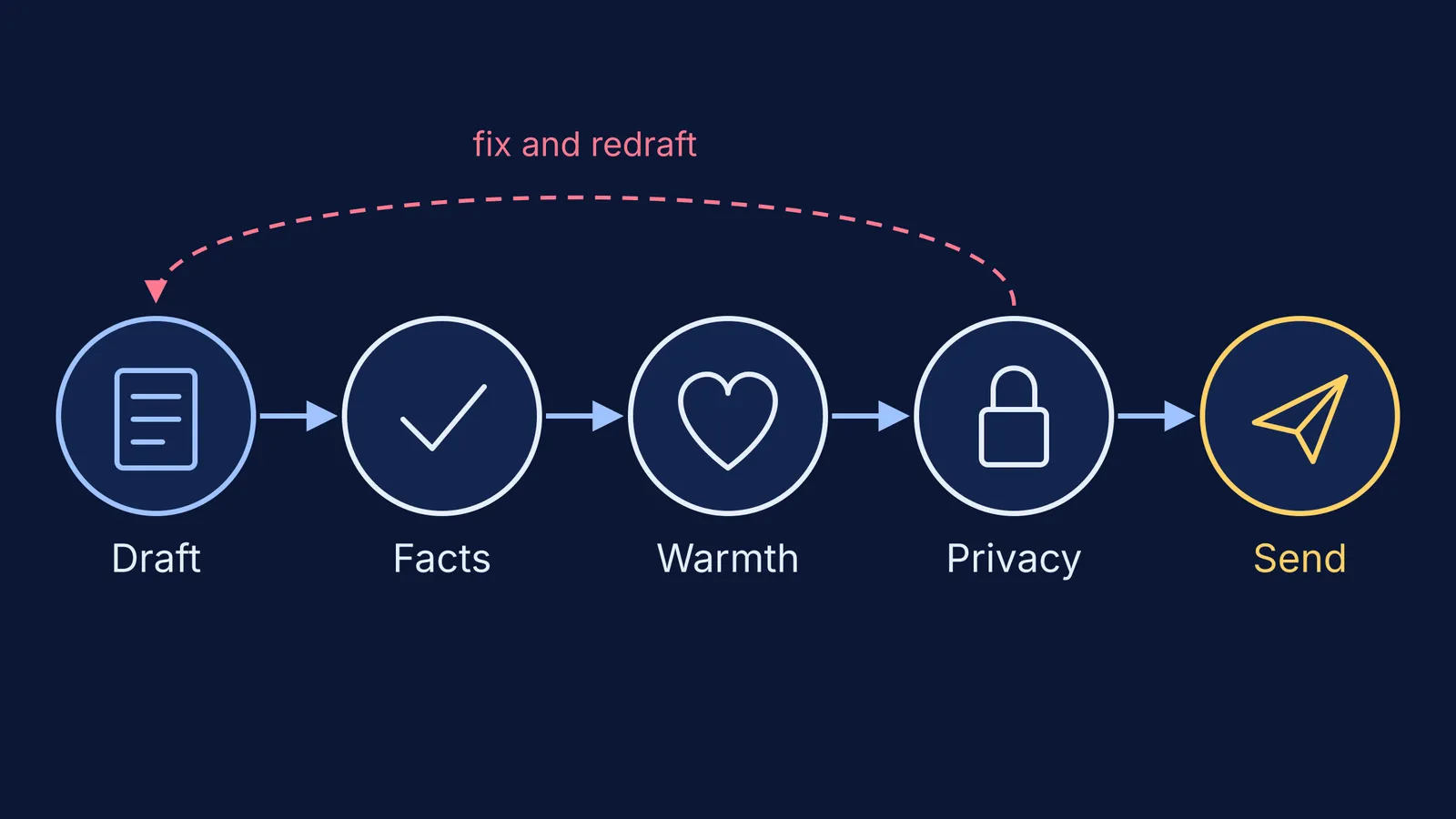
Run these five checks on every AI-drafted message:
Facts: every date, mark, count and name matches your records.
Specific: at least one sentence could only be about this child.
Warmth: it opens with something true and positive, and sounds like you, not a template.
One action: the parent knows exactly what to do next, and how to reply.
Privacy: no sensitive detail went into an unapproved tool, and the message goes only to the right guardian.
For school-wide notices, also check dates and fees against the official circular. If a message touches on a child's wellbeing or mental health, write it yourself and involve the school counsellor.
Where does AI help students after the message?
A good parent message often ends with "needs more practice on X". For a student who does not know where to start, Fermi's AI tutor works out what they already know and builds a plan for the session, so the follow-up at home has a clear first step.
Keep the drafting quick and the checking careful. The one sentence that is true, specific and kind is the one parents remember.


