

On this page
Many parents hear about missed homework or absences weeks later, on a report card. Several randomised trials tested a simple fix: tell parents sooner, by text.
What did the text-message trials find?
In a US trial, Peter Bergman and Eric Chan sent parents of middle and high school students weekly automated alerts about missed assignments, grades and class absences (Journal of Human Resources). The alerts reduced course failures by 27% and increased class attendance by 12%, with no impact on state test scores. More than 32,000 texts were sent at a total variable cost of $63.
In England, an Education Endowment Foundation trial covered 15,697 students in 36 secondary schools; schools sent each parent an average of 30 texts designed to engage them in their child's learning (evaluation summary, Miller and colleagues, 2016). Pupils made about one month of additional progress in maths and had lower absenteeism; there was no evidence of a science effect, and an apparent English gain may reflect missing data.
In Chile, the Papás al Día programme sent weekly and monthly texts on attendance, grades and classroom behaviour to parents in low-income schools (Berlinski and colleagues, Journal of Human Resources). Over 18 months it raised maths scores by 0.09 standard deviations and increased the share of students meeting the attendance requirement for promotion by 4.7 percentage points.
How big are the effects, really?
Small for each student, large for the money. A gain of 0.09 standard deviations in maths, as in the Chile trial (Berlinski and colleagues), is a nudge, not a transformation. What texts changed most was behaviour parents can see and act on: turning up, handing work in, not failing a course. The gains were largest for students who were struggling: those with below-median grades in the US trial (Bergman and Chan) and those at higher risk of repeating a year or dropping out in Chile.
Why do short messages to parents work?
Parents often do not know how much school their child has missed. In a trial covering 28,080 high-risk students, Todd Rogers and Avi Feller sent parents personalised information about absences repeatedly through the school year; the most effective versions reduced chronic absenteeism by 10% or more, partly by correcting parents' mistaken beliefs about how many days their child had missed in total (Nature Human Behaviour, via RePEc). The lesson for any message: a running total beats a vague reminder.
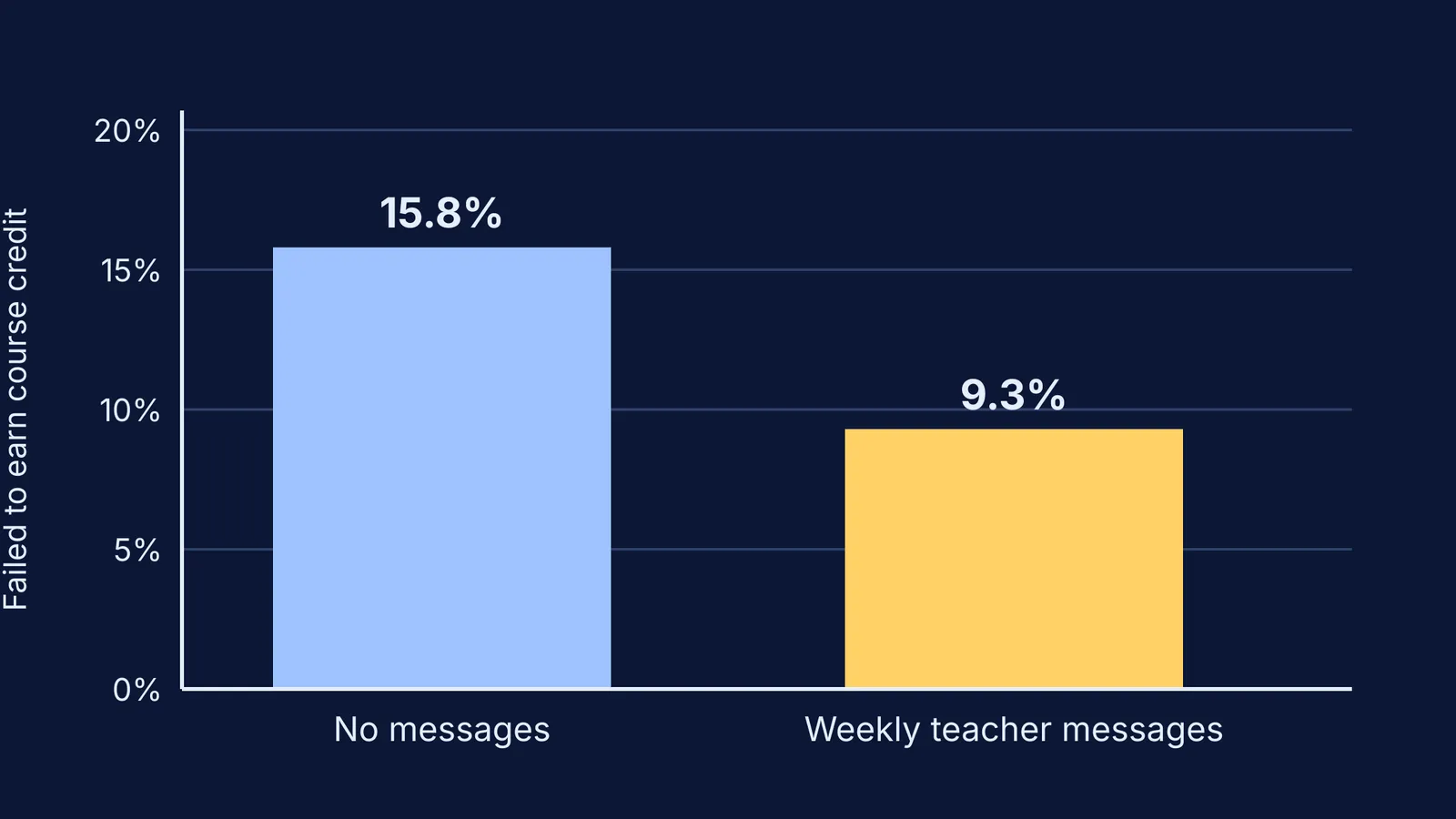
Content matters. Matthew Kraft and Todd Rogers had teachers send weekly one-sentence messages to parents of high school students in a credit recovery programme (Economics of Education Review). The share of students who failed to earn credit fell from 15.8% to 9.3%, a 41% reduction, mostly by preventing drop-outs, and messages about what a student could improve worked better than messages about what they were doing well.
How parents sign up matters even more. In a US trial with 6,976 students, a standard opt-in process got 1% of parents to enrol, a simplified one got 11%, and automatic enrolment with the option to reply STOP got 95% (Bergman, Lasky-Fink and Rogers, Organizational Behavior and Human Decision Processes).
How should a school write parent messages that work?
Enrol every parent by default and let them reply STOP to leave.
Send on the same day each week.
Pull facts from the attendance register and homework log you already keep.
Name the subject, the task and the date.
Give a running total: "absent 5 days this term".
Say what the student can improve, plus one thing the parent can do tonight.
Write briefly, in the language the parent reads best.
Give one way to reach the class teacher.
A weak message and two better ones (names made up):
Weak: "Dear parent, kindly ensure your ward completes all work on time."
Better: "Riya has been absent 5 days this term and missed 2 physics practicals. The next practical is Thursday. Reply CALL to speak to her class teacher."
Better: "Aarav has not handed in the Chapter 3 maths worksheet that was due Monday. He can submit it by Friday. Tonight, you could ask him which question he is stuck on."
What can parents do when a message arrives?
Treat the text as the start of a conversation, not proof your child is failing. Ask one calm question ("What made the worksheet hard?") first; our guide to staying involved in high school without hovering has more. If a problem repeats, take the messages to school with these parent-teacher meeting questions that lead to real follow-up, alongside what the report card shows beyond the marks.
If an alert says a maths or science task is missing because your child got stuck, Fermi's AI tutor can work out what they already know and build a plan for the session, so the evening starts with a clear next step instead of an argument.
If your school does not send updates like these, ask the class teacher to try them for one term.


