

On this page
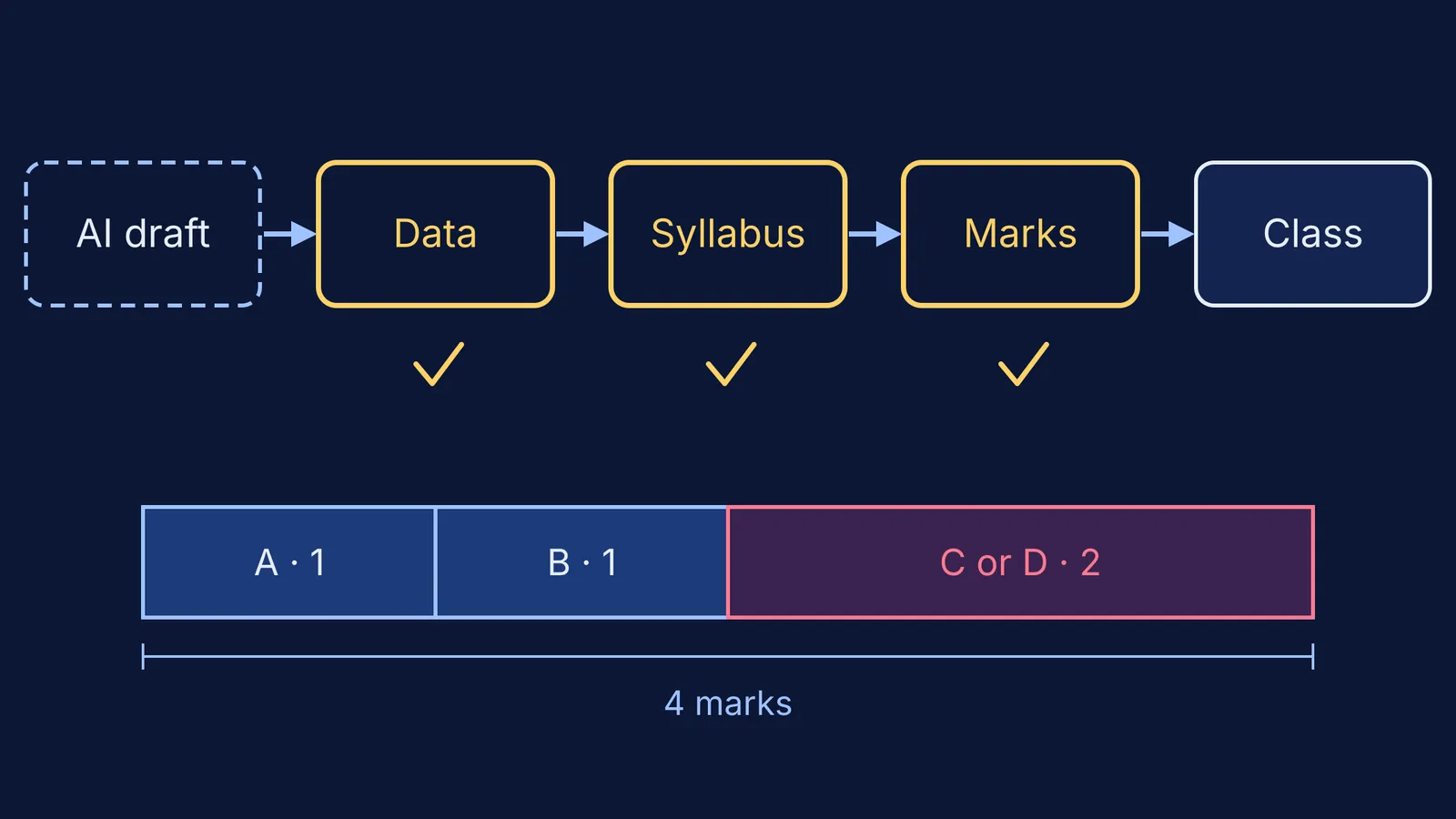
Case-based questions are a fixed part of CBSE board papers. The CBSE Class X Science curriculum for 2026-27 lists "Source-based/ Case-based/ Passage-based/ Integrated assessment questions" among the question types in the theory paper. In the board's 2026-27 sample paper marking scheme, a 4-mark case question has sub-parts A (1 mark) and B (1 mark), then a choice of C or D (2 marks).
Writing a fresh case every week is slow, so it is tempting to ask an AI chatbot for a first draft. The draft is the quick part; the checking is where your judgement matters.
Can AI write good CBSE case-based questions?
It can, but it also writes wrong ones that look fine. A 2024 systematic review in BMC Medical Education by Yaara Artsi and colleagues looked at eight studies in which large language models wrote multiple-choice exam questions. Five of the studies showed that the models could produce questions valid for medical exams. All eight presented some faulty questions that were not fit for an exam, and the authors concluded that, for now, these models may serve as a supplementary tool.
That review was about medical MCQs, not school science, but the lesson carries over: treat the AI output as a draft from a fast colleague who never checks their own work.
What should you check before a class sees it?
Run three checks, in this order.
The data. Redo every calculation yourself, with units. Look for unit slips, "facts" about real people or places you cannot confirm, and numbers that are unrealistic for an Indian home or lab.
The link to the syllabus. Open the current subject curriculum on the CBSE Academic curriculum page and match every sub-part to a line in it. For 2026-27, the Class X Science curriculum says the motor, electromagnetic induction and the electric generator will be assessed only formatively, not in the year-end exam. A chatbot trained on older papers may not know that.
The marking points. Write the marking scheme before you print. Each mark, or half mark, should be one point a second teacher would award the same way.
The same curriculum document gives the competency weightage for the Class X Science theory paper: 50% "Demonstrate Knowledge and Understanding", 30% "Application of Knowledge/Concepts" and 20% "Formulate, Analyze, Evaluate and Create". Its suggested verbs (state and define; calculate and explain; interpret and analyse) show quickly whether a case is all recall.
A worked example: one electricity case, before and after
Here is a prompt you can adapt:
"Write a CBSE Class 10 Science case-based question worth 4 marks on electric power and household energy use. Sub-parts A (1 mark), B (1 mark), and C or D (2 marks). Use only topics in the 2026-27 Class X syllabus. Give one marking point per mark."
Suppose the draft comes back like this:
Case: A family in Pune runs a 2000 W geyser for 1 hour every day.
A. What is the power of the geyser in kilowatts?
B. Calculate the energy it uses in 30 days. Key: 60,000 units.
C. Explain how the generator at the power station produces this electricity. OR D. Why should the geyser's metal body be connected to the earth wire?
Now run the three checks on it:
Data: 2 kW × 1 h × 30 days = 60 kWh, so the key should say 60 units. The draft multiplied in watts and never converted to kilowatt-hours.
Syllabus: sub-part C is about the generator, which is formative-only this year. Replace it with: "The family cuts geyser use to 30 minutes a day. How many units do they save in 30 days?" That stays inside "Electric power", which the syllabus lists for the year-end exam.
Marking: B gets 0.5 for writing energy = power × time and 0.5 for 60 kWh with the unit. New C gets 1 for 30 kWh used and 1 for 30 units saved. D gets 1 for "leaking current flows to the ground" and 1 for "so a person touching it is not shocked".
Unchecked, this case would have taught a wrong answer and tested a topic the board will not set in the year-end exam.
How can students use the same checks?
Students can run the same checks on practice questions they make; our guide to practising CBSE case study questions with AI walks through it. For the answer side, see how to ask AI to mark your answer using the CBSE marking scheme and how to check the answer keys of AI-made MCQs.
When a student keeps choosing the wrong method rather than losing marks on wording, the Fermi Problem Library has worked problems with a step-by-step solver that explains the reasoning rather than printing an answer. If they do not know where to start on a chapter, Fermi's AI tutor works out what they already know and builds a plan for the session.
Draft with AI, then check the data, the syllabus line and the marking points before your class sees it.


