

On this page
A cell takes in food and oxygen, and gets rid of waste, through its outer membrane: its surface. But the demand comes from everything inside: its volume. Grow the cell and those two numbers drift apart. That gap keeps cells small, and the same arithmetic helps explain an elephant's huge ears.
Why are cells so small?
According to OpenStax Biology 2e, prokaryotic cells are 0.1 to 5.0 µm in diameter and eukaryotic cells are 10 to 100 µm.
Surface area to volume ratio (SA:V) is the amount of outer surface a shape has for each unit of volume inside it. OpenStax gives the formulas for a sphere of radius r: surface area 4πr² and volume 4πr³/3. Divide one by the other and SA:V = 3/r, so doubling the radius halves the ratio.
OpenStax adds that if a cell grows too large, the plasma membrane will not have enough surface area to support the rate of diffusion its larger volume needs.
How does surface area to volume ratio change as a cell grows?
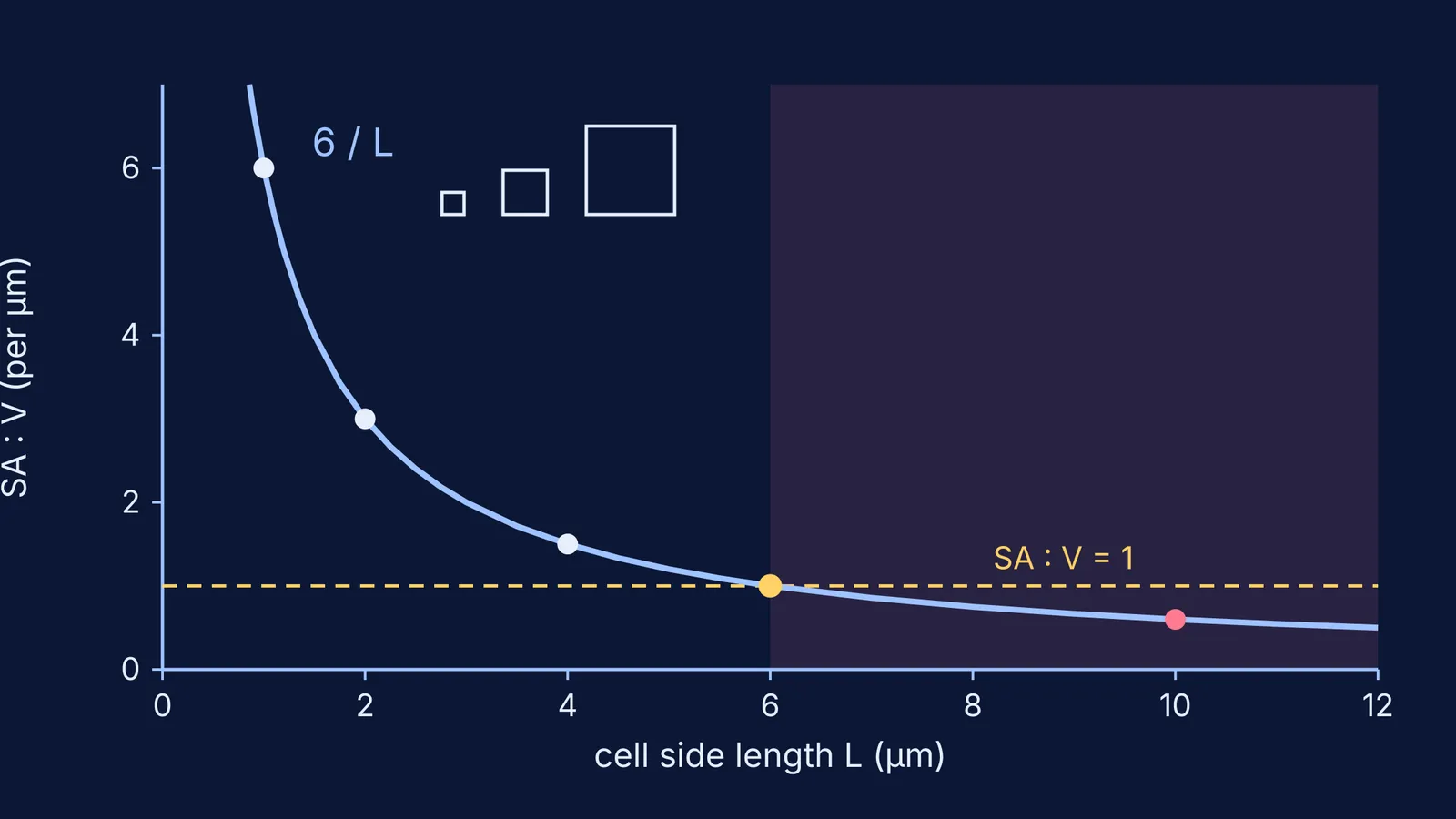
Model the cell as a cube with side L micrometres. Its surface area is 6L² and its volume is L³, so SA:V = 6/L.
Predict first. If you double L from 1 µm to 2 µm, does SA:V halve, quarter, or stay the same?
L = 1 µm: area 6 µm², volume 1 µm³, SA:V = 6
L = 2 µm: area 24 µm², volume 8 µm³, SA:V = 3
L = 4 µm: area 96 µm², volume 64 µm³, SA:V = 1.5
L = 10 µm: area 600 µm², volume 1,000 µm³, SA:V = 0.6
OpenStax shows the same pattern with 1 mm³ and 8 mm³ cubes (6 to 1, then 3 to 1). The inside grows faster than the surface.
Why do big cells starve?
Now add a rule. Say each square micrometre of membrane brings in 1 unit of food per second, and each cubic micrometre of cytoplasm uses 1 unit per second. Supply is 6L² and demand is L³.
Supply equals demand when 6L² = L³, at L = 6 µm. Above that, the cell burns food faster than its surface lets it in: at L = 10 µm, supply is 600 units per second against demand of 1,000. In this model, that is starving.
Change one number: if each cubic micrometre needs 2 units, break-even halves to 3 µm. Real cells are not cubes and real uptake is messier, so treat this as a model, not a measurement.
OpenStax lists the ways cells get around the limit: divide, fold the membrane, become flat or thin and elongated, or develop organelles for specific tasks. Squash the 4 µm cube into a sheet 16 × 16 × 0.25 µm and the volume stays 64 µm³, but the area becomes 528 µm², so SA:V jumps from 1.5 to 8.25. For the same idea in your lungs, see the layers oxygen crosses in the alveoli.
Why do elephants have such big ears?
Scale up and the arithmetic applies to heat. An animal makes heat throughout its volume and loses it through its skin, so a very large animal has a low SA:V and can struggle to shed heat. A thin, flat ear adds a lot of surface for little volume. As a rough model, a body shaped like a 1 m cube has SA:V = 6 per metre, while a sheet 2 cm thick has about 2 ÷ 0.02 = 100 per metre, counting both faces.
Polly Phillips and James Heath measured this in a 1992 study (abstract on PubMed). Using infrared thermography, they measured the ear surface temperatures of four female African elephants at air temperatures of 14 to 32 °C and calculated heat losses of 10.67 to 76.2 W, counting one side of one ear only. Using a model of heat flow from a flat plate, they concluded that up to 100% of an African elephant's heat-loss needs can be met by moving its ears and widening the blood vessels in them. For other animals, compare how polar bears and camels handle cold and heat.
How can you run this as a simulation?
A plan for a student, or a parent and child:
Predict: sketch how SA:V changes as L goes from 1 to 12 µm.
Grow: compute area, volume and SA:V for each L.
Plot SA:V against L and compare with your sketch. The real curve is 6/L, not a straight line.
Feed it: add supply and demand columns and find where the cell starts to starve.
Reshape it: keep the volume fixed, flatten the cell, and watch SA:V climb.
For other ideas that are easier to see than to read, the Fermi Simulation Lab has interactive simulations, and Fermi's AI tutor can work through a model like this with you, checking your understanding as it goes. Exam questions on scaling use the same reasoning; see the ratio method for scaling numericals.
Start with step 1: make your prediction before you calculate anything.


