

On this page
When you study measures of dispersion in Class 11 statistics, calculating variance (σ²) and standard deviation (σ) by hand feels straightforward until your rough work contradicts the textbook. In the NCERT Class 11 Mathematics textbook, you encounter two distinct expressions for ungrouped data: the direct definition formula based on mean deviations, and an algebraic shortcut based on raw squares.
Many students memorise both formulas for board exams without understanding why they produce the exact same value. When practicing, a single arithmetic slip in multiplication or decimal rounding causes the two methods to diverge. Asking an AI chatbot for only the final answer yields a number that reveals nothing about where your manual calculation failed. The real power of an AI study partner lies in having it compute both methods in parallel, display intermediate totals, and explain the algebraic bridge between them.
Why do both variance formulas give the same result?
The definition formula measures the average squared distance of each observation x_i from the arithmetic mean x̄:
σ² = (1/n) Σ (x_i − x̄)²
The shortcut formula bypasses deviations entirely, computing the mean of the squares minus the square of the mean:
σ² = (1/n) Σ x_i² − x̄²
To understand why these expressions are identical, expand the squared binomial in the definition formula:
(x_i − x̄)² = x_i² − 2x_i x̄ + x̄²
Summing this expression across all n observations distributes the summation:
Σ (x_i − x̄)² = Σ x_i² − 2x̄ Σ x_i + Σ x̄²
Because the mean is x̄ = (Σ x_i) / n, the sum of all observations equals Σ x_i = n × x̄. Substituting this into the middle term gives −2x̄(n × x̄) = −2n x̄². Meanwhile, summing the constant x̄² across n terms equals n x̄². Combining these terms yields:
−2n x̄² + n x̄² = −n x̄²
The sum of squared deviations simplifies to Σ (x_i − x̄)² = Σ x_i² − n x̄². Dividing both sides by n produces the shortcut formula: (1/n) Σ (x_i − x̄)² = (1/n) Σ x_i² − x̄². Understanding this derivation stops you from viewing the variance shortcut formula as an arbitrary trick and clarifies why variance divides by n across your syllabus.
How should you ask an AI tutor to check your working?
When checking your calculations, never prompt an AI with a bare query like "find the variance." Instead, instruct the AI to evaluate both formulas and output four intermediate checkpoints:
Sum of observations: Σ x_i
Arithmetic mean: x̄ = (Σ x_i) / n
Sum of squared deviations: Σ (x_i − x̄)²
Sum of raw squares: Σ x_i²
Paste this structured prompt alongside your dataset:
"Calculate the variance and standard deviation of these values: [insert numbers]. Show the working twice: first using σ² = (1/n)Σ(x_i − x̄)², and second using σ² = (1/n)Σx_i² − x̄². Output Σ x_i, x̄, Σ (x_i − x̄)², and Σ x_i² as explicit checkpoints so I can check my rough work."
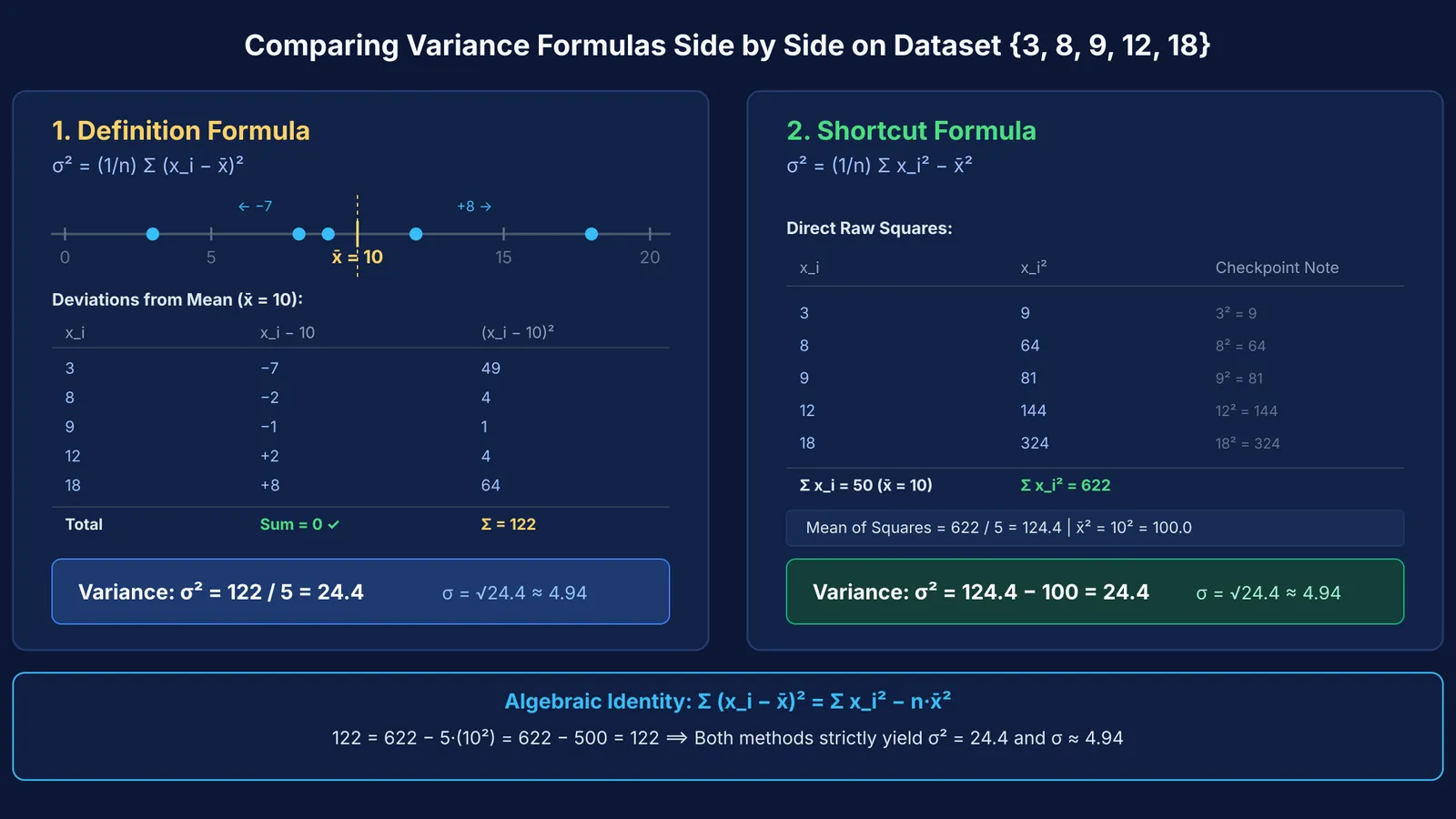
Consider the dataset: 3, 8, 9, 12, 18 (n = 5). The sum is Σ x_i = 50, giving mean x̄ = 10. Under the definition formula, the deviations (x_i − 10) are −7, −2, −1, +2, +8. Their squares are 49, 4, 1, 4, 64, which sum to Σ (x_i − x̄)² = 122. Dividing by 5 yields σ² = 24.4 and standard deviation σ = √(24.4) ≈ 4.94. Under the shortcut formula, the squared observations are 9, 64, 81, 144, 324, summing to Σ x_i² = 622. Dividing by 5 gives 124.4. Subtracting x̄² = 100 gives σ² = 124.4 − 100 = 24.4 and σ ≈ 4.94.
Comparing your rough work against these checkpoints pinpoints whether an error came from a deviation subtraction, a sign error when squaring, or an addition slip. In a 2011 meta-analysis in *Educational Psychologist*, Kurt VanLehn (2011) showed that step-based intelligent tutoring systems achieved an effect size of d = 0.76 (nearly matching adult human tutors at d = 0.79) because step-level feedback diagnoses misconceptions where they happen.
When should you use each variance formula in exams?
In timed exams like CBSE boards or JEE Main, selecting the right formula saves minutes and prevents arithmetic errors:
Use the definition formula when the mean is a clean integer (such as 10 or 25). Deviations remain small integers, and the zero-sum check confirms your arithmetic early.
Use the shortcut formula when the mean is a non-terminating decimal (such as 43 / 7 ≈ 6.14). Squaring rounded decimals across multiple observations causes compounding errors. The shortcut keeps numbers as exact integers until the final division.
This comparative practice aligns with findings in cognitive science. In an experimental study in the *Journal of Educational Psychology*, Bethany Rittle-Johnson and Jon R. Star (2007) tested 70 students and demonstrated that comparing alternative solution methods side by side produced significantly greater gains in procedural knowledge and flexibility than studying methods sequentially, while developing comparable conceptual knowledge.
Using AI to contrast methods turns doubt-clearing into an active habit of understanding mistakes rather than chasing final answers. On Fermi, the AI tutor teaches rather than answers: it notices where a student is stuck and decides whether to explain, ask, or show. For structured problem practice, the Fermi Problem Library offers worked problems with a step-by-step solver that explains the reasoning rather than printing an answer.


