

On this page
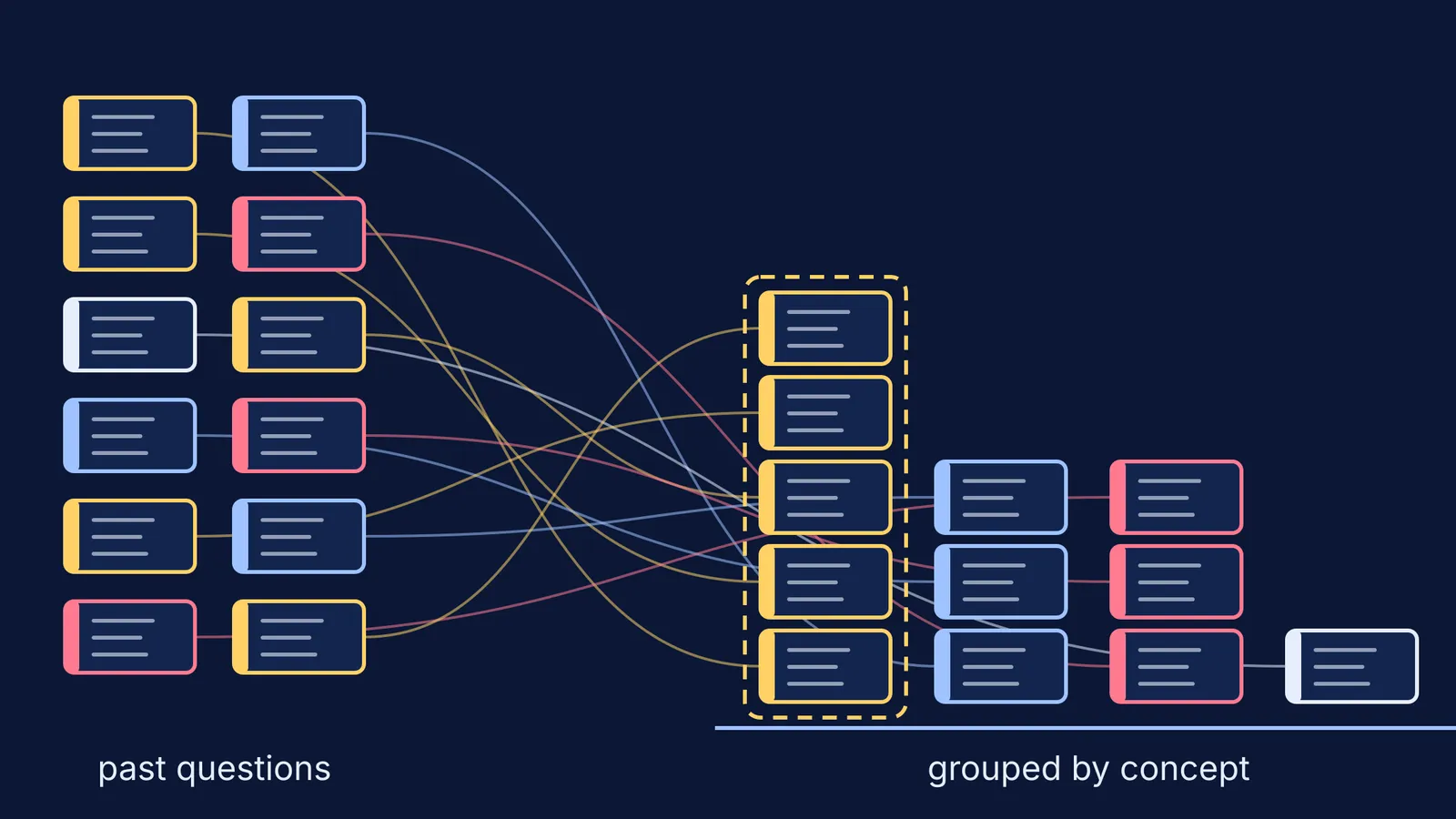
Most students work through past papers year by year. Sorting the same questions by concept shows which ideas keep coming back and what kind of thinking they ask for. AI can do the first round of tagging quickly. Checking and counting the tags is your job, and that is where most of the learning happens.
Why sort past year questions by concept instead of by year?
In a 1981 study, Chi, Feltovich and Glaser found that physics experts grouped problems by the principle that solves them, while novices grouped them by surface features. Sorting by concept practises the expert habit. Our guide on asking AI for the deepest concept behind each question covers that step; this one adds a skill tag, a check and a count.
Start with official papers. CBSE publishes a sample question paper and marking scheme for Class XII subjects, and the JEE Advanced website keeps an archive of past question papers going back to 2007. Sample papers show the current pattern; they are not past exams.
How do you get AI to tag each question by topic and skill?
Give the AI five to ten questions at a time, along with the chapter names from your official syllabus (for CBSE, the 2026-27 curriculum documents), so it picks from your list instead of inventing labels. Then paste this:
"Do not solve these questions. For each one, give: (1) the one chapter from my list it belongs to, (2) the specific concept it tests, in five words or fewer, (3) the main skill it needs, chosen from recall, single-formula use, multi-step calculation, graph or diagram reading, or derivation. Add one sentence explaining your choice. Reply as: question number, chapter, concept, skill, reason."
Copy the reply into a spreadsheet, one row per question, with a column for paper and year and a blank column called checked.
The skill tag matters as much as the concept. One Gauss's law question asks you to state the law; another needs a Gaussian surface and several steps. Losing marks on multi-step questions across many chapters needs a different fix from one weak chapter.
How accurate are AI concept tags?
Useful, but check them. In a 2024 study by Moore, Schmucker, Mitchell and Stamper, GPT-4's best strategy matched human-assigned tags for 56% of university chemistry multiple-choice questions and 35% of e-learning questions. When the two tags differed, expert reviewers preferred the AI's tag about two-thirds of the time, so a mismatch is a reason to look closely, not proof of an error.
Check every row with this four-point test before you count anything:
Syllabus: is the chapter on your official list, with the same spelling every time?
Solve: write the first two lines of a solution. Do they really start from the concept the AI named?
Skill: where there is a marking scheme, check what the marks are for: a fact, a formula or several steps.
Consistency: merge near-duplicates such as "Kirchhoff's laws" and "KVL" into one label.
Tick the checked column only when a row passes all four. Writing those first lines from memory also makes checking a form of self-testing. A 2013 review by Dunlosky and colleagues rated practice testing as one of only two high-utility techniques among the ten it examined.
How do you turn recurring concepts into a revision list?
Sort the spreadsheet by concept, count the rows, then look at the skills within each concept. A made-up example: you tag 60 physics questions from six papers, and the top of the count reads:
Gauss's law: 7 questions, 5 of them multi-step
Moment of inertia: 6 questions, mostly multi-step
Lens formula: 6 questions, mostly single-formula use
Photoelectric effect: 4 questions, mostly recall
Add one column of your own: did you get this kind of question right last time? Then set the order:
Frequent and often wrong: first.
Rare and often wrong: next.
Frequent and usually right: a quick weekly check.
Rare and usually right: last.
For each top concept, try two or three tagged questions without notes, mixed with other concepts. Our plan for interleaved practice shows how to mix them. For JEE Main, compare your list with how to use chapter weightage, but trust your own results over any chart.
If a top concept is a real gap rather than a slip, relearn it from the start. The Fermi Concept Library gives every concept in physics, chemistry, biology, mathematics and computing its own lesson and its place in the map.
Parents can help by asking to see the spreadsheet rather than the marks, with one question: "Which three concepts are at the top, and what will you do with them this week?" If you are not sure where to begin with a top concept, Fermi's AI tutor can work out what you already know and build a plan for the session, so you sit down to a clear next step. Start with one subject and one evening's worth of questions this week.


