

On this page
Many schools in India now advertise "smart classes": a digital board or a large screen at the front of the room, plus a library of animated lessons. Will your child learn more? Not because of the screen alone. What matters is what children do while it is on.
How many Indian schools have digital classrooms now?
Digital equipment is spreading quickly. The Ministry of Education's UDISE+ 2025-26 release (7 July 2026) reports that 69.9% of schools had computer access in 2025-26, up from 64.7% the year before. The same release puts internet connectivity at 67.4% of schools, up from 63.5%.
Those figures count equipment, not how a teacher uses it in a Class 8 science period.
Do smart classes and digital boards improve learning?
The broadest verdict comes from the Global Education Evidence Advisory Panel, which is co-convened by the World Bank, UNICEF and the UK's FCDO. Its 2023 "Smart Buys" report warns against "costly, low-impact investments like hardware alone" (World Bank). Its top recommendations instead include structured support for teachers and teaching at the right level.
We found very few careful trials of smart boards in Indian schools. The closest is a 2026 randomised trial at a medical college in north India, which compared Smartboard and PowerPoint lectures for 360 MBBS students (Indian Journal of Medical Research). Straight after teaching, the two groups scored about the same. At one month, 46.1% of the Smartboard group earned a Grade A, compared with 40.3% of the PowerPoint group, and the authors conclude the Smartboard helped retention. They also note limits, including a single college and a possible novelty effect, and these were adults, so the trial says little about a crowded school classroom.
Why does hardware alone rarely change results?
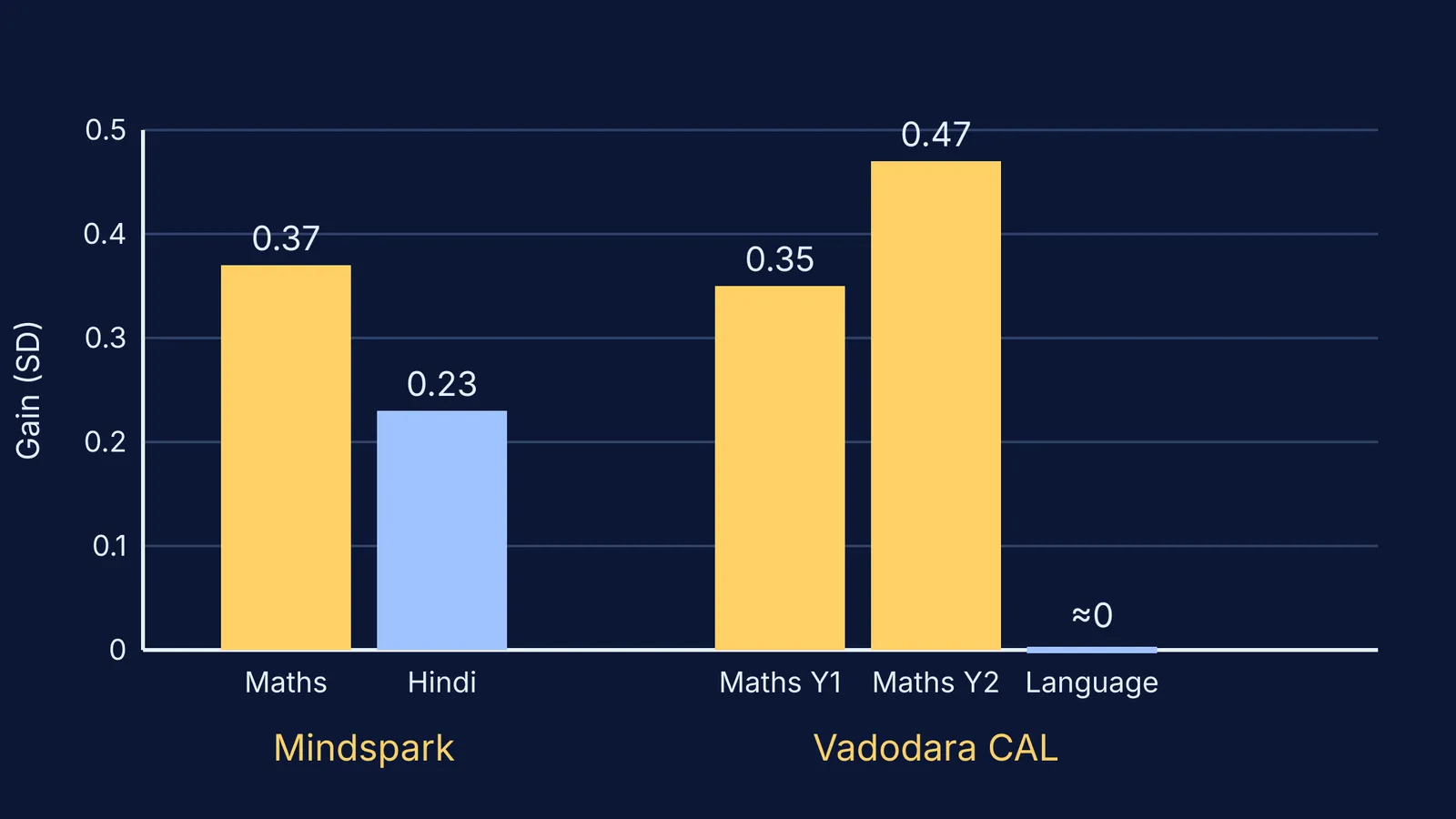
Look at the Indian programmes that did lift scores. In Vadodara, a government scheme had already placed four computers each in 80% of primary schools. The NGO Pratham then gave Class 4 children two hours a week of self-paced maths games in the local language, two children to a computer (J-PAL summary of Banerjee, Cole, Duflo and Linden). Maths scores rose by about 0.35 standard deviations in the first year and 0.47 in the second. Language scores, which the software did not teach, showed no measurable change. The computers were already there; the gain came from what children did on them.
In urban India, students who won a lottery for Mindspark, a personalised after-school programme, scored 0.37 standard deviations higher in maths and 0.23 higher in Hindi over 4.5 months (Muralidharan, Singh and Ganimian, American Economic Review, 2019). Gains were similar in absolute terms for all students, so relative to where they started, weaker students gained much more.
In both programmes, each child worked at their own level, practised instead of watching, and got quick feedback. A board at the front of a room of 40 usually does the opposite: one screen, one pace, and most children watching. Laptop schemes show the same pattern, as we covered in what the evidence says about giving every student a laptop.
What should parents ask a school about smart classes?
Be calm and specific, as when you ask a school about its homework policy. These six questions get past the brochure:
"In a normal maths or science period, what do students do while the board is on? Could I watch part of a lesson?" A good sign: children come up to solve problems, or the teacher pauses an animation and asks the class to predict what happens next. A warning sign: videos play from start to finish.
"Is the content the same for every child, or does it change with each child's level?"
"After the demonstration, do students practise on their own, on paper or a device, and who checks their work?"
"What training did teachers get, and who fixes the board when it stops working?"
"Has the school compared results before and after smart classes began? What did it find?"
"Is there a separate smart-class fee, and what exactly does it pay for?"
If a school answers with brand names and screen sizes, it is describing hardware. If it describes what your child does, how often, and how the teacher knows they understood, it is describing teaching. For decoding sales language more generally, see how to read AI-powered edtech claims.
What can you do at home?
Turn watching into doing. After school, ask your child to explain one thing the board showed, in their own words, and then to solve one question on it without notes. If they follow the animation but freeze on the question, the gap is in practice, not in the screen.
That is where a tool that adjusts to the student can help. Fermi's AI tutor works out what a student already knows, builds a plan for the session and checks understanding as it goes, so practice starts at the right level. For ideas that are easier to see than to read, the Fermi Simulation Lab has interactive simulations your child changes for themselves, rather than only watches.
At the next parent-teacher meeting, take the six questions with you.


