

On this page
Several countries once tried a bold idea: give every schoolchild a laptop and let learning follow. Peru and Uruguay ran some of the biggest schemes, and economists studied both carefully. Their results speak to a question parents now ask about tablets and AI apps: does the device itself make a child learn more?
What happened when Peru gave every child a laptop?
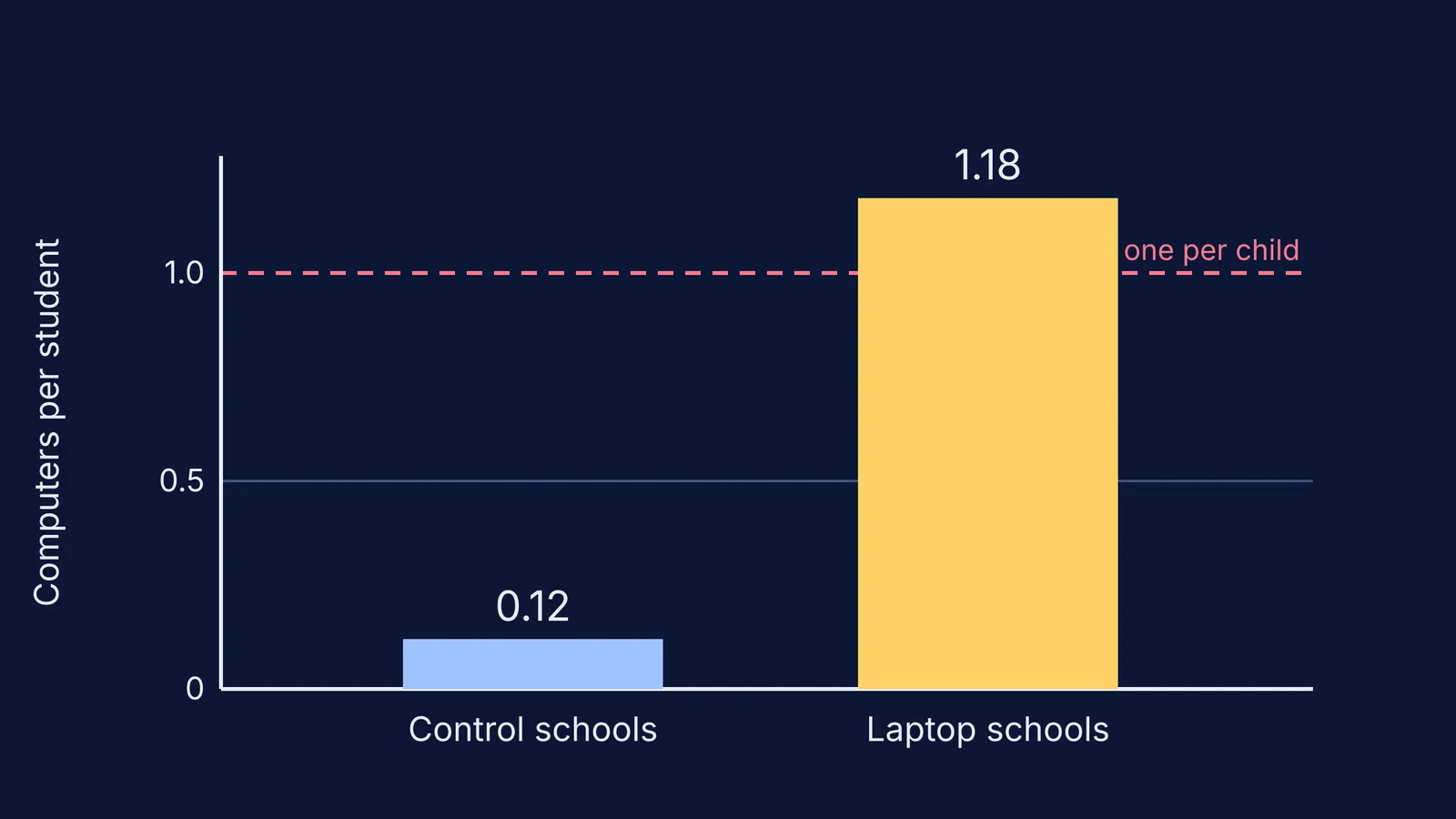
Peru's programme was tested with schools chosen at random to get laptops or not. In a study of 318 rural primary schools published in the American Economic Journal, Julian Cristia and colleagues found that laptop schools had 1.18 computers per student, against 0.12 in comparison schools. Children used the computers much more, at school and at home.
After 15 months, the same study found no evidence of effects on test scores in maths and language. There was some inconclusive evidence of better general reasoning skills.
A second Peru experiment gave about 1,000 laptops to primary children in Lima for use at home. They scored higher on a test of using the laptop itself, but there was no effect on academic achievement or on a reasoning test, and teachers reported lower academic effort.
A 2025 NBER working paper followed 531 rural Peruvian schools using ten years of administrative records. It found no significant effect on academic performance, some evidence of slower progress from grade to grade, and no significant effect on finishing primary or secondary school or on university enrolment. Teachers had received some training but made limited use of the technology in class.
Did Uruguay's Plan Ceibal raise test scores?
Uruguay gave laptops to children across the whole country through Plan Ceibal. Researchers knew the exact date each child got one. Their IZA discussion paper found that in the first two years the programme had no effects on maths and reading scores. The authors suggest one reason: laptops in class were mainly used to search for information on the internet.
Why didn't laptops alone improve learning?
The OECD saw a similar pattern across the countries in its PISA tests. Its 2015 report, Students, Computers and Learning, found no appreciable improvements in reading, maths or science in countries that had invested heavily in computers for education. Students who used computers moderately at school did somewhat better than those who rarely did, while very frequent users did a lot worse.
The report's foreword offered two possible explanations. One is that deep, conceptual understanding needs intensive teacher-student interaction, and technology sometimes distracts from it. The other is that schools have not yet become good enough at teaching with technology, so that "adding 21st-century technologies to 20th-century teaching practices will just dilute the effectiveness of teaching."
Put simply, a laptop is a delivery channel. Learning comes from what travels through it: practice at the right level, quick feedback, and a teacher or tutor who notices when a child is stuck. Hand over the channel without changing any of that, and a child mostly gets a faster way to browse.
When does technology help learning?
The contrast comes from India. In a lottery-based study in Delhi, Karthik Muralidharan, Abhijeet Singh and Alejandro Ganimian tested Mindspark, a personalised after-school programme that adjusted practice to each student's level. Middle-school students who won a place scored 0.37 standard deviations higher in maths and 0.23 higher in Hindi after 4.5 months. Gains were similar for all students, so those who started furthest behind gained much more relative to where they began.
The difference from the laptop schemes is not the hardware. It is that the software changed the practice: each student worked on problems pitched at their level. Our review of AI tutors in real classrooms asks the same question of newer tools, as does our look at decades of calculator research.
How can you tell if a device or app will help your child?
Before buying a tablet or backing a school device scheme, ask:
What will my child practise on it? "Access to content" is not an answer. Look for specific problems at their level.
Does it adjust to where they are? Mindspark pitched practice to each student's level.
Does it give feedback on the reasoning, not just right or wrong?
Who checks progress? A teacher, a parent or the tool itself should notice when a child is stuck.
What will it replace? If the answer is "nothing, it is extra screen time", expect little.
If a school is rolling out devices, you can ask: "Can you tell us what the students will do on them each week, and how teachers will use what they see?" For the policy side in India, see what NEP 2020 says about technology in education.
We built Fermi's AI tutor around the teaching rather than the screen: it works out what a student already knows, builds a plan for the session and checks understanding as it goes. For practice, the Fermi Problem Library has a step-by-step solver that explains the reasoning rather than printing an answer.
The lesson from Peru and Uruguay is simple: judge any device by the teaching it brings.


