On this page
NEP 2020 is often summed up in a few headlines: a new school structure, more choice of subjects, a push for mother-tongue teaching. Its sections on technology get less attention, but they shape the apps, platforms and online exams students meet today. This post sets out what the policy text actually says about technology, so you can read claims about "NEP-aligned" products with the source in hand.
Where does NEP 2020 talk about technology?
The Union Cabinet approved the policy on 29 July 2020, according to the Press Information Bureau release. The full text is on the NCERT website as a PDF. Technology runs through it, but two chapters deal with it directly: Chapter 23, "Technology Use and Integration", and Chapter 24, "Online and Digital Education: Ensuring Equitable Use of Technology".
A policy states intentions. How each part is carried out depends on later schemes, regulations and state decisions, so check current notices from the Ministry of Education, your board or your university for what applies to you.
What does the policy say ed-tech must do?
The key condition is in paragraph 23.3. Technology to improve education "will be supported and adopted, provided these interventions are rigorously and transparently evaluated in relevant contexts before they are scaled up."
To support this, the policy proposes an autonomous National Educational Technology Forum (NETF). Its listed functions include giving "independent evidence-based advice" to central and state agencies on technology-based interventions, building capacity in educational technology, and setting directions for research. Paragraph 23.5 says the main purposes of technology should be improving teaching, learning and evaluation, supporting teacher training, widening access, and streamlining administration such as admissions, attendance and assessment.
That standard is worth using yourself. Rigorous evaluation of ed-tech in India does exist. A randomised study by Muralidharan, Singh and Ganimian (2019) in the American Economic Review tested a personalised, technology-aided after-school programme for middle-school students in Delhi. Students who won a lottery for free access scored 0.37 standard deviations higher in maths and 0.23 higher in Hindi after just 4.5 months, with the largest relative gains for weaker students. That is the kind of evidence the policy asks for.
What does it say about platforms, content and coding?
Paragraph 23.6 says e-content from states, NCERT, CIET, CBSE, NIOS and other bodies will be uploaded to DIKSHA, and that platforms such as DIKSHA and SWAYAM will be better integrated across school and higher education, with ratings and reviews by users. It also says educational software should be available in all major Indian languages and accessible to students in remote areas and to Divyang students.
Paragraph 24.4 lists further steps, including a digital repository of content such as "Learning Games & Simulations, Augmented Reality and Virtual Reality", virtual labs through DIKSHA, SWAYAM and SWAYAM PRABHA, and use of television and radio for students with limited digital access.
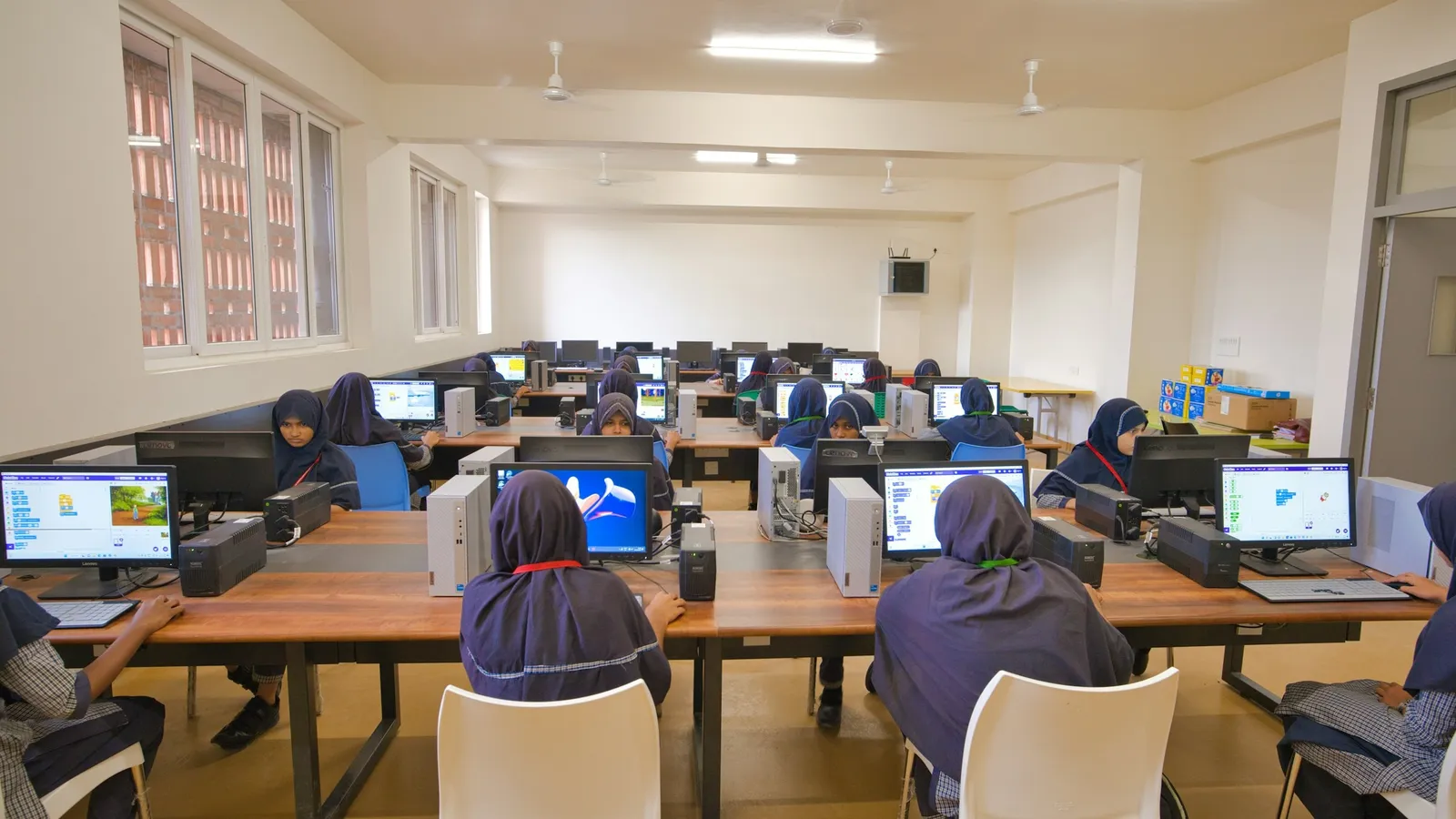
On coding, paragraph 4.25 says mathematics and computational thinking will get more emphasis through the school years, and "Activities involving coding will be introduced in Middle Stage", which is Grades 6 to 8.
What risks does the policy name?
NEP 2020 is not uncritical about technology. Paragraph 24.1 recognises technology's "potential risks and dangers" and calls for carefully designed pilot studies. Paragraph 24.2 says the benefits of online education cannot be realised unless the digital divide is closed. Paragraph 24.3 warns that "unless online education is blended with experiential and activity-based learning, it will tend to become a screen-based education with limited focus on the social, affective and psychomotor dimensions of learning." It also lists student "device addiction" as a topic for the pilot studies.
On AI, paragraphs 23.8 to 23.13 call it a disruptive technology the education system must respond to, and say students should learn about data privacy, data protection and the ethics of AI.
What does this mean for students and parents?
Ask for evidence. The policy's own standard is evaluation before scale. Ask a provider what studies support its product.
Use the free public platforms. DIKSHA and SWAYAM are named in the policy. Our guide to free official learning resources in India explains what each offers.
Keep hands-on learning in the mix. The policy itself warns against purely screen-based learning. Pair videos and apps with practicals, written problems and discussion.
Treat AI as something to understand, not just use. The policy's emphasis on AI ethics and data privacy is a good prompt to ask what an app does with your data.
Where interactive tools fit
The policy's list of digital content includes simulations, which help most when an idea is easier to see than to read, such as field lines or wave interference. The Fermi Simulation Lab has interactive simulations for ideas like these; use one alongside a written problem rather than instead of it.
Read paragraphs 23.3 and 24.3 of the policy yourself; together they take about five minutes.