

On this page
When a student is drowning in assignments, evenings turn into battles and the love for learning quickly fades. If your child is spending hours at a desk long after the school day ends, you might wonder if this workload is normal.
The first step to helping an overworked student is asking the school administration for their official guidelines. Most schools are bound by national curriculum frameworks that place strict limits on how much work teachers can assign.
Does the school have a homework policy?
Every affiliated school should have a homework policy that dictates daily and weekly assignment limits. However, these documents are rarely shared proactively with parents.
In India, the Ministry of Education has set clear boundaries on what schools can demand of students at home. According to the School Bag Policy 2020, schools must not assign any formal homework to students in Classes 1 and 2. The focus at this age should be on joyful, activity-based learning rather than rote memorisation.
For older primary students (Classes 3 to 5), the policy limits homework to a maximum of two hours per week. When students reach middle school (Classes 6 to 8), the limit increases to one hour per day. Finally, for high school students (Classes 9 to 12), homework is capped at a maximum of two hours per day.
How much homework is too much?
These official caps align closely with decades of educational research. The standard guideline used by many educators worldwide is the "10-minute rule". Supported by Harris Cooper, a researcher at Duke University, this rule suggests that students should receive 10 minutes of homework per day multiplied by their grade level. Under this framework, a first-grader would get 10 minutes, while a twelfth-grader would get 120 minutes.
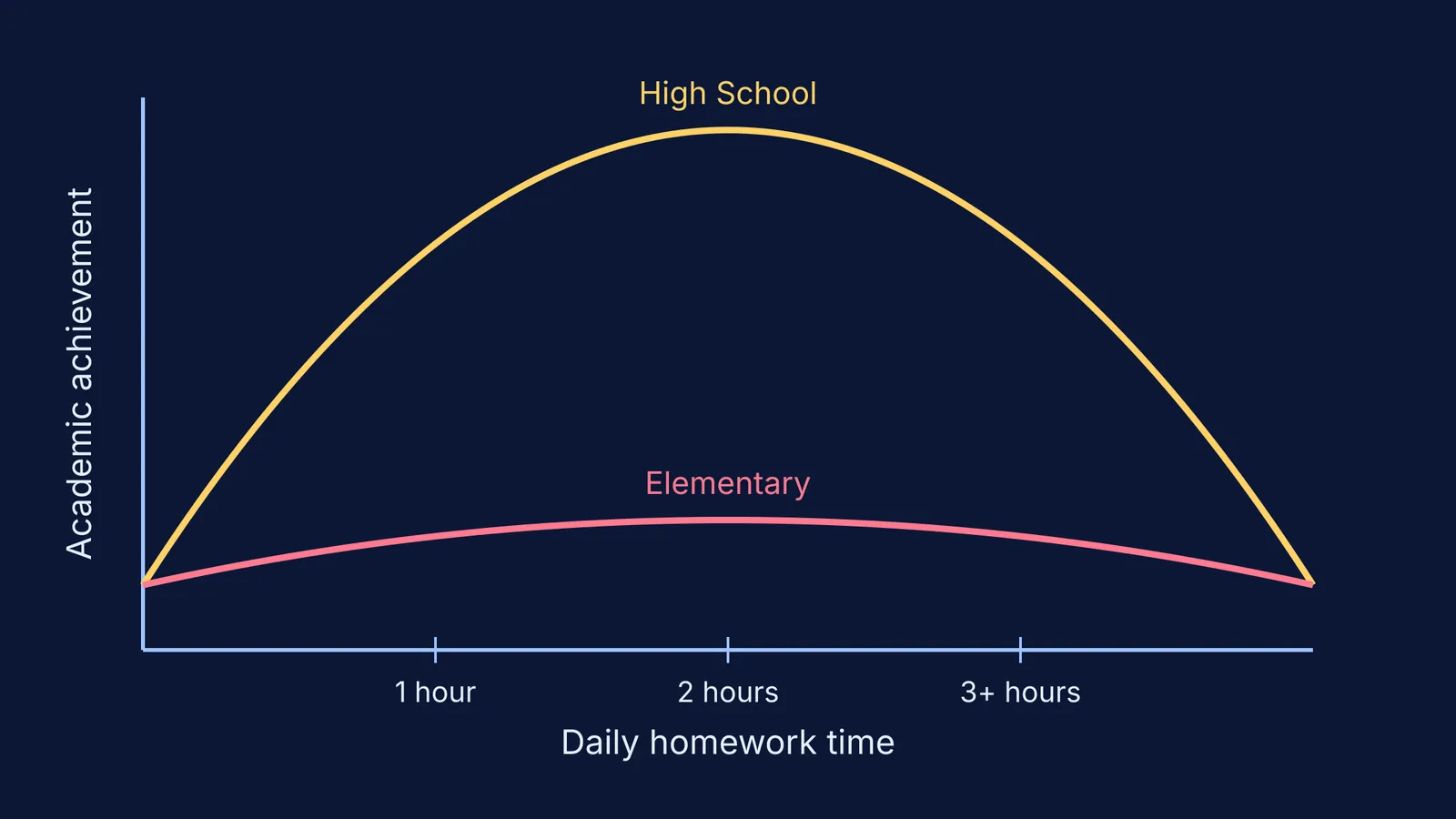
Cooper's landmark 2006 meta-analysis found that for elementary students, the academic benefit of homework is trivial, serving mostly to build study habits rather than improve test scores. For high school students, the data showed a clear point of diminishing returns. Academic achievement peaks at about two hours of homework per night; beyond that, extra hours do not translate to higher grades, and can instead cause severe student burnout.
How to raise concerns if your child is overwhelmed?
If your child consistently exceeds these limits, it is time to have a conversation with the school. Before scheduling a meeting, keep a log of how much time your child spends on assignments for one week. Note what type of work it is—are they actively solving problems, or just copying text? This provides concrete data rather than vague complaints.
When you speak to the teacher or principal, start by asking to see the school's homework policy. You might say: "My child is spending three hours a night on assignments, which leaves them exhausted. Could you share the school's official homework policy so we can understand the expected daily limits?"
Framing the conversation around the school's own policy shifts the focus from a personal grievance to a structural standard. If the school claims to follow the two-hour cap for high school but assigns four hours in practice, you have clear grounds to ask for adjustments. You can also advocate for teachers to coordinate with one another so that multiple subjects do not stack heavy assignments on the same day.
Finding a better way to study?
Sometimes, the issue is not the volume of homework, but how the student approaches it. Staring at a blank page or getting stuck on a single concept can stretch a 30-minute task into a three-hour ordeal. Asking a student to simply "work harder" when they are missing foundational knowledge only leads to frustration.
A healthy homework routine is about quality, not just quantity. When parents help students shift from rote memorisation to active problem-solving, even a short study session becomes highly effective. Setting a strict timer—for example, stopping all work at the two-hour mark—teaches students how to prioritise tasks and manage their time.
Instead of letting your child struggle alone, consider tools that actively teach. Fermi's AI tutor works out what they already know and builds a plan for the session, so they sit down to a clear next step. When they hit a roadblock in a physics or maths assignment, the tutor does not just print the answer. It explains the reasoning and works through the steps alongside them, ensuring they actually understand the material.
For subjects where visualising the problem is half the battle, the Fermi Simulation Lab provides interactive simulations for the ideas that are easier to see than to read. You can integrate these tools into a study routine that lasts, keeping your child focused and preventing evening burnout.
By combining clear school boundaries with active, guided study methods, you can help your child reclaim their time. Knowing when to help with homework and when to rely on structured practice ensures they learn from mistakes instead of repeating them every night.


