

On this page
Put your calculator in radian mode and try sin 0.1. You get 0.0998, almost exactly 0.1. As the angle shrinks, sin x and x become nearly the same number, so their ratio heads to 1. Here is why, using one unit circle and one graph, and why it only works in radians.
What happens to sin x / x as x gets smaller?
Before reading on, predict: for small positive x, is sin x / x a bit more than 1 or a bit less? Then check (x in radians, rounded):
x = 1: sin x / x = 0.841471
x = 0.5: sin x / x = 0.958851
x = 0.1: sin x / x = 0.998334
x = 0.01: sin x / x = 0.999983
The ratio stays just below 1, and the gap shrinks fast. Notice that x = 0 is not on the list: sin 0 / 0 is 0/0, which has no value. A limit asks what the ratio approaches, not what it equals at the point.
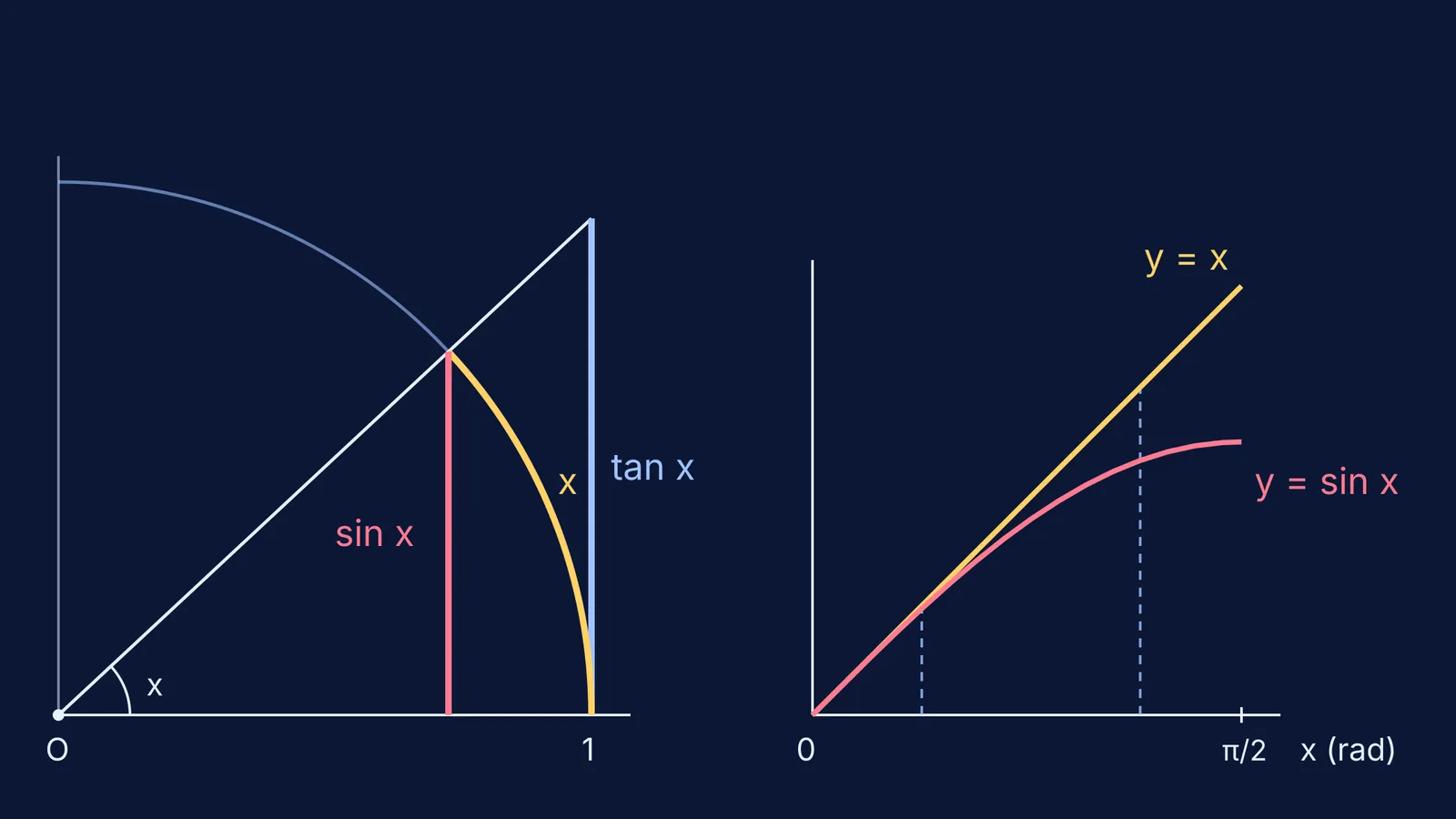
On the graph in the diagram above, y = sin x sags below the line y = x further out, but near 0 the two are almost impossible to tell apart. That closeness is what the limit measures.
Why is the limit of sin x over x equal to 1?
The NCERT Class 11 Mathematics textbook proves it with a unit circle in Chapter 12, Limits and Derivatives (NCERT Chapter 12 PDF). Take an angle of x radians at the centre, with 0 < x < π/2. Three lengths appear, shown on the left of the diagram:
the half-chord dropped from the circle to the axis, which is sin x (pink)
the arc, which is x itself (gold)
the tangent segment at the edge of the circle, which is tan x (blue)
The radian measure of an angle is the length of the arc it subtends on the unit circle (OpenStax Calculus Volume 1, section 2.3). NCERT compares the areas of the small triangle, the sector (x/2 on a unit circle) and the big triangle to get sin x < x < tan x.
Divide through by sin x, which is positive for these angles, and flip the fractions:
cos x < sin x / x < 1
As x shrinks to 0, cos x goes to 1, so the ratio is trapped between two things that both reach 1. NCERT finishes with the sandwich theorem: the limit is 1. Negative x gives the same answer because sin(−x)/(−x) = sin x / x.
Why does the limit need radians?
The proof leans on one fact: arc length equals the angle. That is only true in radians. An angle of x degrees has arc length πx/180 on a unit circle (The Math Doctors on radians), so in degrees sin x / x tends to π/180, about 0.01745, not 1.
Check it: sin 1° = 0.017452, almost exactly π/180 = 0.017453. In degrees, the derivative of sin x would be (π/180) cos x instead of cos x, as the same Math Doctors article notes. Radians are the unit that makes this constant 1, which is why calculus formulas for trigonometric functions assume them. More in why calculus uses radians instead of degrees.
How do you use sin x / x = 1 in exam questions?
The rule works whenever the same quantity, going to 0, sits inside the sine and underneath it. A worked example from the NCERT chapter: find the limit of sin 4x / sin 2x as x → 0.
Rewrite it as (sin 4x / 4x) × (2x / sin 2x) × 2.
As x → 0, both 4x and 2x go to 0, so the first two factors each go to 1.
The answer is 1 × 1 × 2 = 2.
Before you use the rule, check:
Is the angle in radians, with no degree sign?
Does the angle go to 0? As x → π, sin x / x goes to 0, not 1.
Is the same expression inside sin and in the denominator? If not, multiply and divide to make it so.
For more practice, see how to use the sandwich theorem for limits. The physics shortcut sin θ ≈ θ comes from the same idea; see when the small angle approximation is valid.
A five-minute zoom you can try
Draw a unit circle with an angle of about 45°, then again at about 10°. Colour sin x, the arc and tan x and watch them close in.
Predict sin x / x for x = 0.05, then check in radian mode.
Repeat in degree mode and explain the 0.01745 you see.
The Fermi Simulation Lab has interactive simulations for ideas that are easier to see than to read, and the Fermi Concept Library gives each mathematics concept its own lesson if limits still feel shaky.


