

On this page
You took the screenshot so you would not forget the formula. Three weeks later it sits between a meme and a bus timetable, unopened. If your gallery holds hundreds of whiteboards and NCERT pages, you are not lazy. You are doing what most students do.
Why do screenshots feel like studying?
Saving feels like progress because you saw something useful and acted. But saving can quietly tell your memory it is off duty.
In a study in Science, people who believed the computer would erase trivia statements they had typed recalled those statements better than people who believed they were saved (Sparrow, Liu and Wegner, 2011). The same paper found people were better at remembering where information was kept than the information itself.
A camera can do the same. On a guided museum tour, people remembered fewer objects, and fewer details, when they photographed each object whole instead of just looking (Henkel, 2014). When they zoomed in to photograph one specific part, their memory was not impaired; the author suggests the extra attention that focusing takes made the difference.
Saving is not all bad. Saving one file before studying a new one improved memory for the new file, which the authors explain as people offloading what they no longer needed (Storm and Stone, 2015). A screenshot works as a holding area. The trouble starts when it becomes the whole archive.
Why don't I ever revise my screenshots?
Because looking at them again feels like revision, and that feeling misleads you.
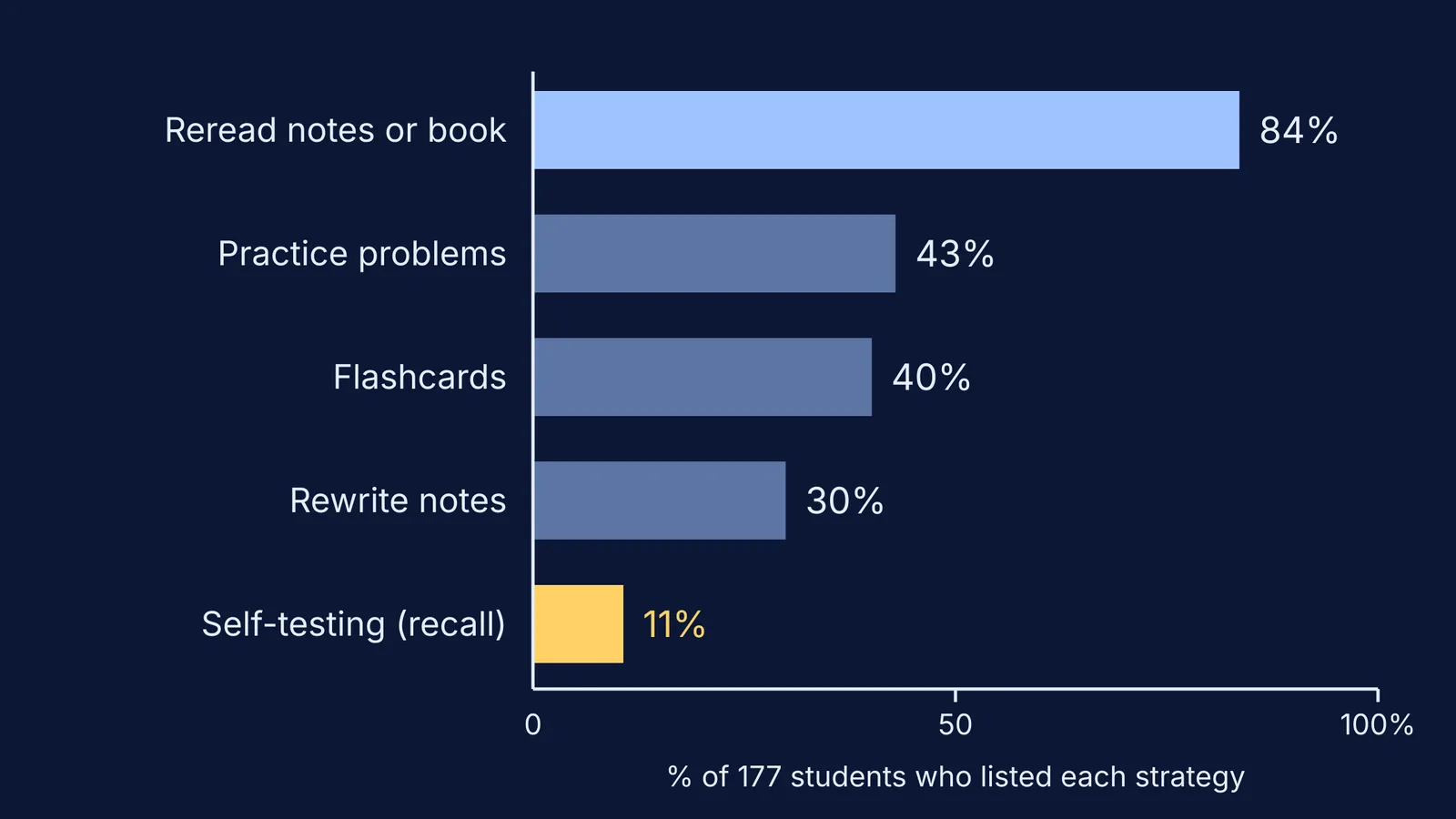
In a survey of 177 US college students who listed their study strategies, 84% listed rereading notes or textbooks and 55% ranked it their number-one strategy, while only 11% said they practised recalling information as they studied (Karpicke, Butler and Roediger, 2009). The authors propose that many students experience illusions of competence while studying: material that looks familiar feels learned.
The testing effect is the habit that works. When students either reread prose passages or took recall tests on them, the tested students remembered substantially more two days and one week later, even though rereading made students feel more confident (Roediger and Karpicke, 2006). A review of ten study techniques rated practice testing and spaced practice as high utility, and rereading and highlighting as low utility (Dunlosky and colleagues, 2013).
Scrolling a gallery is rereading at best. The fix is to make each screenshot ask you something.
How do I turn screenshots into revision questions?
Set aside 30 minutes once a week, same day and time. Sunday evening works for many students, while the week's lessons are recent.
Collect. Move only the last seven days of screenshots into one album called This week.
Sort. Put each into one of three piles: Question (a formula, definition, diagram or solved problem you need for an exam), Reference (a timetable or school notice) or Delete (duplicates, things you know, motivational posts, blurry shots).
Write one question per keeper, in a notebook or notes app, with the answer hidden below a gap.
Answer from memory, then check. Open the image only after you try, and mark yourself right, partly right or wrong.
Delete the image. Once the question exists, the screenshot has done its job. Reference images go to a separate folder.
Carry the misses forward to the top of next week's list, or into a weekly cumulative quiz you build with AI.
The same rule applies to copied chatbot answers: see how to save good AI explanations to your notes.
What does a good screenshot question look like?
Say on Tuesday you screenshotted a Class 11 physics page showing the range of a projectile on level ground, R = u² sin 2θ / g.
Weak question: What is the range formula? You will recognise the answer, not recall it.
Better question: Why does a ball thrown at 45° go farthest, and which other angle gives the same range as 30°? To answer, you rebuild the formula and use it: sin 2θ is largest when 2θ is 90°, and sin 60° equals sin 120°, so 60° gives the same range as 30°.
If you cannot even start, that is a gap in understanding, not in memory. The Fermi Concept Library has a lesson for each concept in physics, chemistry, biology, mathematics and computing, so you can fill the gap before testing yourself again. For a screenshot of a solved numerical, try the problem fresh first; if you get stuck, Fermi's AI tutor works out what you already know, notices where you are stuck, and decides whether to explain, ask or show.
How can parents help without checking the phone?
Counting screenshots tells you little, and scrolling through a teenager's gallery starts a fight. Ask about the questions instead: "Show me two questions you made this week. Pick one and answer it without looking." If they get it wrong, say "Good, that one goes on next week's list" and move on.
This week, open your gallery, pick the last seven days, and make your first five questions.


