

On this page
Erythrocyte, phagocyte, gymnosperm, glycolysis: NEET biology asks you to hold a great many terms like these. Many of them are built from a small set of Greek and Latin parts. Learn the parts once and a new word becomes a clue. AI is quick at splitting words but less reliable about what each part originally meant, so this method pairs every AI answer with a dictionary check.
Why do word roots help you learn biology terms?
The smallest parts of a word that carry meaning are called morphemes: prefixes, roots and suffixes. Teaching students to use them is called morphological instruction.
A 2010 meta-analysis in Review of Educational Research by Peter Bowers, John Kirby and Hélène Deacon pooled 22 studies of morphological instruction and found that it benefits learners, with particular benefits for less able readers (Bowers, Kirby and Deacon, 2010). The same review found it worked better when combined with other literacy teaching than on its own.
Two honest limits: those studies covered children from preschool to Grade 8, not teenagers preparing for NEET-UG, and they measured reading, spelling and vocabulary, not exam marks. The fair takeaway is narrower: knowing word parts helps you read and remember unfamiliar words.
How do you ask AI to break a science term into roots?
Give the AI one term at a time and ask for parts, sources and a connection to the biology. You can copy this:
"Break the term phagocyte into its Greek or Latin parts."
"For each part, give the original word, its literal meaning, and two other Class 11 or 12 biology terms that use it."
"Explain in one sentence how the literal meaning connects to what the term means in biology."
"If you are not sure of a root or its meaning, say so instead of guessing."
Step 3 matters most: a root is only useful if you see why the old meaning fits the modern term. For more on getting a model to admit doubt, see our guide on prompting an AI to say when it is unsure.
Worked example: five NEET terms checked against a dictionary
We checked each part against Wiktionary, a free dictionary that lists each word's origin.
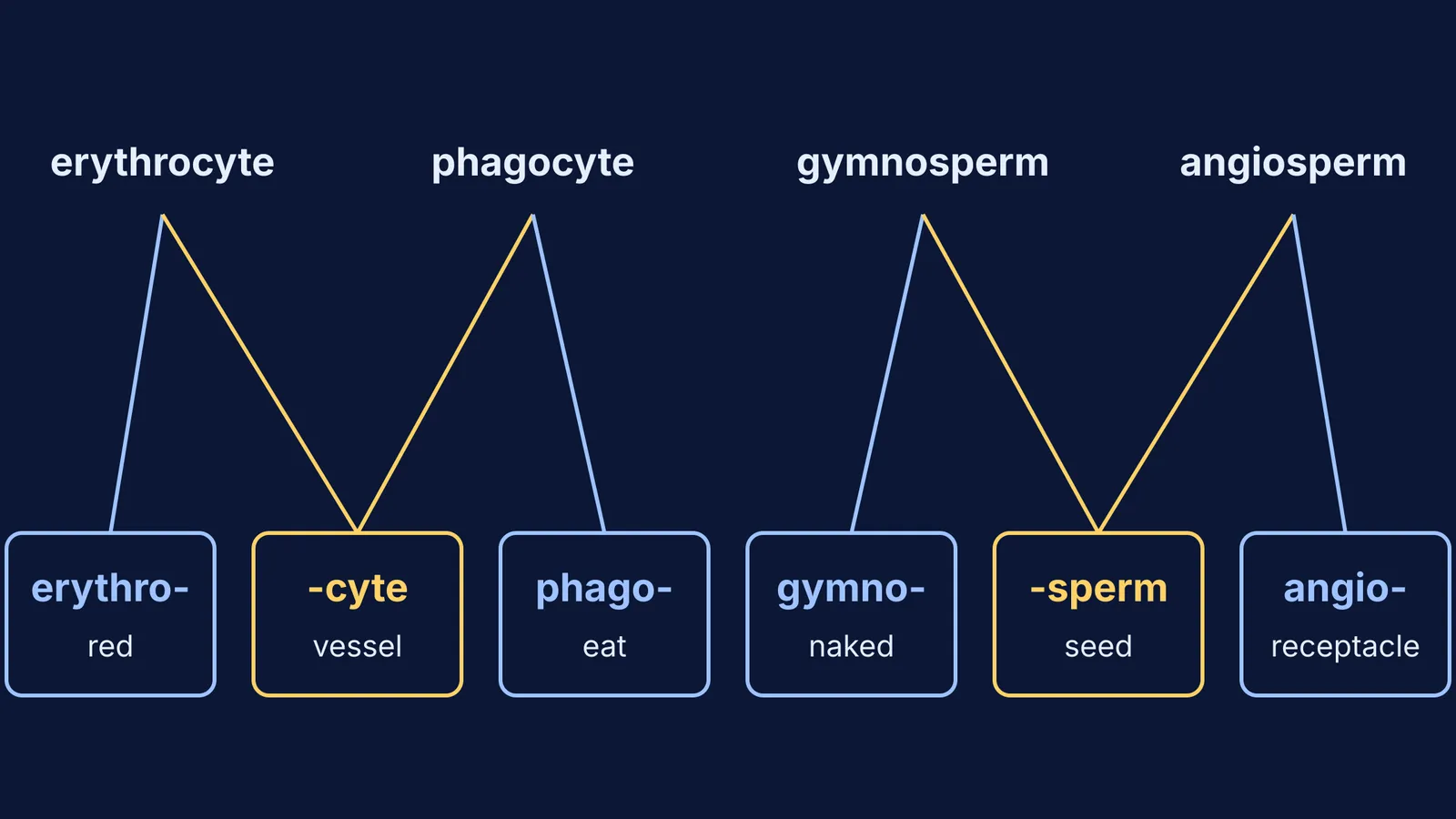
Erythrocyte: erythro- means "red" (Wiktionary: erythrocyte).
-cyte: from Greek kytos, "vessel, jar", and is used to form the names of cells (Wiktionary: -cyte).
Phagocyte: phago- means eating, feeding or consuming, from the Greek stem phag-, as in ephagon, "I ate, I devoured" (Wiktionary: phago-).
Glycolysis: glyco- is from Greek glukus, "sweet" (Wiktionary: glyco-), and -lysis is from Greek lusis, "a loosening", used for breakdown or dissolving (Wiktionary: -lysis).
Gymnosperm: from Greek gymnos, "naked", and sperma, "seed" (Wiktionary: gymnosperm).
Angiosperm: from Greek angeion, "receptacle", and sperma, "seed" (Wiktionary: angiosperm).
Notice -cyte. An AI may gloss it simply as "cell", and so does the erythrocyte entry. The suffix's own entry gives the older meaning, "vessel, jar". That is why you check the root's own entry, not just the word that contains it.
How do you build a root list for NEET biology?
Keep one notebook page or one document. For each root, write five things:
The root, with its hyphen (phago-, -lysis).
The meaning, copied from the dictionary, not from the AI.
The dictionary link or name, so you can recheck it later.
Three terms from your NCERT biology chapters that use it.
One sentence in your own words linking the meaning to the biology.
Add roots as you meet them in chapters rather than memorising a ready-made list. Then quiz yourself: cover the meanings and recall them from the root alone. In a classic experiment, students who took recall tests remembered prose passages better after 2 days and 1 week than students who simply restudied, though restudying did better on a test 5 minutes later (Roediger and Karpicke, 2006). The same principle runs through our post on remembering NCERT biology examples for NEET.
What should you not use word roots for?
A root is a hint, not a definition. Gymnosperm means "naked seed", but you still need the textbook to know what the seed is naked of and why it matters. Write exam answers from the definitions in your textbook, and use AI to check your definitions for missing keywords once you have written them.
When a root makes sense but the idea behind the word still does not, that is a concept gap rather than a vocabulary gap. The Fermi Concept Library has a lesson for every concept in biology, physics, chemistry, mathematics and computing, and Fermi's AI tutor can work out what you already know and build a plan for the session.
Start tonight with the five terms in your current chapter that you keep forgetting.


