

On this page
Stir a pinch of salt into water and it seems to vanish. It hasn't: the salt is still there as charged particles, each wrapped in water. A simulation lets you watch this, and it teaches more if you predict first.
What happens to salt when it dissolves in water?
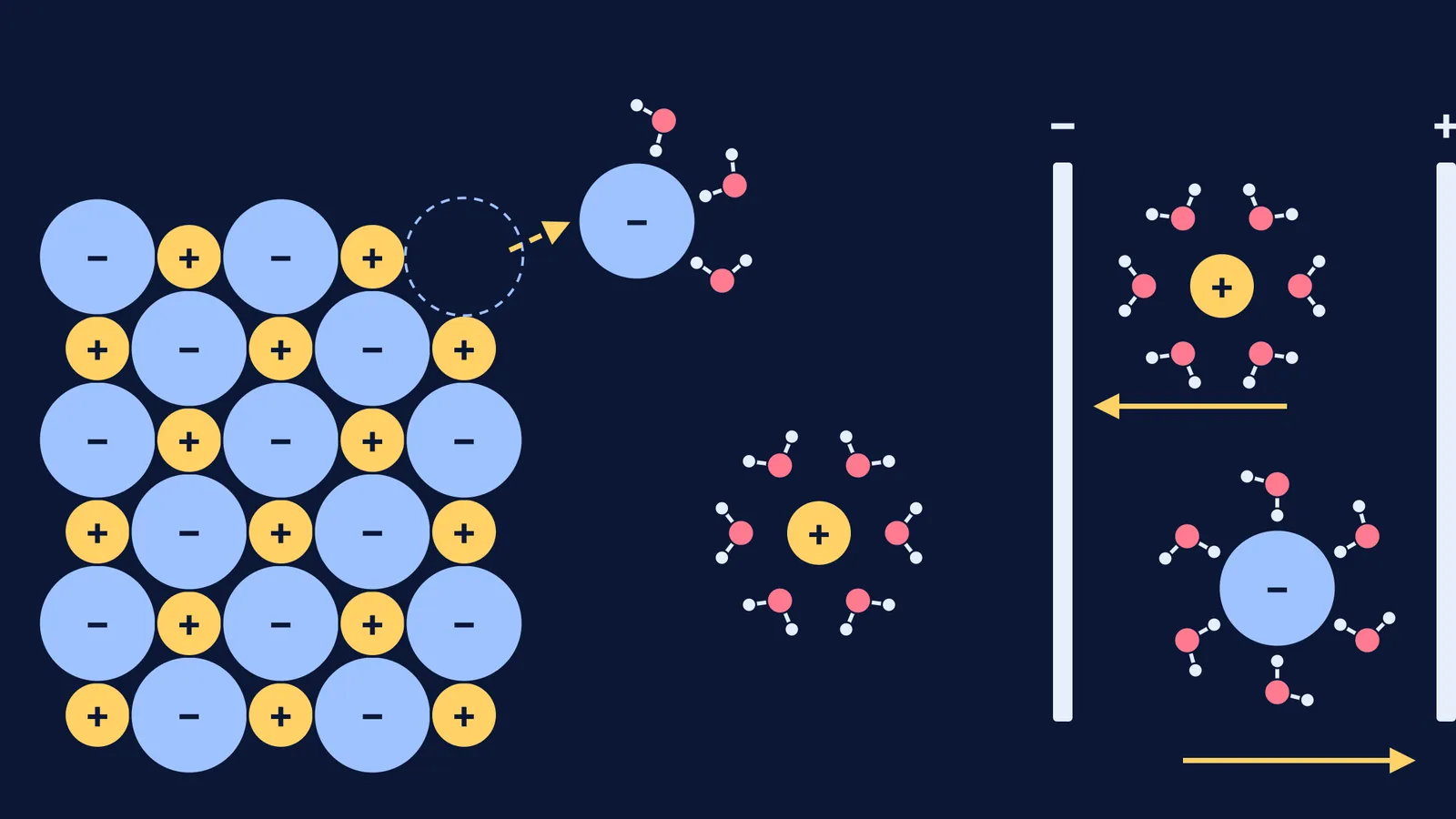
Table salt is sodium chloride: a crystal in which positive sodium ions (Na⁺) and negative chloride ions (Cl⁻) sit in a repeating grid. Water molecules are polar, with a slightly negative oxygen end and slightly positive hydrogen ends.
At the crystal surface, water molecules point their oxygen atoms at sodium ions and their hydrogen atoms at chloride ions, forming ion-dipole attractions (Chemguide). When enough water molecules crowd round an ion, it is pulled out of the crystal and carried off inside a shell of water. Wrapping ions in water is called hydration; the overall change is written as NaCl(s) → Na⁺(aq) + Cl⁻(aq).
Dissolving salt takes in a little heat: the enthalpy change of solution of sodium chloride is +3.9 kJ per mole, so the water ends up very slightly cooler (Chemguide). There is also a limit. About 36.0 g of sodium chloride dissolves in 100 g of water at 25 °C (PubChem, citing the CRC Handbook).
What does a salt-dissolving simulation show that a diagram can't?
Molecular dynamics simulations calculate the forces on every atom and step them forward in time, showing which ions leave first.
In 2014, Nico Holmberg, Adam Foster and colleagues simulated sodium chloride nanocrystals in water and found that dissolving began at the corner sites, with chloride ions reaching the fully dissolved state more often than sodium ions (Holmberg et al., Physical Chemistry Chemical Physics). A corner ion has fewer neighbours holding it in place than an ion in the middle of a face.
In 2015, Gabriele Lanaro and G. N. Patey simulated crystals of about 2,400 ions at 300 K and saw three stages: the most exposed ions come off first, then a long stretch at a roughly fixed rate, then a fast finish once fewer than about 200 ions remain (Lanaro and Patey, Journal of Physical Chemistry B). The middle stage fit a simple rate law: rate proportional to the active surface area, where ions detach most easily.
If ions leaving a crystal still feels abstract, the Fermi Simulation Lab has interactive simulations for ideas that are easier to see than to read.
How do stirring, heat and crystal size change how fast salt dissolves?
Dissolving is a surface process: it depends on water molecules colliding with the outside of the solid (LibreTexts, Rate of Dissolving/16%3A_Solutions/16.02%3A_Rate_of_Dissolving)). Use that one idea to predict all three changes before you test them.
Stirring: faster. Fresh water keeps reaching the solid, so the layer touching it does not saturate (same LibreTexts page).
Heat: faster. Hotter water molecules have more kinetic energy, so they hit the solid more often and harder (same page).
Smaller grains: faster. Crushing exposes more surface for water to reach (same page), and more corners, where the simulations above saw dissolving begin.
The twist: heat speeds salt up, but it barely changes how much dissolves. One gram of sodium chloride dissolves in 2.8 mL of water at 25 °C and in 2.6 mL of boiling water (PubChem, citing the Merck Index). For contrast with a sugar, read why sugar dissolves faster in hot tea than cold.
How much salt can one glass of water hold?
A worked example: take 200 mL of room-temperature water, about 200 g. At 36.0 g per 100 g of water (PubChem), it holds about 2 × 36.0 = 72 g of salt. Boiling water, at 1 g per 2.6 mL (same PubChem page), takes only about 200 ÷ 2.6 ≈ 77 g. Stirring gets you to the limit sooner but does not move it. Extra salt sits at the bottom; our salt solubility simulation guide picks up from there.
Why does salt water conduct electricity?
Current needs charges that can move. In salt water, current is carried by sodium ions moving towards the negative electrode and chloride ions moving towards the positive one (LibreTexts, Ions in Solution/11%3A_Reactions_in_Aqueous_Solutions/11.02%3A_Ions_in_Solution_(Electrolytes))). Sugar stays as whole, neutral molecules, so sugar water conducts no better than plain water (same source). In a solid crystal the ions are locked in place, which is why molten salt conducts but solid salt does not.
How should you test your predictions?
Write down which ion you expect to leave first, and from where.
Predict the effect of stirring, heat and grain size, each with a reason.
Change one thing at a time.
Where you were wrong, say which idea you missed: surface area, fresh water, or molecular speed.
Draw one Na⁺ and one Cl⁻ with their water molecules facing the right way.
If step 4 keeps tripping you up, Fermi's AI tutor notices where you are stuck and decides whether to explain, ask or show.


