

On this page
Have you ever noticed that sugar disappears almost instantly into a fresh cup of hot tea, but sits stubbornly at the bottom of a glass of iced tea? The difference is not just about time; it is about the physics of how molecules move and the chemistry of how much a liquid can hold.
If you are preparing for exams like JEE or NEET, questions about solubility, kinetics and thermodynamics often test the very principles happening in your teacup.
Why does sugar dissolve faster in hot water?
To dissolve sugar, water has to dismantle a solid crystal. Sucrose (table sugar) is a polar molecule, meaning it has regions of positive and negative charge. In solid form, these molecules are locked together in a crystal lattice. Water is also polar, and when it touches the crystal, its molecules form hydrogen bonds with the sugar and pull it out into the liquid.
The speed of this process depends entirely on kinetic energy. Temperature is a measure of the average kinetic energy of the molecules in a substance. In a cold drink at 20 °C (293 K), the water molecules are moving rapidly. But in boiling water at 100 °C (373 K), they move even faster.
This extra speed does two things:
Forceful collisions: Faster water molecules strike the surface of the sugar crystal much harder, breaking the intermolecular bonds holding the sugar together.
Frequent collisions: Because they are moving faster, they hit the crystal more often per second, stripping away sucrose molecules at a higher rate.
This is why we see a Temperature coefficient of rate: why rates double every 10 °C for many chemical processes.
How much sugar can hot water hold?
There is a second reason hot tea takes sugar so well: it can physically hold more of it. While the rate of collisions controls *how fast* sugar dissolves, the thermodynamics of the mixture control *how much* can dissolve.
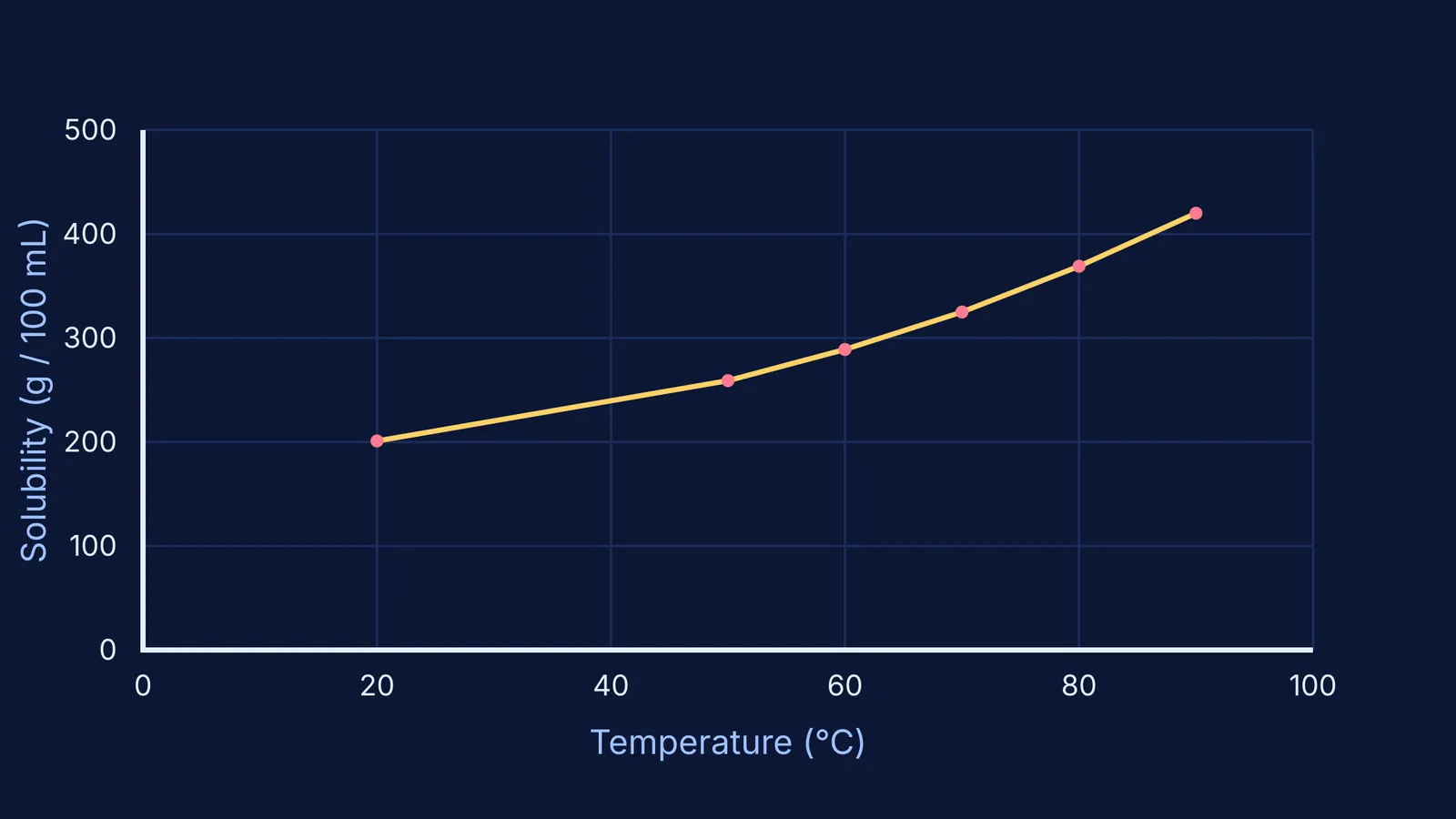
Dissolving sugar is an endothermic process; it requires an input of heat energy to break the bonds between the sucrose molecules. Because it absorbs heat, raising the temperature shifts the equilibrium to favour the dissolved state. According to standard chemical data, 100 mL of water at 20 °C can dissolve 201 grams of sugar. At 90 °C, that capacity more than doubles to 420 grams.
Why does stirring help sugar dissolve?
Once a sugar molecule is pulled off the crystal, it has to move out of the way so fresh water can attack the next layer. In cold water, dissolved sugar lingers near the surface, saturating the immediate area and slowing down the process.
In hot tea, the high kinetic energy causes rapid diffusion. The dissolved sugar scatters quickly into the bulk of the liquid, clearing the path. Stirring with a spoon does the same job on a larger scale, which is why Heterogeneous equilibria: why solids and pure liquids drop out of K rely on the surface area remaining available.
In the Fermi Simulation Lab, you can run interactive models that show how temperature changes the speed of molecules in real time, making the invisible process of diffusion suddenly clear.
How can I use this in my studies?
When studying physical chemistry, do not just memorise the rule that "solubility increases with temperature". Picture the violent, high-speed collisions happening at the microscopic level. This approach is central to what we know about Carl Wieman: why a Nobel physicist moved beyond the lecture—when you can visualise the mechanism, you don't need to rely on rote memory.
If you are stuck on a kinetics problem and cannot picture the forces at work, the Fermi Problem Library breaks down the steps and explains the reasoning, helping you see the physics in the equations.


