

On this page
Most of us learn angles in degrees. Then trigonometry and calculus switch to radians, and π shows up everywhere. This post builds a radian with your hands, asks you to make a prediction, and then shows you why calculus formulas are simplest in radians.
What is a radian, in one picture?
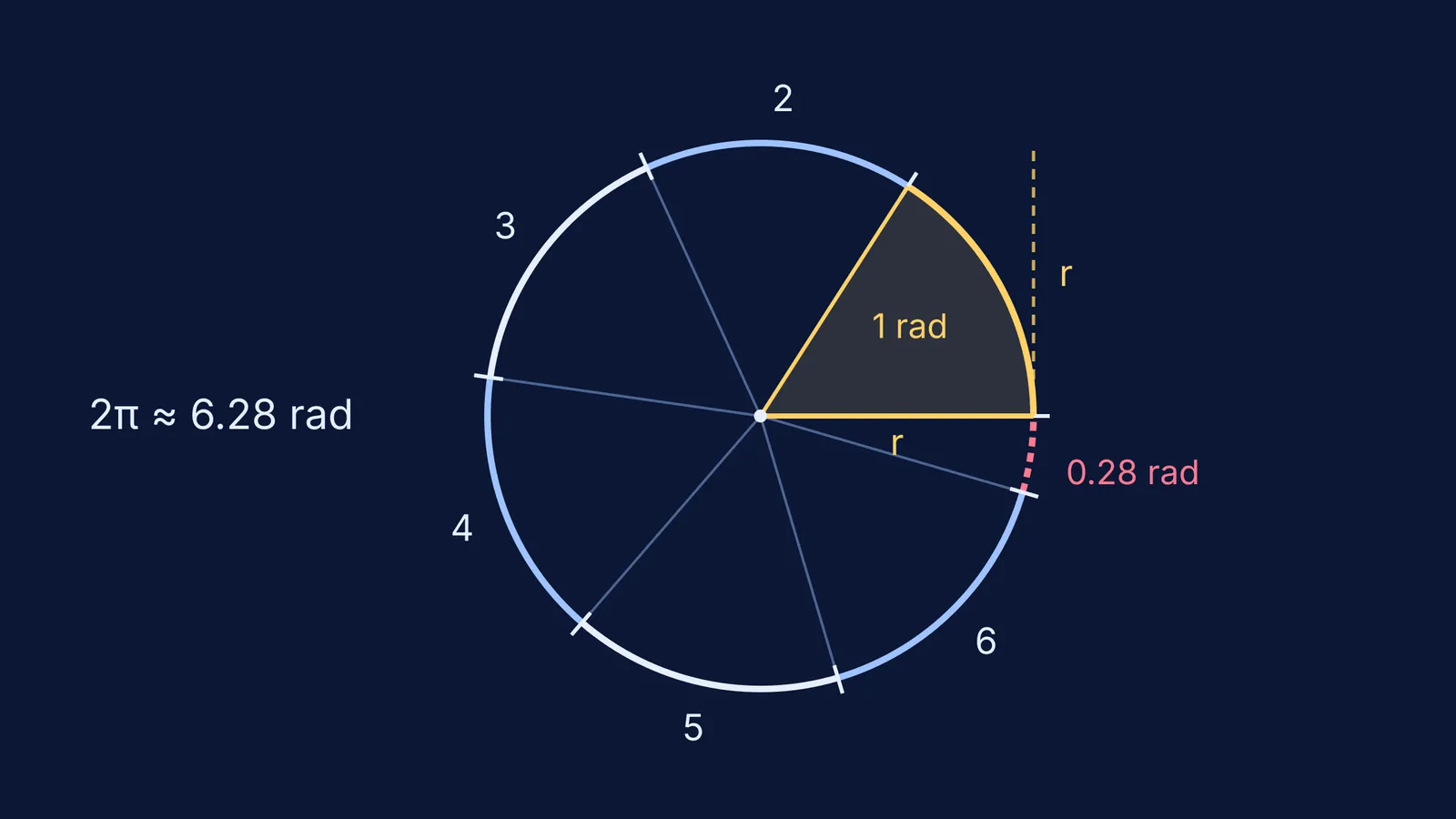
The official definition comes from the SI Brochure published by the BIPM, the body that maintains the International System of Units: "One radian is the angle subtended at the centre of a circle by an arc that is equal in length to the radius."
You can build that yourself with a bangle or a steel plate and a piece of thread:
Cut a piece of thread as long as the radius (centre to rim).
Lay it along the rim, bending it so it follows the curve.
Draw lines from the centre to both ends of the thread.
The angle between those two lines is one radian. It does not matter how big the circle is. A bigger circle has a longer radius and a longer arc, and the ratio stays the same. The same brochure notes that this suggests rad = m/m, a length divided by a length, but adds that writing it this way can mislead, because an angle is not the same kind of quantity as other length ratios.
How many radians fit in a full circle?
Before reading on, make a guess. You keep laying radius-length pieces of thread end to end around the rim. How many fit before you get back to the start?
The circumference is 2πr, so the number of radius lengths is 2πr ÷ r = 2π, which is about 6.28. Six whole pieces fit, and then there is a short gap of about 0.28 of a radius. The diagram above shows the six arcs and the leftover piece in red.
From 2π rad = 360° you get the conversions. The SI Brochure's table of non-SI units gives 1° = (π/180) rad. Flip it and you get 1 rad = 180/π degrees, which is about 57.3°. A right angle is π/2 rad, and the brochure uses that as another way to define the radian.
Why does calculus use radians instead of degrees?
Everything rests on one limit: as θ gets close to 0, sin θ / θ gets close to 1. OpenStax Calculus Volume 1 proves it with the unit circle. It uses the fact that the radian measure of an angle *is* the arc length on that circle, and that gives sin θ < θ < tan θ for small positive angles. The derivative of sin x then comes out as cos x, using that limit.
The proof only works because the arc length equals the angle. In degrees the arc is a different number, and the ratio no longer tends to 1.
Check it on your calculator. Put your calculator in RAD mode and work out sin x ÷ x:
x = 1: sin 1 ÷ 1 = 0.8415
x = 0.1: 0.09983 ÷ 0.1 = 0.9983
x = 0.01: 0.0099998 ÷ 0.01 = 0.99998
The ratio heads to 1. Now switch to DEG mode and do the same:
x = 10: 0.17365 ÷ 10 = 0.017365
x = 1: 0.017452 ÷ 1 = 0.017452
x = 0.1: 0.0017453 ÷ 0.1 = 0.017453
This ratio heads to about 0.01745, which is π/180. That is the conversion factor from the SI Brochure, turning up in your calculus. So in degrees, the derivative of sin x is (π/180) cos x. That factor would follow every trig derivative and integral. Radians make it equal to 1.
Where will you meet radians next?
Arc length and sector area: s = rθ and A = ½r²θ, both with θ in radians.
Circular motion: v = ωr works only when ω is in radians per second.
Small angles: sin θ ≈ θ for small θ, which is the limit above. It is how the pendulum formula is derived.
Graphs: the sine curve has period 2π because one trip around the circle is 2π radians.
To see that last point move, read our walkthrough of how the unit circle unrolls into the sine graph. For a quick test of your intuition, try which is greater, sin 1 or sin 1°. For the full derivative argument, see why calculus uses radians instead of degrees.
Angles and arcs are easier to see than to read about. The Fermi Simulation Lab has interactive simulations for the ideas that are easier to see than to read, so you can make a prediction first and then check it. If the definition still feels shaky, the Fermi Concept Library gives each mathematics concept its own lesson and shows where it fits in the map.


