

On this page
Across a period, first ionisation enthalpy normally increases because the nuclear charge grows while the shielding effect stays roughly the same. Yet, nitrogen breaks this rule.
What is the nitrogen-oxygen anomaly?
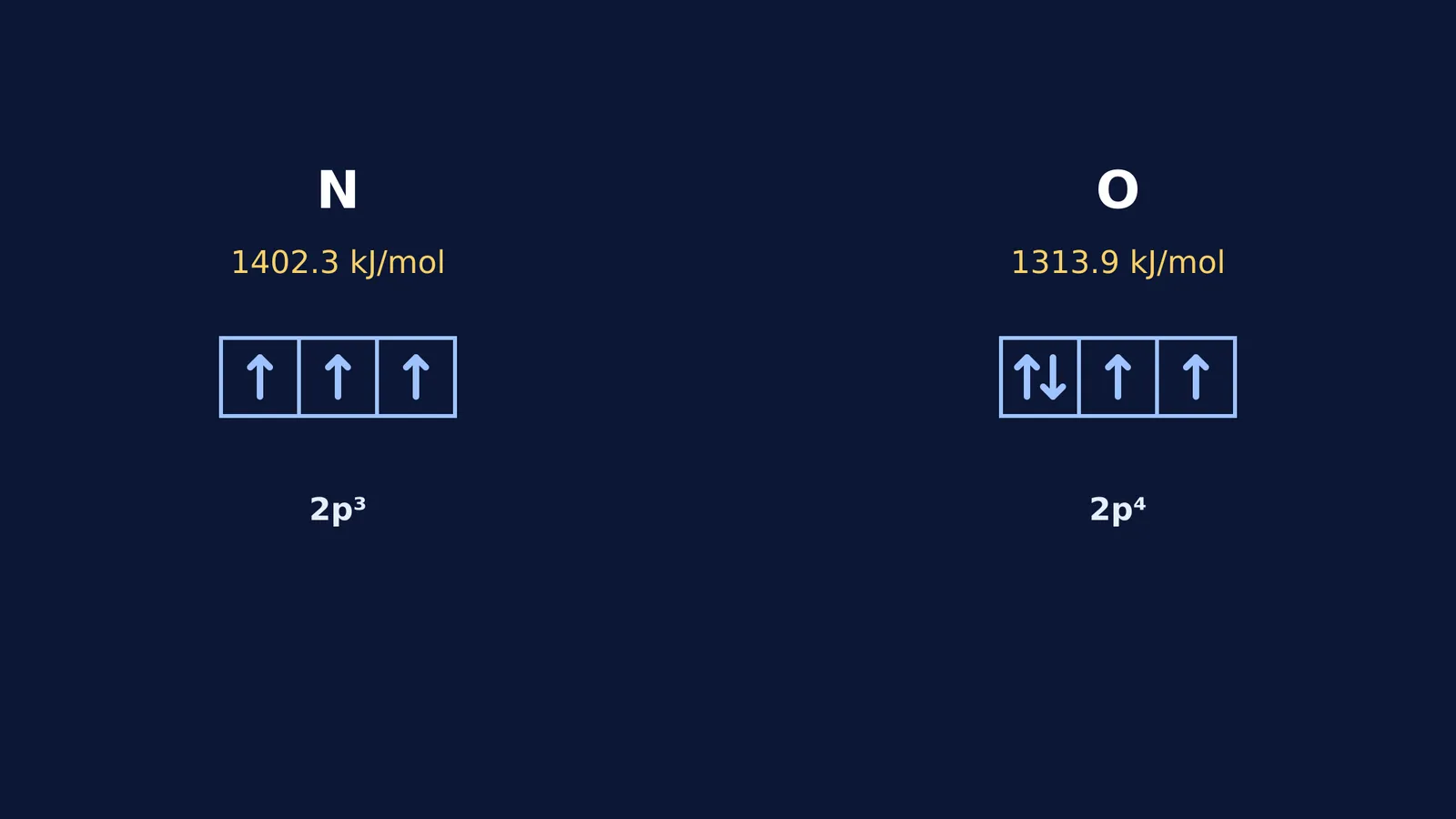
Nitrogen requires 1402.3 kJ/mol to remove its outermost electron. Move one spot to the right on the periodic table, and you might expect oxygen to need even more energy because of its higher nuclear charge. Instead, oxygen's first ionisation enthalpy drops to 1313.9 kJ/mol.
When revising for inorganic chemistry exams, it is easy to ask an AI chatbot to "list the ionisation enthalpy exceptions in Period 2" and walk away with a rote list. That is a missed opportunity for active learning, especially since memorising exceptions without understanding the physical mechanism often leads to mistakes under exam pressure.
Why does nitrogen have a higher ionisation enthalpy than oxygen?
If you instead press your AI tutor for the electronic reason behind the anomaly, you get to the physics of the atom:
Nitrogen (1s² 2s² 2p³) has exactly one electron in each of its three 2p orbitals. A half-filled subshell is symmetrical and highly stable. The minimised electron-electron repulsion and high exchange energy make it difficult to pull an electron away.
Oxygen (1s² 2s² 2p⁴) has four electrons in the 2p subshell, meaning one orbital must hold a pair. These two negatively charged electrons occupy the same region of space and strongly repel each other. Removing one of them relieves that repulsion and leaves a stable, half-filled 2p³ state behind. This structural advantage makes oxygen more willing to lose an electron than nitrogen.
Instead of just handing you the final text, Fermi's AI tutor can draw the orbital diagrams on a whiteboard and ask you to find which atom has paired electrons in its outermost shell, helping you discover the repulsion principle yourself. The tutor teaches rather than simply answering, deciding whether to explain, ask or show a concept based on your current understanding.
Pressing AI for other electronic reasons
Once you understand the 'why' for nitrogen and oxygen, you can use the same technique for other periodic table puzzles.
If you ask the AI, "Does the same anomaly happen in Period 3?", you will find the pattern repeats. Phosphorus requires 1011.8 kJ/mol to remove an electron. This is a higher first ionisation enthalpy than sulphur's 999.6 kJ/mol. Because phosphorus has a 3p³ arrangement, it benefits from the same half-filled stability that protects nitrogen's electrons.
The second ionisation enthalpy of oxygen is actually much higher than nitrogen's, because oxygen is now breaking its stable 2p³ arrangement, while nitrogen is removing an electron from a less stable 2p² state. Asking "what if" questions ensures you grasp the underlying mechanism rather than just memorising the first step of the process.
You can also use this approach to explore electron gain enthalpy. When studying these topics, you might wonder if you can trust AI on inorganic chemistry exceptions. The trick is to force the AI to explain the orbital structure—like how fluorine's tiny 2p orbitals create intense repulsion for incoming electrons—rather than accepting a one-word answer. By asking the tutor to step through the orbital diagram, you verify the logic.
How to structure a study session with an AI tutor
Instead of treating an AI tutor like a search engine, you can use it to build a full session around these atomic trends. Start by bringing a list of the first twenty elements and ask the tutor to test you on their electron configurations using the Fermi Concept Library. When you inevitably encounter the drops in ionisation energy at groups 13 and 16, ask the tutor to pause and let you guess the physical reason.
This interactive approach keeps you engaged. When you get stuck, the tutor will notice and offer a hint, like asking you to draw the boxes for the 2p orbitals. It holds a line of reasoning across a session, working out what you know and building a plan to bridge the gaps.
Remember, the goal of a study session is to use AI to understand mistakes and uncover the foundational rules governing atomic behaviour. When you press for the electronic reason behind the numbers, chemistry becomes a logical system rather than a long list of exceptions to memorise before test day.


