

On this page
NCERT's physics chapters close with a short box called Points to Ponder, placed after the summary and before the exercises. In the 2026-27 reprint of Class 11 Physics, the chapter Motion in a Straight Line has six of them. The box is easy to skim, but it is where the book says where its own rules stop working.
The fix takes one sitting: for every point, ask an AI for one example and one counterexample, then check both against the chapter.
What is the Points to Ponder section in NCERT physics?
It is the fine print. The summary gives formulas; Points to Ponder gives their conditions and sign traps. Two lines from the Motion in a Straight Line chapter show the style:
"The zero velocity of a particle at any instant does not necessarily imply zero acceleration at that instant."
The kinematic equations "are true only for motion in which the magnitude and the direction of acceleration are constant during the course of motion."
Each point is a boundary, and you see a boundary best from both sides.
Why ask for an example and a counterexample?
In a review of instructional design research, Robert Tennyson and Ok-Choon Park (1980) proposed defining a concept by its critical attributes, then selecting and arranging examples by manipulating critical and variable attributes. Put simply, you learn where a rule applies by seeing cases just inside it and just outside it.
A second study is about mechanics itself. Michelene Chi and colleagues (1989) recorded students thinking aloud while studying worked examples. The stronger students produced explanations that "refine and expand the conditions" of each step; weaker students explained less and leaned heavily on the examples later.
Neither study tested AI. Here the AI only supplies cases; you do the explaining and checking.
What should you type into the AI?
Keep the chapter open next to the chat. For each point, use this script:
"Here is a Point to Ponder from NCERT Class 11 Physics, chapter [name]: [paste the point]."
"Give one everyday example where it is true, with numbers and a stated positive direction."
"Give one counterexample that breaks the shortcut this point warns against. Name the condition that fails."
"Ask me why each case works before you confirm anything."
The last line makes the AI question you instead of handing over a finished answer.
How does this work on a real point?
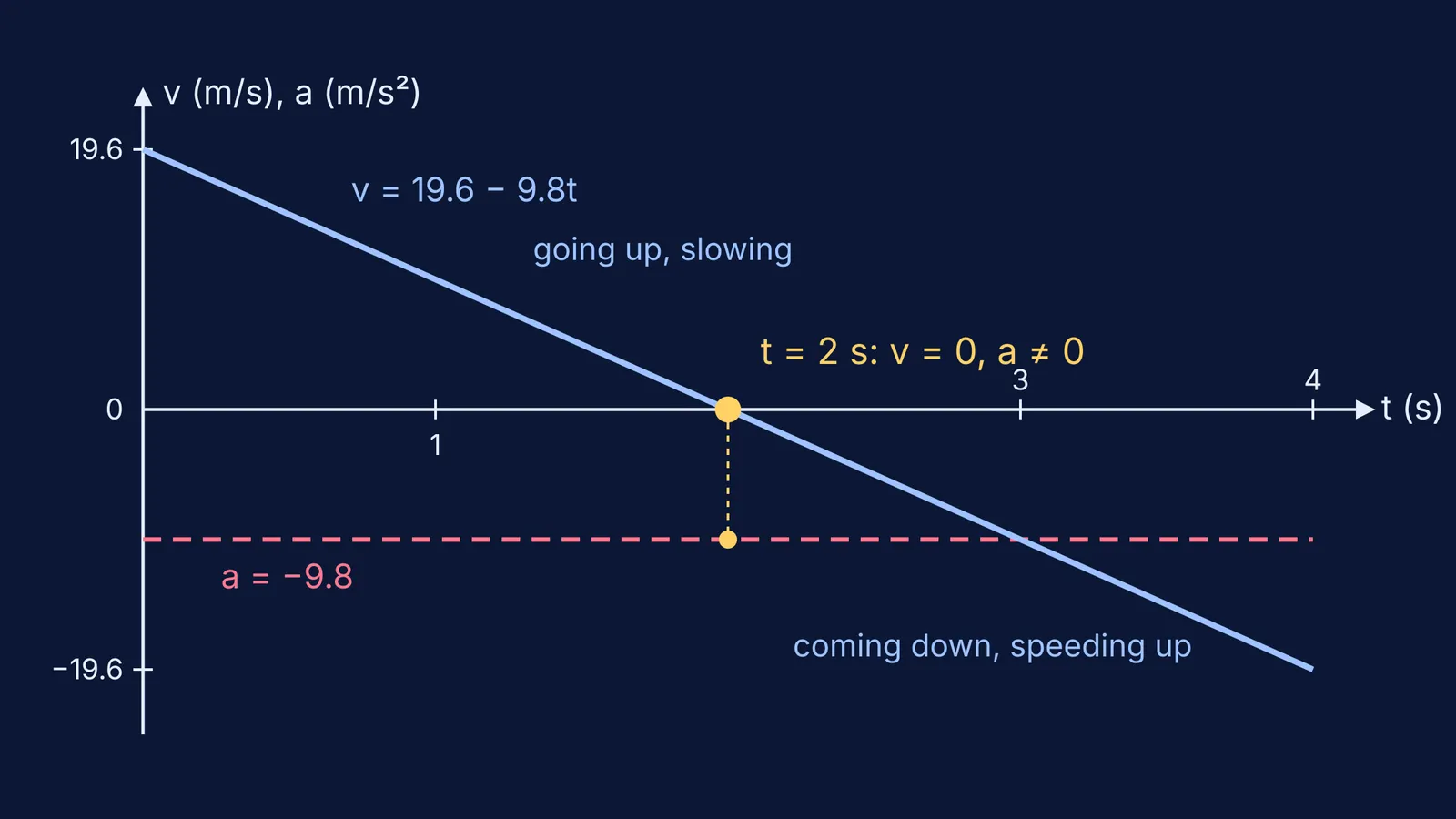
Point 3 of the chapter says the sign of acceleration does not tell you whether speed is increasing or decreasing. Take upward as positive, so the acceleration due to gravity is −9.8 m/s².
Example: a ball thrown up at 19.6 m/s. Velocity is positive and acceleration negative, so it slows; after 2 s it is momentarily at rest.
Counterexample to "negative acceleration means slowing down": the same ball 1 s after the top, falling. Velocity is −9.8 m/s and acceleration is still −9.8 m/s², yet speed is increasing.
Check it with Point 2: speed increases when acceleration points along the velocity. On the way down both are negative, so the ball speeds up. The pair covers Point 4 too: at the top, v = 0 but a is not.
How do you check the AI's answer?
A chatbot can state a wrong sign confidently, so test each pair:
Axis first. Has it stated the origin and positive direction, as Point 1 asks? Without that, signs mean nothing.
Every condition met. Does the example satisfy all of the point's conditions, such as constant acceleration?
One thing broken. Does the counterexample break exactly one condition, and does the AI name it?
Your numbers. Redo one calculation. A block on a spring is a fair counterexample for Point 6, since its acceleration changes; if the AI applies v² = v₀² + 2ax to it, you have caught an error.
When the AI and the book disagree, the book wins; ask the AI to find its own mistake. See also how to check the conditions behind a formula with AI, how to find counterexamples in maths with AI and check them, and where an AI analogy for physics breaks down.
How do you fit this into revision?
Do one chapter's box per sitting, after its exercises. Write each pair in your notebook margin as "holds:" and "fails:". Before a test, cover the pairs and rebuild them; the ones you cannot rebuild are your weak spots. Parents do not need physics to help: ask your child to read one pair aloud and say which condition the counterexample breaks.
For points that are hard to picture, like a velocity crossing zero while acceleration stays fixed, the Fermi Simulation Lab has interactive simulations for ideas that are easier to see than to read. If you would rather be questioned than handed answers, Fermi's AI tutor decides whether to explain, ask or show, and checks understanding as it goes.
Start tonight with the last chapter you studied: one point, one example, one counterexample.


