On this page
Some rules feel true until they aren't: "a continuous function is differentiable", or "a bigger perimeter means a bigger area". A quick way to learn where such rules break is to ask an AI chatbot for a counterexample, then check it yourself. The checking is where the learning happens.
What is a counterexample, and why is one enough?
A counterexample is a single case that meets every condition of a "for all" claim but breaks its conclusion. A thousand fitting cases cannot prove a rule; one breaking case settles it.
In 1966, L. J. Lander and T. R. Parkin disproved Euler's conjecture on sums of like powers with one equation: 27⁵ + 84⁵ + 110⁵ + 133⁵ = 144⁵ (Bulletin of the American Mathematical Society). Both sides equal 61,917,364,224.
Finding counterexamples takes practice. In a study of 82 students in Years 4 to 6 in Victoria, Australia, Wanty Widjaja and Colleen Vale found the children could list many examples supporting the claim that a rectangle with a larger perimeter always has a larger area, but struggled to find counterexamples (Journal on Mathematics Education, 2021). Try it: a 1 × 9 rectangle has perimeter 20 and area 9, while a 4 × 4 square has perimeter 16 and area 16.
Can AI find counterexamples in maths reliably?
Not reliably enough to trust unchecked. CounterMATH is a benchmark of 1,216 university-level statements, from algebra to functional analysis, that test whether AI models can reason with counterexamples (Li et al., arXiv, 2025). The authors found that even advanced models such as OpenAI o1 "have insufficient counterexample-driven proof capabilities". In their case study they note that "while the LLM correctly judges mathematical statements, it sometimes provides incorrect examples".
So a chatbot can say "false" correctly and back it with an example that breaks nothing; copy that and you learn the wrong reason. More failure modes are in why AI chatbots get maths wrong, and a five-step way to check.
How do you ask AI for a counterexample?
Treat the AI as a sparring partner, not an answer key. Send these one at a time:
"Here is a statement: [statement]. Don't say if it's true. Give me one candidate counterexample."
"Which conditions does your example satisfy, and which part of the conclusion fails?"
"Drop one hypothesis of [theorem] at a time and give the simplest example where the conclusion fails."
"Give me a near-miss: an example that looks like a counterexample but isn't. Don't say why."
After you check: "I tested your example and got [result]. Who made the mistake?"
Near-misses force you to read conditions precisely, which is what many tricky exam options test.
A worked example: what happens when Rolle's theorem loses a condition?
Rolle's theorem says: if f is continuous on [a, b], differentiable on (a, b), and f(a) = f(b), then f′(c) = 0 for some c between a and b. (Our guide to Rolle's theorem and the mean value theorem covers its uses.) Ask an AI to break it one condition at a time, then verify.
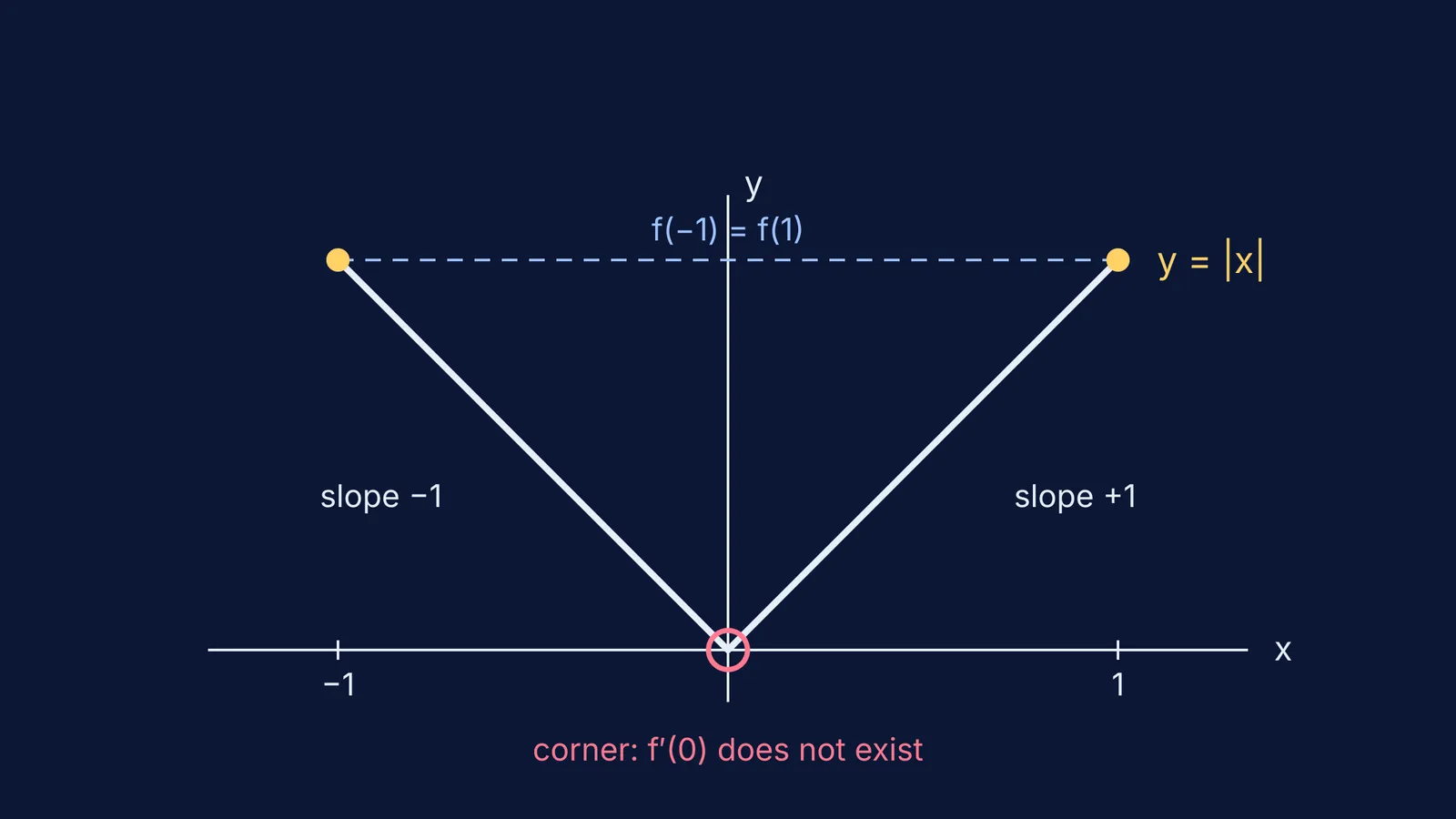
Drop differentiability. A typical answer is f(x) = |x| on [−1, 1]. Check each piece:
Continuous on [−1, 1]? Yes, no break.
f(−1) = f(1)? Both equal 1.
Differentiable on (−1, 1)? No. The slope is −1 for x < 0 and +1 for x > 0: a corner at 0.
Any c with f′(c) = 0? No. Every slope is −1 or +1.
Only differentiability was missing, so this is a valid counterexample. It also kills the rule from the top of this post: |x| is continuous at 0 but not differentiable there. More on corners in differentiability for JEE: corners, modulus and piecewise functions.
Drop continuity at an endpoint. Take f(x) = x for 0 ≤ x < 1, and f(1) = 0. Then f(0) = f(1) = 0 and the slope inside (0, 1) is always 1. The jump at x = 1 breaks it.
A false rule from algebra. "n² + n + 41 is always prime" survives many tests, but n = 40 gives 1681, which is 41 × 41.
How do you check an AI's counterexample yourself?
Run every example through this before it goes in your notes:
Restate the claim with "for all" written out.
Confirm the example meets every hypothesis. Substitute numbers; don't accept "clearly".
Show the conclusion fails with a calculation or a sketch.
Ask whether a simpler example exists; simple ones are easier to recall in an exam.
Write one line: "Condition X is needed because of example Y."
The Fermi Concept Library gives every mathematics concept its own lesson, useful when a counterexample shows you weren't sure what "differentiable on an open interval" means. If you would rather be questioned than told, Fermi's AI tutor decides whether to explain, ask or show, so you still do the checking.
Tonight, pick one theorem from this week's chapter, remove one condition, and find the example that breaks it.