

On this page
Ask a Class 11 biology student which colour of light plants prefer, and the answer is almost always blue or red. Ask about green light, and most declare it useless because leaves look green and reflect it away.
Yet illuminate a seedling with pure red light, and leaves become distorted. Bombard it with pure blue, and stems become severely stunted. Understanding which colour of light plants grow best under requires separating two processes: the instantaneous rate of photosynthesis per absorbed photon, and the long-term structural development of the living plant.
Why do plants look green if they absorb light?
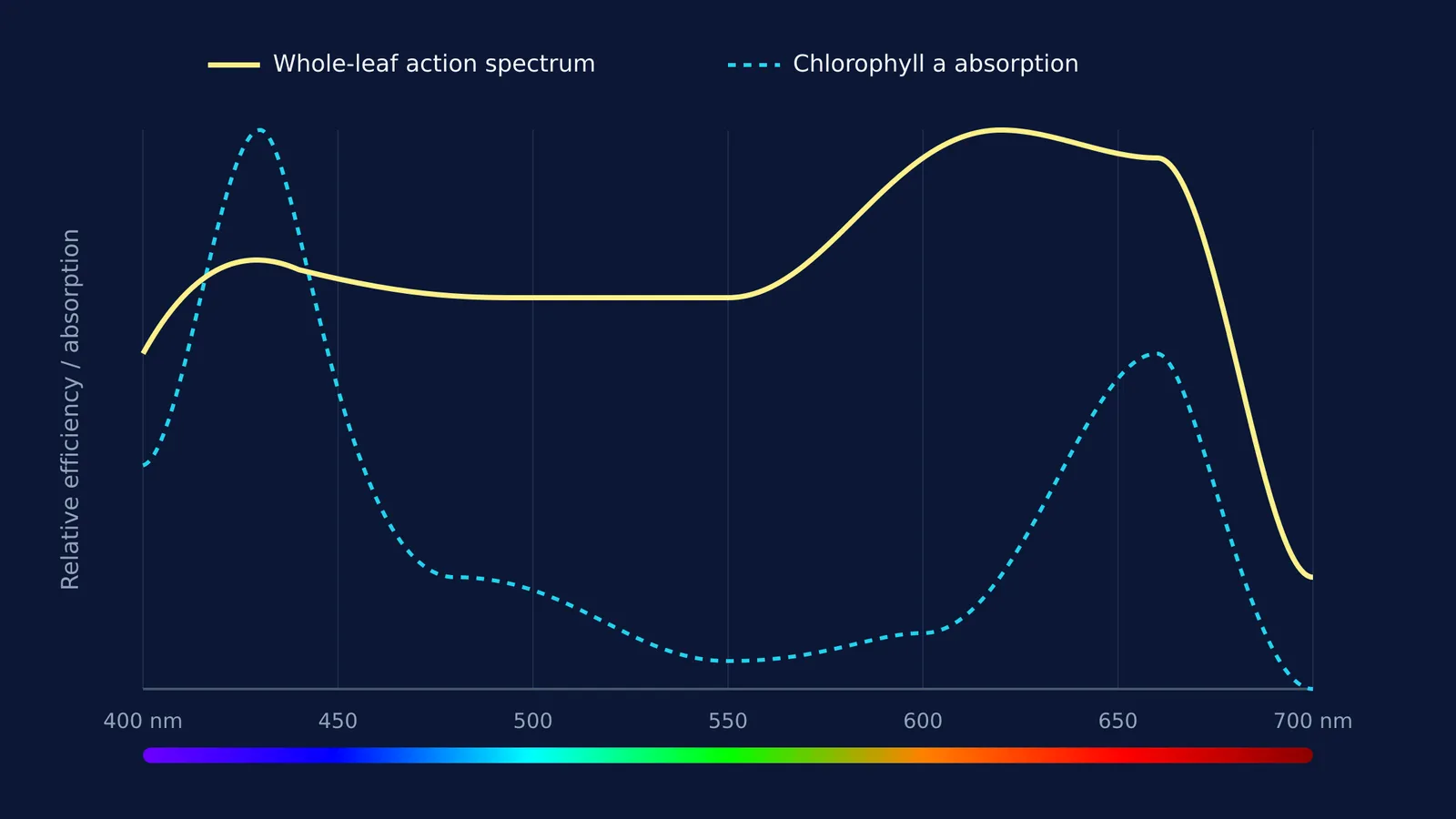
The idea that plants reject green light confuses isolated pigments with living leaves. Chlorophyll a and b in an extract absorb primarily in the blue (400–450 nm) and red (640–660 nm) bands. But a leaf is a dense optical structure packed with light-scattering cell walls.
While chloroplasts reflect 10% to 15% of green photons, the remaining 85% to 90% is absorbed as light bounces through internal cell layers (Terashima et al. 2009). That small reflected fraction creates the emerald colour we see. In 1882, T.W. Engelmann demonstrated the first photosynthetic action spectrum in *Pflüger's Archiv* (Engelmann 1882). Using a prism to split sunlight across a filament of *Spirogyra*, Engelmann added oxygen-seeking bacteria (*Bacterium termo*). The bacteria clustered around blue and red zones where oxygen release peaked, extending Jan Ingenhousz's foundational discovery that light drives air purification.
Which colour of light drives photosynthesis fastest?
For immediate energy conversion per absorbed photon, red light wins. In 1971, K.J. McCree published a landmark action spectrum in *Agricultural Meteorology* (McCree 197190022-7)), measuring quantum yield—moles of carbon dioxide fixed per mole of absorbed photons—across 22 crop species. McCree showed that photosynthetic efficiency peaks in the orange-red band between 600 nm and 630 nm, defined as 1.0 on the relative yield scale.
This advantage comes from quantum physics. Photosystem II needs about 1.8 electron volts to split water. A 660 nm red photon delivers exactly that energy. A 430 nm blue photon carries 2.8 electron volts, lifting an electron into a higher excited state. Within femtoseconds, the extra energy is lost as heat through internal conversion. As a result, blue light achieves only 70% to 75% of red's efficiency per photon. Short-term rates are also bounded by carbon dioxide, as outlined by Blackman's law of limiting factors.
Why is green light not completely wasted?
If red light has the highest quantum yield, should growers discard green light? Plant physiologists once thought so, until they tested leaves under high light. In 2009, Ichiro Terashima and colleagues published findings in *Plant and Cell Physiology* (Terashima et al. 2009), demonstrating that green light drives leaf photosynthesis more efficiently than red light under strong white light.
The reason lies in leaf architecture. Chloroplasts in upper palisade cells absorb red and blue light so strongly that in bright sunlight, they become light-saturated. Extra red photons are lost as heat. Green light penetrates deeper into the spongy mesophyll and lower canopy, reaching unsaturated chloroplasts. Absorbed green photons achieve an 80% to 85% quantum yield, powering carbon fixation in tissue that red light never reaches.
Can plants grow under only red or blue light?
Photosynthetic quantum yield measures carbon fixed over minutes, but growth measures development over weeks. As Kevin R. Cope and colleagues noted in *Photochemistry and Photobiology* (Cope et al. 2014), under 100% monochromatic red light, plants suffer from 'red light syndrome': leaves turn thin, stomata fail to open fully, and stems stretch uncontrollably.
Blue light provides essential developmental signals. Photoreceptors called cryptochromes use blue light to regulate stem elongation and leaf thickness. Cope's team tested crops under LED arrays and found that while minimal blue light is required to prevent stretching, blue fractions above 15% reduce leaf expansion and dry mass. Plants grow best under a balanced spectrum: 80% to 90% red for energy, 10% to 20% blue for shape, and green for canopy penetration.
How can you test light colour on plant growth in a simulation?
Memorising absorption curves leaves many students with misconceptions. Interactive digital tools help learners confront these errors through structured inquiry, as reviewed in research comparing simulations and static diagrams. In 2012, Nico Rutten and colleagues reviewed virtual experiments in *Computers & Education* (Rutten et al. 2012), concluding that computer simulations improve conceptual understanding when students engage in guided discovery.
The Predict-Observe-Explain framework turns virtual testing into active learning. In the Fermi Simulation Lab, you can adjust wavelengths, photon flux, and photoperiods on virtual plants:
Predict the outcome: Guess which colour (450 nm blue, 530 nm green, or 660 nm red) yields the highest oxygen release per minute, and which produces the sturdiest plant over 21 days.
Test short-term photosynthesis: Apply equal photon flux (e.g. 200 μmol m⁻² s⁻¹) to each wavelength. Watch oxygen release peak under red, decline under blue due to thermal dissipation, and remain active under green.
Observe vegetative growth: Run a 3-week simulation. Note how pure red causes spindly stems, while pure blue produces stunted foliage.
Blend a complete spectrum: Combine 85% red with 15% blue, then add green light. Compare total dry mass against single-colour runs.
If you hit concept gaps connecting absorption spectra to ATP synthesis, the Fermi Concept Library explains each photochemical step.


