On this page
You have a kinetics numerical, an AI chat window and a deadline. Pasting the question and copying the answer is quick. The route that builds marks is slower at the start: you write the equation yourself, then use the AI to check each number it plugs in.
Why can using AI for numericals make you worse at them?
The clearest evidence comes from a field experiment by Hamsa Bastani and colleagues, published in PNAS in 2025, which gave nearly a thousand high school maths students access to GPT-4 tutors (PNAS, Bastani et al. 2025). While the AI was available, grades rose 48% with a plain ChatGPT-style tool and 127% with a version prompted to safeguard learning. Once access was taken away, students who had used the plain version scored 17% lower than students who never had it. The authors say those students used the AI as a "crutch", and that the safeguards in the tutor version largely mitigated the drop.
The study was about maths, not chemistry, but physical chemistry numericals lean on the same algebra, with units attached. The same abstract notes that generative AI "is fallible and users must check its outputs". That checking is the skill to build.
How should you use an AI tutor for physical chemistry numericals?
Use the same four steps for mole concept, equilibrium and kinetics:
Name the relation yourself. Write the governing equation before you open the AI: n = m/M, Kp = Kc(RT)^Δn, or the first-order integrated rate law. If you cannot, you have a concept gap, not a calculation problem.
Write units next to every quantity. The unit of a rate constant tells you the order: min⁻¹ means first order.
Ask the AI to check your set-up, not to solve. Paste your equation and substitutions, not just the question.
Audit every number it uses. For each constant, ask which value, which units, and why that one.
For how to lay those steps out in a board answer, see our guide to setting out CBSE chemistry numericals step by step.
Which numbers should you check? A worked example
The constants in these chapters have official values, published by the US National Institute of Standards and Technology as the CODATA recommended values (NIST fundamental constants).
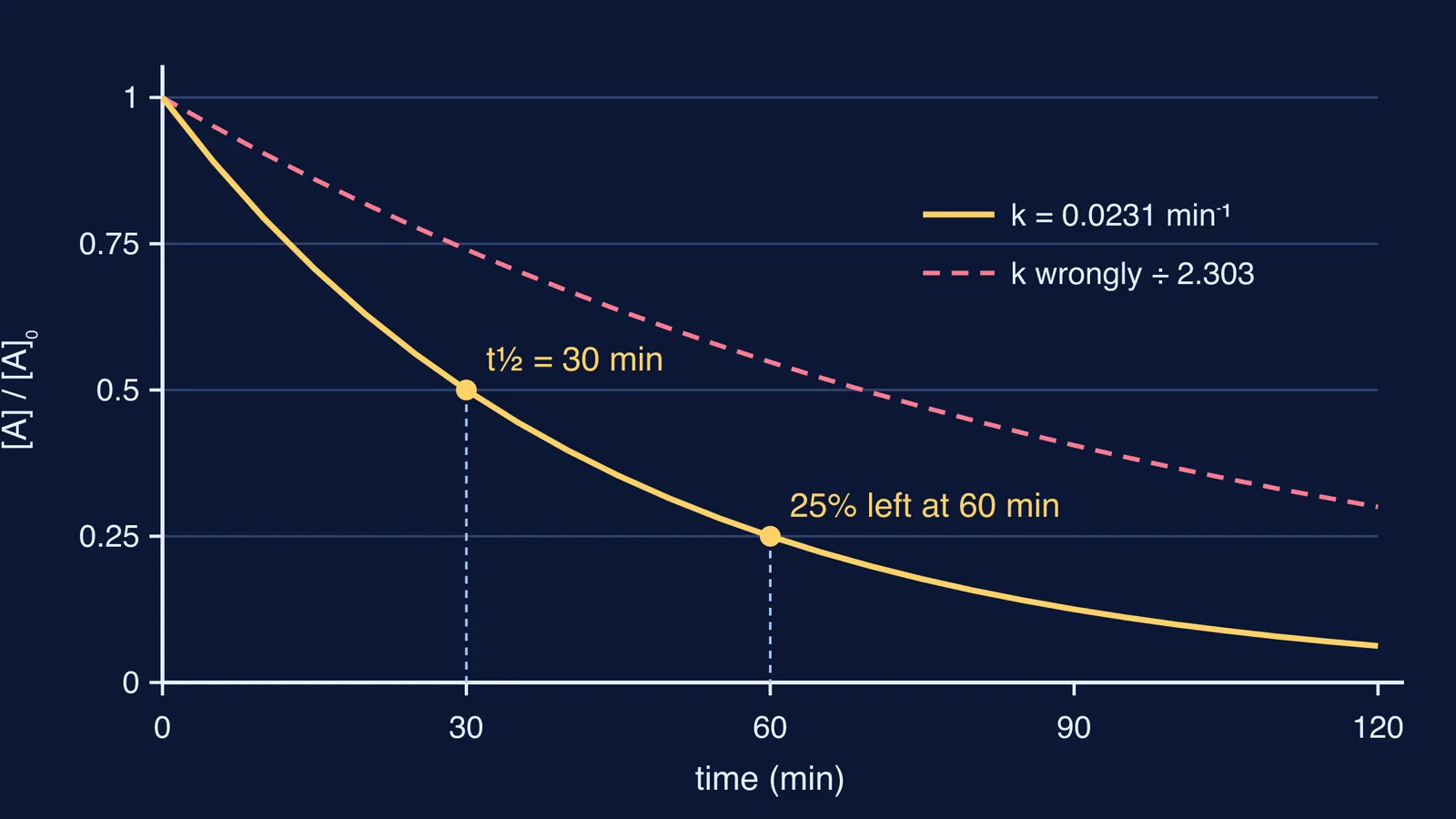
Question: a first-order reaction has k = 0.0231 min⁻¹. How long until a quarter of the reactant is left?
Your set-up: t = (2.303 / k) × log₁₀([A]₀/[A]) = (2.303 / 0.0231) × log₁₀ 4.
Now check each number:
2.303 is ln 10. It belongs only with log₁₀. If the AI writes ln 4 and still multiplies by 2.303, it gets about 138 min instead of 60 min.
log₁₀ 4 = 0.602, so t = 99.7 × 0.602 = 60.0 min.
Cross-check with half-lives. t½ = 0.693 / 0.0231 = 30 min, and a quarter left is exactly two half-lives, so 60 min. If the AI's answer disagrees, one of its numbers is wrong.
The same audit works in the other two chapters:
Mole concept: the Avogadro constant is exactly 6.022 140 76 × 10²³ mol⁻¹ (NIST CODATA). Check that the AI used the molar mass of the right species (O₂, not O) and the mole ratio from the balanced equation. Our post on mass-to-mass stoichiometry in three steps walks through that ratio.
Equilibrium: the molar gas constant is 8.314 462 618 J mol⁻¹ K⁻¹ (NIST CODATA). One standard atmosphere is exactly 101 325 Pa (NIST CODATA), so in litre-atmosphere units R is about 0.0821 L atm mol⁻¹ K⁻¹. In Kp = Kc(RT)^Δn, with Kp in atm and Kc in mol/L, use 0.0821, not 8.314. Also check that Δn counts only gaseous moles, products minus reactants (−2 for N₂ + 3H₂ ⇌ 2NH₃), and that T is in kelvin.
If the AI assumes amounts end up equal at equilibrium, stop it: see why equilibrium does not mean equal concentrations.
What should you type into the AI?
Copy this:
"Here is my set-up for this question: [your equation, with numbers and units]. Do not solve it. Tell me whether my equation fits the question, list every constant I used with its units, and point to the step that is wrong, if any. Then ask me to redo that step."
If the AI gives a full solution anyway, reply: "Show me only the line where my working differs from yours."
Fermi's AI tutor is built to teach rather than answer: it notices where you are stuck and decides whether to explain, ask or show. For practice, the Fermi Problem Library has worked problems with a step-by-step solver that explains the reasoning rather than printing an answer, so you can compare your set-up line by line.
Tonight, take three numericals, one each from mole concept, equilibrium and kinetics. Write the first line of each yourself, then let the AI check it.