

On this page
The paper helicopter experiment is a classic way to test how changing one variable affects an outcome. By adjusting the length of the helicopter's wings, you can observe real changes in its terminal velocity and flight time.
How does wing length affect fall time?
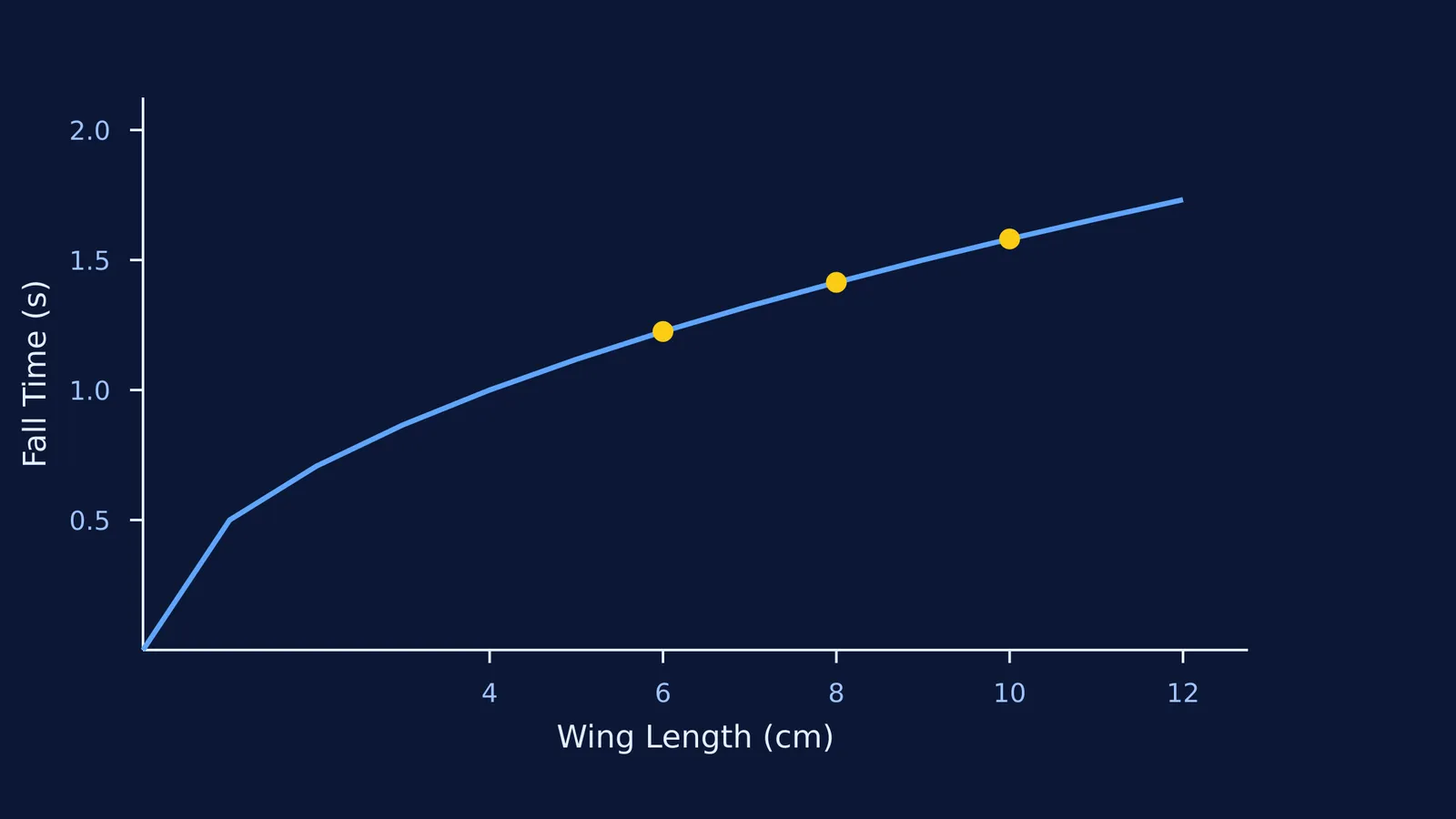
When you drop a paper helicopter, gravity pulls it downward, but the air pushes up against the spinning wings. The longer the wings, the greater the surface area interacting with the air.
This difference happens because of air resistance (drag). Longer wings generate more drag, which opposes gravity more effectively and slows the descent. If you were doing this on Mars, where the atmosphere is only 1% as dense as Earth's, you would need much larger blades spinning about 10 times as fast as those of helicopters on Earth to generate enough lift, as the NASA Jet Propulsion Laboratory notes about their Ingenuity helicopter.
What is terminal velocity in this experiment?
When you release the paper helicopter, it accelerates. But as it falls faster, the upward drag force increases. When the drag force exactly equals the downward force of gravity, the helicopter stops accelerating and falls at a constant speed, known as terminal velocity.
Adding weight increases the gravitational pull, requiring a higher speed to balance the forces, which means a shorter fall time. Conversely, increasing wing length increases drag, allowing the forces to balance at a lower speed, resulting in a longer fall time. You can see this force balance visually in the Fermi Simulation Lab, where interactive models let you pause and adjust variables like drag and gravity.
How to run the paper helicopter experiment
To see this yourself, you can build and test your own models following guides like the NASA JPL Mars Helicopter project.
Make the helicopters: Cut out a standard paper helicopter template from regular printer paper. Make three versions, changing only the wing length (for example, 6 cm, 8 cm, and 10 cm). Keep the body length and wing width identical.
Predict the outcome: Before you drop them, guess which one will take the longest to hit the ground.
The drop: Stand on a chair or staircase and drop each helicopter from exactly the same height (e.g., 2 metres).
Time the fall: Use a stopwatch to time how long each takes from release to landing. Do three trials for each wing length and average the results to reduce timing errors.
What other variables can you test?
Once you understand how wing length affects the fall time, you can design a new experiment by changing a different variable.
Weight: Add paper clips to the bottom of the helicopter. Increasing the mass will increase the downward force of gravity, meaning the helicopter must fall faster to generate enough drag to reach terminal velocity.
Wing width: Just like wing length, widening the wings increases the surface area and the air resistance, which should also slow the descent.
Paper type: Try using cardstock instead of printer paper. Heavier paper adds mass, but it is also stiffer, which might change how the wings bend upward during the fall.
This method of changing one thing at a time is called controlling your variables. It ensures that any difference in the fall time is definitely caused by the wing length, rather than a different drop height or a heavier piece of paper.
How do you plot the results?
Once you have your average times, plot them on a graph. Put the independent variable (wing length in cm) on the horizontal x-axis and the dependent variable (average fall time in seconds) on the vertical y-axis.
If you want to explore how falling objects behave in different environments, check out our guide to free fall on Earth, the Moon and Jupiter. For a deeper look at drag, read about how shape affects speed in a terminal velocity simulation.


