On this page
Ask an AI why fluorine's electron gain enthalpy is less negative than chlorine's and you will get a fluent paragraph in seconds. It might be right. To find out, make the reason predict a number, then look the number up. Below are a script, a worked example and a checklist.
There is a catch for 2026-27. The current NCERT reprints of Class 11 Chemistry (contents of Parts I and II) and Class 12 Chemistry (Part I, Part II) have no p-block unit. Yet the NEET-UG 2026 syllabus notified by NMC and published by NTA listed Unit 10, p-Block Elements, Groups 13 to 18, including the "unique behaviour of the first element in each group". For NEET-UG 2027 or JEE Main, check the current NTA syllabus. Either way, the numbers to check against now sit in Class 11 Unit 3, on periodicity.
Why do p-block elements have so many exceptions?
The exceptions checked below trace back to three causes, and NCERT's Class 11 Unit 3 chapter explains each one.
Small second-period atoms. An electron added to oxygen or fluorine enters the smaller n = 2 shell and suffers significant repulsion.
s versus p electrons. A 2s electron penetrates closer to the nucleus than a 2p electron, so boron's 2p electron is easier to remove than beryllium's 2s.
Paired p electrons. Two of oxygen's four 2p electrons share an orbital, so one is easier to remove than any of nitrogen's three unpaired ones.
For the bigger picture, see our explainer on why the first member of each group behaves anomalously.
How should you ask an AI tutor about a p-block exception?
Type the first four steps; do the fifth yourself.
"Why is [exception]? Give the cause in one or two sentences, no mnemonic."
"Which quantity in an NCERT Class 11 table would show this, and which way should it point?"
"Use the same reason to predict one other pair of elements. Which should be larger?"
"What does this reason not explain?"
Open the table and compare. The data gets the last word, not the AI.
A confident tone tells you little on its own; see what an AI's confidence statement actually means.
Worked example: why is chlorine's electron gain enthalpy more negative than fluorine's?
The claim. A good answer: fluorine's incoming electron enters a compact 2p subshell and is repelled by the electrons already there; chlorine's enters the larger 3p subshell, where repulsion is weaker.
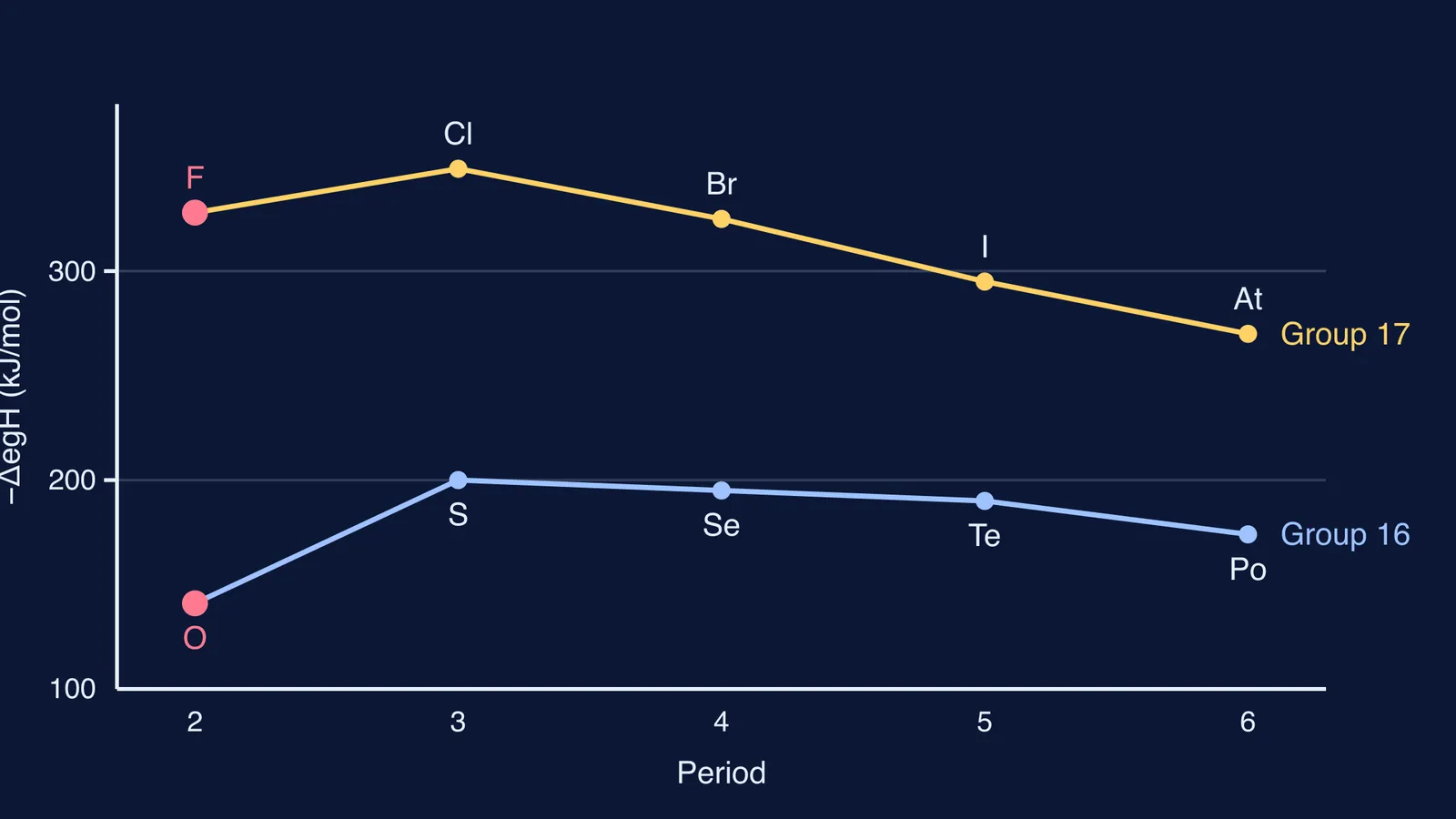
Check it. Table 3.7 in NCERT Class 11 Unit 3 gives the electron gain enthalpy of fluorine as −328 kJ/mol and of chlorine as −349 kJ/mol. Chlorine is more negative, so the reason fits.
Transfer test. The same reason predicts that oxygen should be less negative than sulphur. Table 3.7 gives oxygen −141 kJ/mol and sulphur −200 kJ/mol. It passes again.
Normal trend. Below chlorine, bigger atoms should simply attract the electron less. Table 3.7 gives bromine −325, iodine −295 and astatine −270 kJ/mol. Pass.
Catch a bad reason. Suppose the AI had said "because fluorine is more electronegative". Table 3.8(b) in the same chapter gives fluorine 4.0 and chlorine 3.0 on the Pauling scale, which would predict the opposite of what is measured. That reason cannot be the cause.
Small mismatches are normal: Table 3.6(b) lists fluorine's atomic radius as 64 pm, while Fig. 3.4(b) on the next page plots 72 pm. If the AI's number differs slightly, use the book's value in exams and check the direction of the trend.
This loop works best when the tutor remembers the thread. Fermi's AI tutor holds a line of reasoning across a whole session and checks understanding as it goes, so you can move to the next exception without re-explaining where you are. If shielding or effective nuclear charge itself feels shaky, the Fermi Concept Library gives every chemistry concept its own lesson.
Fluorine is still the strongest oxidising halogen; our explainer on fluorine's oxidising power shows why.
Which p-block exceptions and trends can you check against NCERT tables?
Every value below is from NCERT Class 11 Unit 3. Tick each off only when the AI's reason predicts the right direction.
Boron's first ionisation enthalpy, 801 kJ/mol, is below beryllium's 899 kJ/mol (Fig. 3.6a).
Oxygen's first ionisation enthalpy, 1314 kJ/mol, is below nitrogen's 1402 kJ/mol (Fig. 3.6a).
Fluorine's electron gain enthalpy, −328 kJ/mol, is less negative than chlorine's −349 kJ/mol (Table 3.7).
Oxygen's electron gain enthalpy, −141 kJ/mol, is less negative than sulphur's −200 kJ/mol (Table 3.7).
Aluminium's first ionisation enthalpy sits nearer 575 than 760 kJ/mol, below magnesium's 737, because 3s electrons shield its 3p electron (Problem 3.6).
Atomic radius falls across period 3 from aluminium, 143 pm, to chlorine, 99 pm (Table 3.6a).
Electronegativity falls down group 17 from fluorine, 4.0, to astatine, 2.2 (Table 3.8b).
Two exceptions a day covers this list in four days. Start tonight with boron and beryllium.