

On this page
You do 20 maths problems tonight, the teacher checks them tomorrow, and you may have practised the same mistake 20 times. US randomised trials in ordinary schools tested marking every answer the moment you type it. Here is what they found, and how to copy it with any practice tool.
What did the randomised trials of online maths homework find?
The largest study ran in Maine, USA. Roschelle, Feng, Murphy and Mason (AERA Open, 2016) randomly assigned schools to use a free online homework tool, ASSISTments, or carry on as usual, then tested 2,850 seventh-grade students in the 43 schools analysed. The tool marked each answer instantly and offered hints; teachers saw common wrong answers. From the full paper:
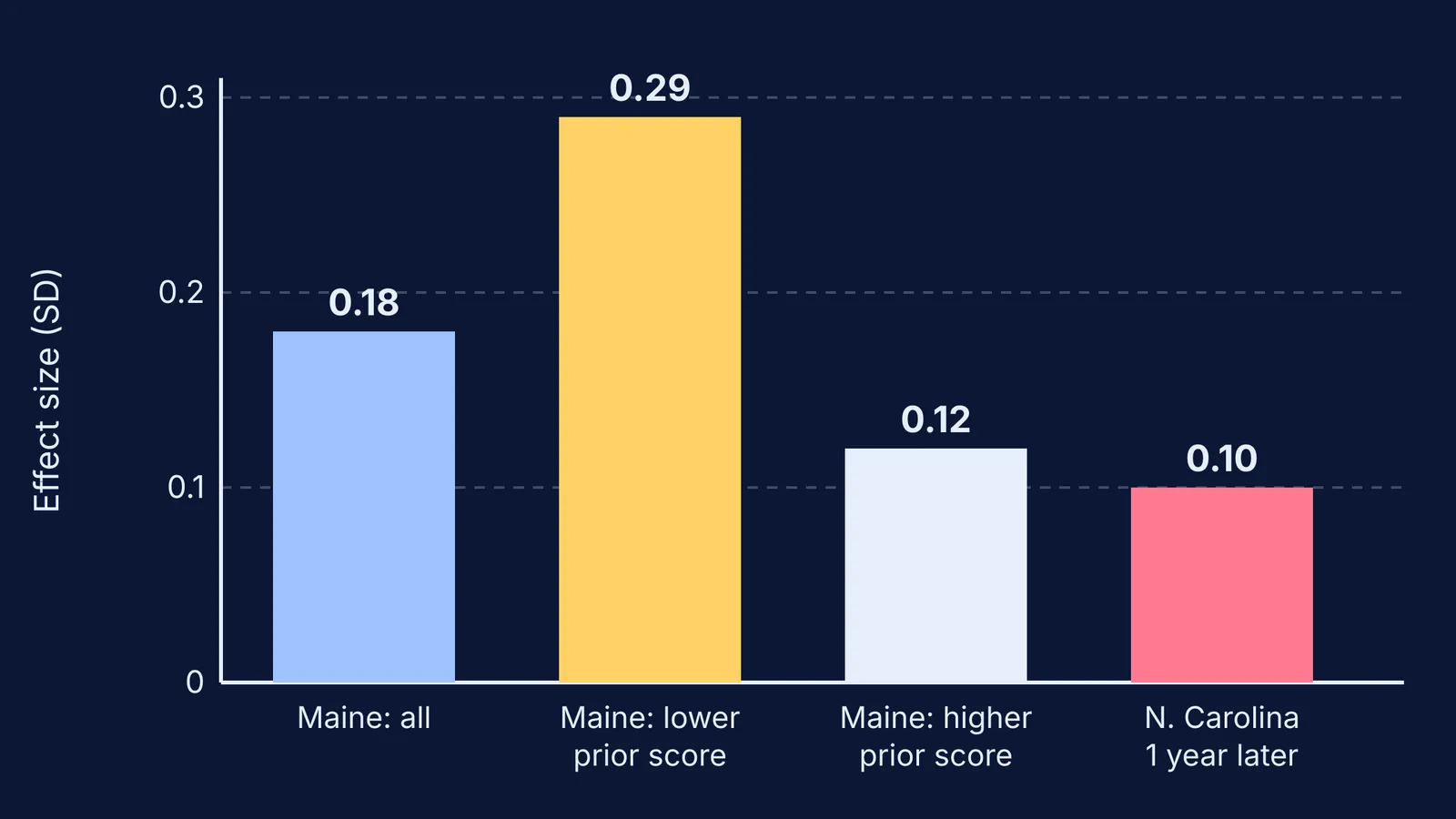
Students in ASSISTments schools scored 0.18 standard deviations higher on a standardised maths test than students in the comparison schools.
Students who started at or below the median gained more (0.29) than those who started above it (0.12).
The average student did 967 problems in about 14 hours of use across the whole school year, less than the 18 to 24 hours the researchers had expected.
An effect size expresses the gap between groups in standard deviations. For scale, a 2023 WestEd report, citing an earlier review by Lipsey and colleagues, notes that the mean effect across 124 education studies with more than 2,000 students was only 0.05.
Did the result hold up when it was repeated?
Yes, though the evidence is less direct. From 2018 to 2020, Feng, Huang and Collins at WestEd repeated the trial in 63 North Carolina schools with 102 seventh-grade teachers, who were asked to set 20 to 30 minutes of work at least twice a week. COVID-19 closed schools and cancelled the 2020 state test, so the team measured 5,991 students in eighth grade, a year after the intervention ended. Students from ASSISTments schools still scored higher, with an effect size of 0.10.
Many North Carolina teachers already set homework on platforms such as IXL, iReady and Khan Academy, and comparison teachers kept their usual tools, so this was not simply screen versus paper. The authors say the ingredients behind the gain still need study.
Is it the instant feedback, or something else?
A small, tightly controlled study points at the feedback. Kelly and colleagues (2013) gave 63 Massachusetts students the same 20 questions on negative exponents. About half were told right or wrong and could retry; the rest saw only "Answer recorded". The feedback group scored higher on a test the next day (effect size 0.52) and another a day later (0.56), from a small sample, in about the same 23 minutes. Without feedback, students tended to repeat one mistake on all three similar questions in a set; with it, 18 of the 22 who missed the first question of the first set got that set's last one right.
Teachers were part of the package: in Maine they were trained to have students rework wrong problems and to discuss common wrong answers, and the authors could not yet say which parts drove the gain. The Maine paper also cites a review suggesting immediate feedback may be more useful for procedural tasks, like most of that homework.
How can you get the same benefit from any practice tool?
Here is a same-night feedback loop built from what the trials did:
Keep the answer key open, and check each answer as soon as you finish it, not after all 20.
If it is wrong, make one more attempt before you read the solution.
Practise in threes: after a miss, do two similar questions to see whether the fix has stuck.
Keep a short wrong-answer log: the question, your answer, why it was wrong.
Take problems you and your friends all missed to the teacher.
Go short and regular: 20 to 30 minutes, at least twice a week, as in the North Carolina trial.
A worked example. Riya, in Class 8, writes 2 to the power minus 3 as minus 8; the key says 1/8. Before reading the solution she retries, recalls that a negative power means a reciprocal, and gets 1/8. She then gets 5 to the power minus 2 (1/25) and (1/3) to the power minus 2 (9) right. Her log line: "Read the minus in the power as a negative number."
Still stuck after two tries? The Fermi Problem Library has a step-by-step solver that explains the reasoning rather than printing an answer, and Fermi's AI tutor notices where you are stuck and decides whether to explain, ask or show. With any chatbot, use an AI hint ladder for hard maths problems and use AI to understand mistakes, not get answers.
What should parents look for?
Watch how the reveal-answer button is used, not just the score. A child who retries before revealing, and logs errors, is doing what the trials encouraged. For marking at home, see how to set and mark practice tests at home.
Tonight, try the loop on ten problems and count the misses you fix on the second try.


