On this page
You finish every exercise at the end of the work and energy chapter. Then a test question puts the same idea inside a pendulum or a skateboard ramp, and your mind goes blank. That is not a sign you are bad at physics. It is a well-studied gap between knowing a method and spotting when to use it, and it can be trained.
Why can you solve textbook problems but not new ones?
Most practice sets are built in blocks. A study in the Journal of Educational Psychology points out that a typical maths assignment is mostly problems that need the strategy from the lesson just taught, so students know which strategy to use before they read the problem. Doug Rohrer and colleagues gave 126 seventh-grade students the same problems over three months, with some skills practised in blocks and others mixed ("interleaved") so that students had to choose the strategy. On a surprise test 30 days later, interleaved practice beat blocked practice, with an effect size of d = 0.79.
Experts and beginners also see problems differently. In a classic sorting study, Chi, Feltovich and Glaser (1981) found that experts start from the physics principle behind a problem, while novices go by its literal features. If you file a problem under "ramp" or "pulley" rather than "energy conservation", a new setting hides it from you.
What are near and far transfer?
Transfer means using what you learned in one situation to solve a problem in another. In near transfer, the new problem looks like the old one; in far transfer, the topic, format or setting differs. In a review in Psychological Bulletin, Susan Barnett and Stephen Ceci described 9 dimensions along which transfer can be near or far. They concluded that a century of research gives substantial evidence for transfer under some conditions.
In Gick and Holyoak's 1980 experiments90013-4), people memorised a story about a general who split his army to attack a fortress, along with two unrelated stories. Then they tried a medical problem with the same kind of solution. When told that one of the stories might give a hint, 92% (11 of 12) solved it. Without that sentence, only 20% (3 of 15) did. The groups were small, but the lesson holds: people had the knowledge and did not notice it applied.
How do you practise applying a concept to new problems?
Take a problem you can already solve and change one thing at a time. Each change keeps the principle and moves the setting further away. Here is a worked example with energy conservation (g = 9.8 m/s²):
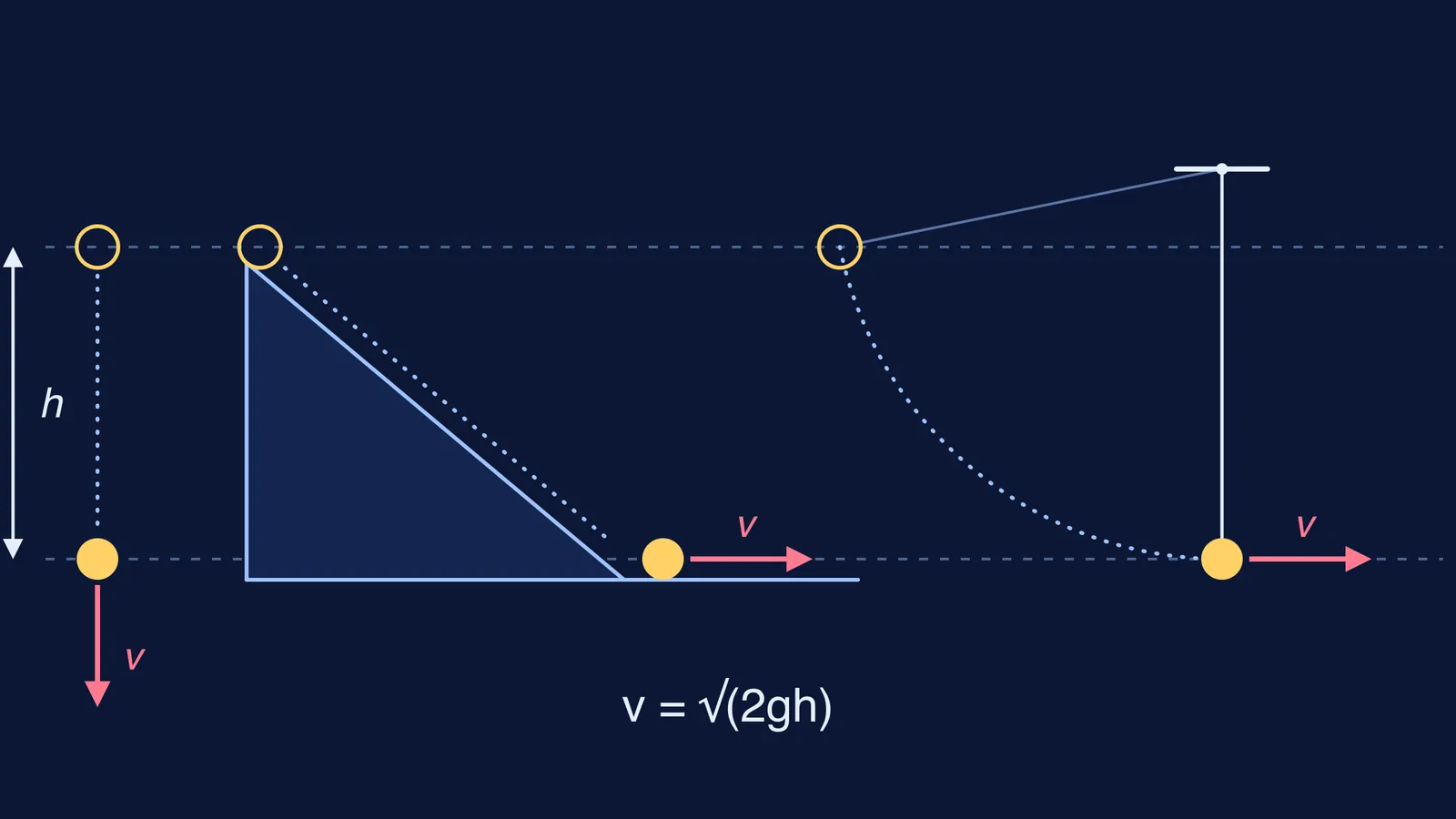
Start: a ball is dropped from 5 m. Speed at the bottom? ½mv² = mgh, so v = √(2gh) = √98 ≈ 9.9 m/s.
Change the path: the ball slides down a frictionless ramp of the same height, at any angle. Same answer. Notice that the angle does not matter.
Change the object: a pendulum bob is released 0.8 m above its lowest point. At the bottom, v = √(2 × 9.8 × 0.8) ≈ 4.0 m/s. The string does no work because it pulls at right angles to the motion.
Change the unknown: a skateboarder reaches 6 m/s at the bottom of a smooth half-pipe. How high can they rise? h = v²/2g ≈ 1.8 m.
Change the chapter: an electron is accelerated from rest through 100 V. Its potential energy eV becomes ½mv², giving about 5.9 × 10⁶ m/s. Same structure, different topic.
Break it on purpose: add friction to the ramp. Mechanical energy is no longer conserved, so you need the work–energy theorem. Knowing where a principle stops is part of knowing it.
Then put two of the variants side by side. A meta-analysis of 57 experiments by Louis Alfieri and colleagues found that comparing cases usually led to more learning than other ways of studying them, such as one case alone (d = 0.50). Asking learners to find the similarities between cases was linked with larger gains.
What does a weekly transfer routine look like?
Spend 20 minutes once a week on each subject:
Pick one problem you solved correctly this week.
Write its principle in one line, with no numbers.
Make three variants: change the path or object, change the unknown, change the chapter.
Solve them, then write what stayed the same.
In your next practice set, mix problems from different chapters.
If you keep choosing the wrong method, the Fermi Problem Library has worked problems with a step-by-step solver that explains the reasoning rather than printing an answer. If the principle itself is shaky, the Fermi Concept Library gives each concept its own lesson. If you do not know where to start, Fermi's AI tutor works out what you already know and builds a plan for the session.
Parents can help with one question. Instead of "How many problems did you do?", ask "Which idea was that question testing, and where else have you seen it?"