

On this page
Ask a room of students why the Moon changes shape and someone will say Earth's shadow. In a study of 78 trainee primary teachers, Trundle, Atwood and Christopher (2002) found that, without instruction, most were likely to hold alternative ideas about what causes the phases; those taught through inquiry-based lessons were much more likely to reach the scientific explanation afterwards. A 2026 interview study of 25 final-year high-school students found a wide variety of explanations, some not described in earlier research.
The fix is not a better diagram to memorise. It is to move the Moon yourself and predict before you look.
What actually causes the Moon's phases?
The Moon makes no light of its own; moonlight is reflected sunlight, as NASA's Moon phases guide explains.
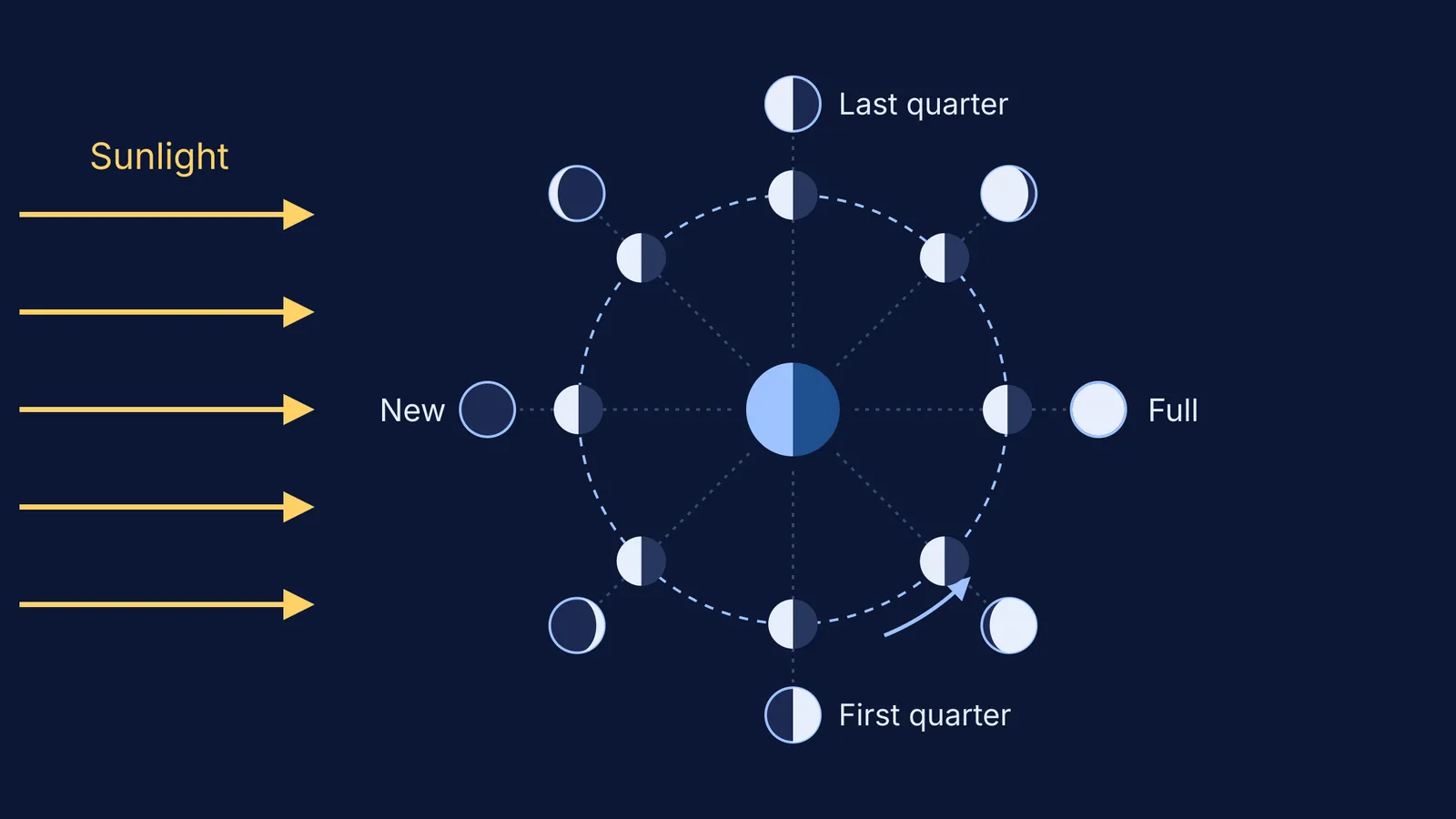
The Sun always lights half of the Moon, and the phase is how much of that lit half faces Earth at a given point in the Moon's orbit (NASA).
The full cycle, new moon to new moon, takes about 29.5 days (NASA).
So a phase is a viewing angle, not a cover: nothing blocks the light.
How do you set up a Moon phase simulation?
You can use an on-screen orbit model or a lamp and a ball. For the home version:
Put a bright lamp at one end of a dark room. That is the Sun.
Your head is Earth. Hold a ball at arm's length, a little above head height. That is the Moon.
Turn slowly to your left, so the ball moves anticlockwise around you, as the Moon does seen from above the North Pole.
Stop at each of eight positions, predict the shape first, then look.
Which phase do you see from each position, and when does it rise?
Measure the Moon's angle from the Sun, going anticlockwise. Earth turns 360 degrees in 24 hours, which is 15 degrees per hour, so a simple model rule is: the Moon rises about (angle ÷ 15) hours after sunrise. With sunrise at 6 am:
0 degrees, new moon: no lit side faces you; rises with the Sun, about 6 am.
45 degrees, waxing crescent: thin sliver; rises about 9 am, after the Sun is up.
90 degrees, first quarter: half lit; rises about noon.
135 degrees, waxing gibbous: more than half; rises about 3 pm.
180 degrees, full moon: whole face lit; rises about 6 pm, at sunset.
225 degrees, waning gibbous: rises about 9 pm.
270 degrees, last quarter: rises about midnight.
315 degrees, waning crescent: rises about 3 am, before sunrise.
NASA's phase guide agrees: the full moon rises at sunset, the first quarter around midday, the waxing crescent after sunrise and the waning crescent before it. Real rise times shift with latitude and season, so treat these as rough guides.
Worked example: how much later does the Moon rise each day? It gains 360 degrees on the Sun in about 29.5 days, so about 12.2 degrees per day. At 15 degrees per hour, 12.2 degrees takes about 0.81 hours, or roughly 49 minutes. So a Moon rising at 8 pm tonight rises at about 8:50 pm tomorrow.
Why is it not Earth's shadow?
Test the shadow idea in your simulation. Earth's shadow always points away from the Sun, so it can reach the Moon only when Earth sits between them: the full moon position.
At a crescent, the Moon is on the Sun's side of Earth. The shadow points the other way.
A first-quarter Moon rises around midday, so it is often visible in the afternoon sky, 90 degrees from the Sun, where no shadow can reach it. (Our piece on why you can see the Moon during the day goes further.)
When Earth's shadow really does fall on the Moon, that is a lunar eclipse, and it happens only at full moon, as NASA's eclipse page explains.
Why no eclipse every full moon? The Moon's orbit is tilted about 5 degrees to the plane of Earth's orbit, so it usually passes above or below the shadow (NASA). When it does pass through, see why the Moon turns red in a total lunar eclipse.
How can you check your predictions this week?
Find the date of the last new moon, Amavasya, on a calendar or panchang.
Count the days since then and multiply by about 12 degrees (360 degrees spread over NASA's 29.5-day cycle) to get the Moon's angle from the Sun.
Write down the shape and the rise time your rule predicts.
Look at sunset, and again the next evening. Note how far east the Moon has moved.
The thin crescent just after new moon is hardest to spot, which is why the date of Eid depends on sighting the Moon.
If the geometry still feels slippery, the Fermi Simulation Lab has interactive simulations for ideas that are easier to see than to read. Fermi's AI tutor can draw the figure, run the simulation and check your understanding as it goes, deciding whether to explain, ask or show.
Tonight, predict the phase and its rise time before you look up. Then go and check.


