

On this page
When you look up at the night sky during a total lunar eclipse, the Moon does not disappear completely. Instead, it takes on a striking, dark red colour. This phenomenon, often called a "blood moon", is a spectacular display of optics playing out on a cosmic scale.
What happens during a total lunar eclipse?
A total lunar eclipse occurs when the Earth passes directly between the Sun and the Moon. For this to happen, the Moon must be in its full phase. However, the Moon's orbit is tilted about 5 degrees relative to Earth's orbit, which is why eclipses do not happen every month (NASA Science). Most of the time, the full moon passes slightly above or below Earth's shadow. When the three bodies align perfectly, Earth casts a shadow, called the umbra, across the lunar surface.
Even though Earth blocks the direct rays of the Sun, the Moon remains visible and takes on a reddish glow. The key to this transformation lies not in the vacuum of space, but in the thin layer of gas surrounding our planet. If the Earth had no atmosphere, the Moon would go completely black during an eclipse.
Why does the moon turn red during a total lunar eclipse?
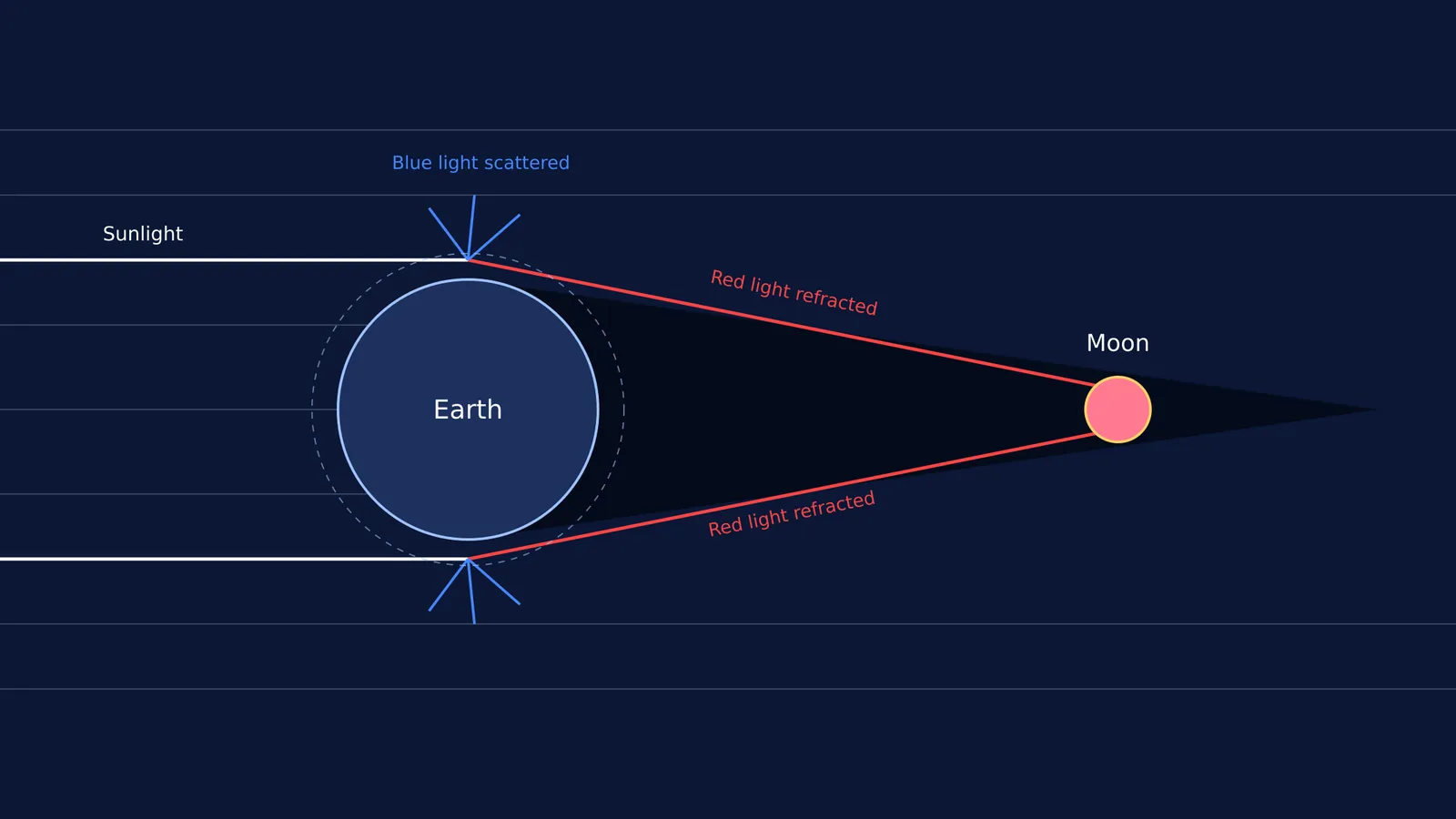
The red colour is the result of Earth's atmosphere acting as a giant lens that both filters and bends sunlight.
First, as sunlight grazes the edges of Earth, it passes through hundreds of kilometres of the atmosphere. Sunlight contains all the colours of the visible spectrum, but these colours have different wavelengths. Short wavelengths, such as blue and violet, hit nitrogen and oxygen molecules in the air and scatter in all directions. This is the same Rayleigh scattering that explains dispersion of white light by a glass prism and makes the daytime sky look blue. Because the intensity of scattering depends on the inverse fourth power of the wavelength, blue light scatters much more strongly than red light (Wikipedia). The thicker the slice of atmosphere the light passes through, the more of the blue light is lost to scattering.
Second, the longer wavelengths—red, orange and yellow—pass through the atmosphere mostly uninterrupted. As this red light travels through the air, it is refracted, or bent, inward toward the Earth's shadow. The light reaches the Moon, illuminating it with the combined light of every sunrise and sunset happening on Earth at that moment.
How bright will the eclipse be?
Not every lunar eclipse looks exactly the same. The exact shade of the Moon depends on how much dust, water and pollution is in Earth's atmosphere at the time. A clear atmosphere produces a bright copper-red Moon, while volcanic ash or heavy cloud cover can make the Moon appear very dark brown or almost invisible.
Astronomers use a framework called the Danjon Scale to measure this brightness. Created by French astronomer André-Louis Danjon, the 5-point scale gives observers a standardised way to record what they see (NASA Eclipse Web Site):
L = 0 (Very dark): The Moon is almost invisible, especially at mid-totality.
L = 1 (Dark): The Moon is grey or brownish; surface details are hard to distinguish.
L = 2 (Deep red or rust): The centre is very dark, but the outer edge of the shadow is relatively bright.
L = 3 (Brick-red): The shadow usually has a bright or yellow rim.
L = 4 (Bright copper-red or orange): The shadow has a very bright, bluish rim.
If you are observing an eclipse, use this scale near the middle of totality. Record the L-value and the time, noting any differences in colour across the Moon's face.
Seeing the science with Fermi
Optics concepts like refraction, wavelength and scattering are much easier to understand when you can see the light paths in action. When you bring a tricky optics problem, Fermi's AI tutor can work out what you already know, build a plan for the session, and teach through it — writing on a board, drawing the figure, running the simulation, and checking understanding as it goes.
For the mechanics of light you want to experiment with yourself, the Fermi Simulation Lab has interactive simulations for the ideas that are easier to see than to read. Whether you are prepping for a physics exam or just looking up at the sky, learning the science behind the spectacle changes how you see the world.


