On this page
You type a freezing-point question into a chatbot and get a neat answer in seconds. But the key decision in a colligative-properties problem comes before any arithmetic: choosing the van 't Hoff factor, i. If the AI picks i silently, you will not see the mistake.
What is the van 't Hoff factor, and why find it first?
The van 't Hoff factor i is the total number of moles of particles after association or dissociation divided by the number of moles before it, as defined in the NCERT Class 12 Chemistry unit on solutions. Every colligative formula in that unit carries it: ΔTb = i Kb m, ΔTf = i Kf m, and Π = i n₂RT/V.
NCERT spells out both directions. When a solute dissociates, i is greater than 1; for aqueous KCl it is close to 2. When a solute associates, i is less than 1; for ethanoic acid in benzene, which dimerises through hydrogen bonding, it is nearly 0.5.
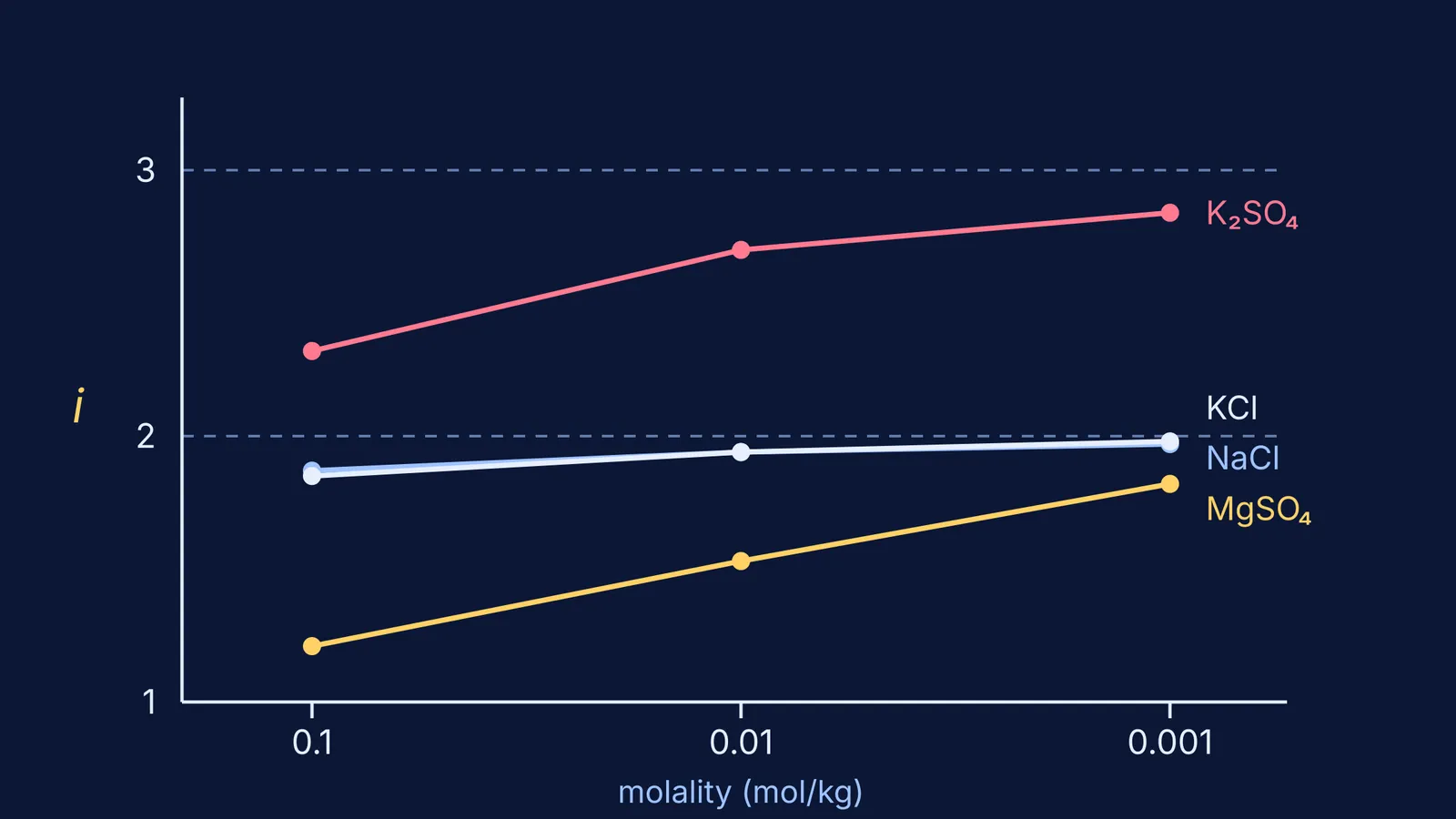
Real salts also fall short of the ideal number. In NCERT's Table 1.4, MgSO₄ has i = 1.21 at 0.1 m, 1.53 at 0.01 m and 1.82 at 0.001 m, against 2.00 for complete dissociation. The chart above plots that table. So i is a chemistry decision, not a number to plug in.
How do you prompt AI to find i before the formula?
There is a second reason to slow the AI down. In a field experiment with nearly a thousand high-school maths students, Bastani and colleagues reported in PNAS that open GPT-4 access raised practice grades by 48%, but once access was taken away those students scored 17% lower than students who never had it. A version with prompts designed to safeguard learning largely removed that harm. The lesson: make the AI show its decisions, and make yourself check them.
Paste this before your question:
The "stop there" line matters. It turns one number you have to trust into three claims you can check.
Worked example: where does a wrong i hide?
Take 0.01 m aqueous MgSO₄, with Kf for water = 1.86 K kg mol⁻¹, the value used in Example 1.13 of the NCERT solutions unit.
If the AI assumes complete dissociation, i = 2 and ΔTf = 2 × 1.86 × 0.01 = 0.0372 K.
If you use NCERT's tabulated i = 1.53 at 0.01 m, ΔTf = 1.53 × 1.86 × 0.01 ≈ 0.0285 K.
Both are right, for different questions, so good questions settle it: NCERT's exercises say "assuming that it is completely dissociated" for K₂SO₄ or give i = 2.47 for CaCl₂. If a question does neither, ask the AI which assumption it made and why.
Association is the bigger trap. In NCERT's Example 1.12, 2 g of benzoic acid in 25 g of benzene lowers the freezing point by 1.62 K (Kf = 4.9 K kg mol⁻¹). Treat i as 1 and you get a molar mass of 241.98 g mol⁻¹, about twice the true 122 g mol⁻¹. That doubled value is what NCERT calls an abnormal molar mass, and the book works back from it to a degree of association of 99.2%.
How do you check the AI's molality and units?
Once the AI has stated i, run this checklist, based on the NCERT solutions unit.
Molality, not molarity. Molality is moles of solute per kilogram of solvent. Check that the AI divided by the solvent mass, not the solution volume.
Grams to kilograms. 25 g of benzene is 0.025 kg. A missed factor of 1000 is an easy slip.
Units cancel. K kg mol⁻¹ × mol kg⁻¹ should leave K. If anything else is left, a step is wrong.
Direction of i. Salts in water: i above 1. Ethanoic or benzoic acid in benzene: i below 1. A solute that neither dissociates nor associates: i = 1.
Weak electrolytes. For acetic acid in water, NCERT's Example 1.13 finds i = 1.041, so do not let the AI use 2.
Size of the answer. At 0.01 m in water, ΔTf is a few hundredths of a kelvin, as the example above shows. An answer in tens of kelvin means a slip.
What if the AI and your textbook disagree?
Trust the textbook's definitions, then find where the answers split: usually i, the solvent mass or a unit. If you keep reaching for the wrong method, the Fermi Problem Library has worked problems with a step-by-step solver that explains the reasoning rather than printing an answer. If the gap is the idea itself, Fermi's AI tutor works out what you already know, builds a plan for the session and checks understanding as it goes.
Next time you open a colligative question, write down i and your reason before anything else.