

On this page
If you are 14 or 15 and want to start coding, the choice usually comes down to two languages. Both are free, both run on an ordinary laptop, and the core ideas carry over: once variables, loops and functions make sense in one, picking up the second is far quicker than starting from zero. So the useful question is not which language is better, but which one gets you to a working program soonest and fits what you want to build.
What are Python and JavaScript actually used for?
Python is free to download and use, and its syntax makes programs easier to read, according to the Python wiki's beginner overview. It also has an interactive mode, so you can type one line and see the result straight away.
The 2025 Stack Overflow Developer Survey reports that Python's use rose by 7 percentage points from 2024 to 2025, and links that rise to its role as a go-to language for AI, data science and back-end development.
JavaScript is the language that makes web pages interactive, the third layer on top of HTML (structure) and CSS (style), as MDN's introduction to JavaScript explains. Every web browser can already run it, so you can start without installing anything.
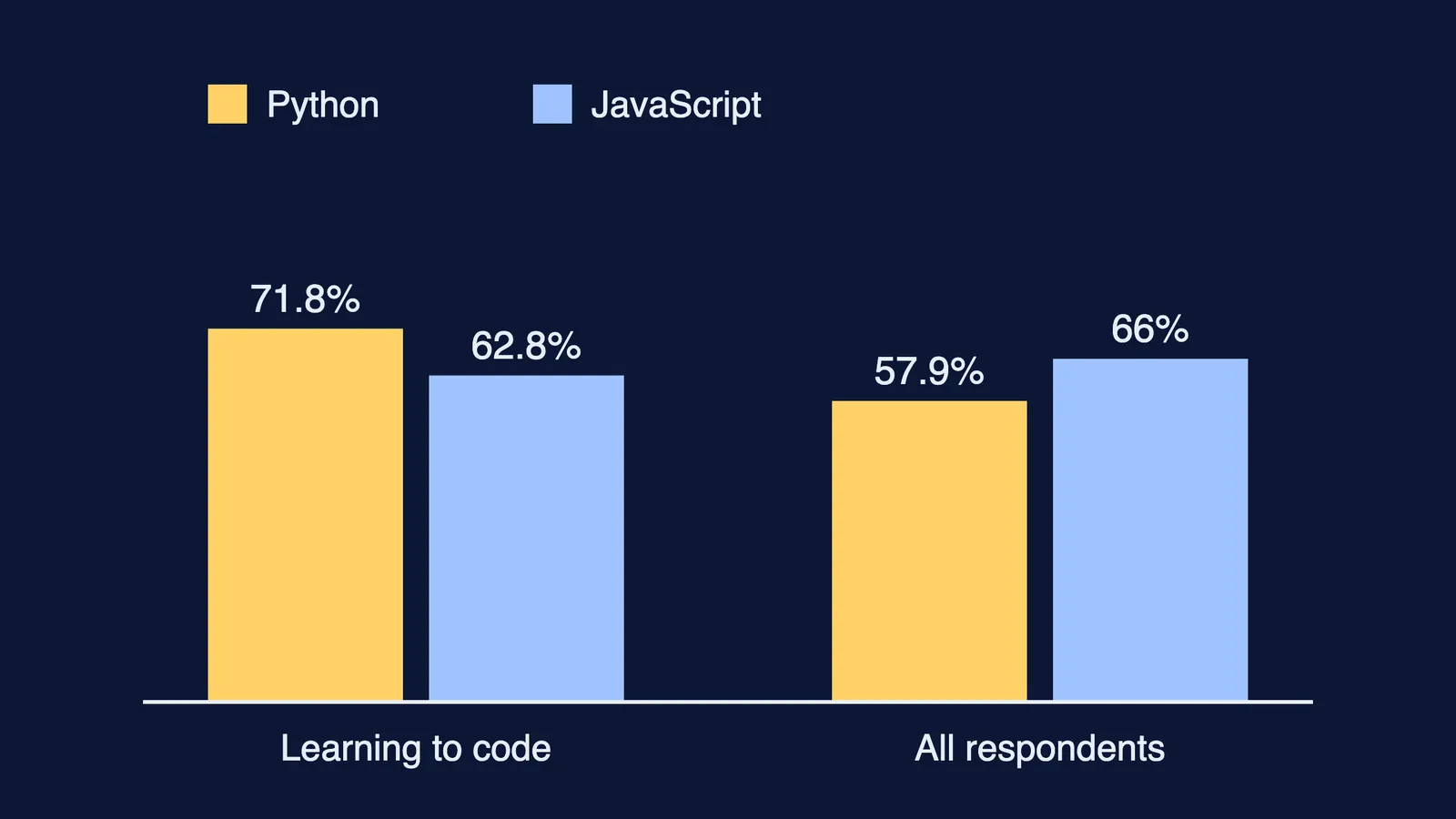
In the same Stack Overflow survey, 66% of all respondents reported using JavaScript and 57.9% reported using Python. Both are widely used, so neither choice is a dead end.
Should I learn Python or JavaScript first?
Among survey respondents who were learning to code, 71.8% used Python and 62.8% used JavaScript, according to the 2025 Stack Overflow Developer Survey. Learners in that survey lean towards Python, but your own goal matters more than the crowd. Use this quick check:
Pick Python if you take, or plan to take, CBSE Computer Science in Class 11. The CBSE Class XI Computer Science syllabus for 2026-27 teaches programming in Python, and its Computational Thinking and Programming unit carries 45 of the 70 theory marks.
Pick Python if you enjoy maths, science or data and want to calculate, graph or automate things.
Pick JavaScript if you want to build things you can show friends on their phones: a quiz page, a browser game, a personal website.
Pick JavaScript if you cannot install software on the computer you use, because it runs in the browser you already have.
What does a four-week start look like?
Aim for about half an hour on most school days. The weekly goal is a program that works, not hours logged.
Week 1: run and change. In Python, open IDLE and type print("Namaste"); in JavaScript, open your browser's developer console and type console.log("Namaste"). Then learn variables and input. Goal: a program that asks your name and birth year and tells you the year you turn 18.
Week 2: decisions and loops. Learn if and else, then loops. Goal: a multiplication-table printer and a number-guessing game. When something breaks, try a five-step debugging routine for beginners before you ask anyone.
Week 3: lists and functions. Python calls them lists; JavaScript calls them arrays. Goal: a marks tracker that stores your last five test scores and prints the average and the highest.
Week 4: one small project of your own. For example, a quiz on chemical symbols that keeps score. In Python it runs in the terminal; in JavaScript you can turn it into a web page with a button.
If an idea such as a loop or a function does not click, the Fermi Concept Library has a lesson for each concept in physics, chemistry, biology, mathematics and computing. If you are not sure where to begin on a given day, Fermi's AI tutor can work out what you already know and build a plan for the session.
How can parents help without knowing how to code?
You do not need to judge the code. Once a week, ask three questions: "Show me what you made this week." "What broke, and how did you fix it?" "What will you build next week?" A child who can answer all three is making progress.
Both languages are free, so there is no need to pay for anything in the first month. If a paid course or bootcamp comes up later, read how to check whether a coding bootcamp suits a school student first.
What comes after the first month?
Whichever language you chose, keep building small projects and add one new idea at a time. If you started with Python, harder ideas come next, such as recursion in Python, with the base case and the call stack. If you started with JavaScript and plan to take CBSE Computer Science, learning some Python before Class 11 can make the course easier.
Pick one language today, open it, and make it print your name.


