On this page
Ask a chatbot to explain Ohm's law in Hindi or Tamil and you will usually get fluent text back in seconds. Fluent is not the same as correct. Here is how it works and how to check it.
How does AI translate between Indian languages?
Modern translation AI is a neural network that learns from parallel text: the same sentence written in two languages. From a huge number of example pairs, it learns which words and phrases line up.
Most of today's systems are built on the Transformer, a design introduced in 2017 in the paper Attention Is All You Need and first tested on translation. Its key idea is attention: as the model writes each output word, it looks back across the whole input sentence and weighs which words matter for that choice. It then writes the translation one piece at a time, each time choosing a likely next piece given everything so far. Inside, words become lists of numbers that capture meaning, which we explain in how AI finds words with similar meaning.
For Indian languages, the hard part has been data. The team behind IndicTrans2 describes it as the first model to support all 22 scheduled Indian languages. Its released corpus, BPCC, holds 230 million sentence pairs, including 644,000 translated by hand. At a global scale, the NLLB Team reported a single system covering 200 languages in Nature in 2024.
General chatbots translate the same basic way: they predict likely text. That is why a wrong translation can read just as smoothly as a right one, a pattern we cover in why AI sounds confident when it is wrong.
Why do science terms in Hindi or Tamil come out wrong?
Three common problems cause these slips.
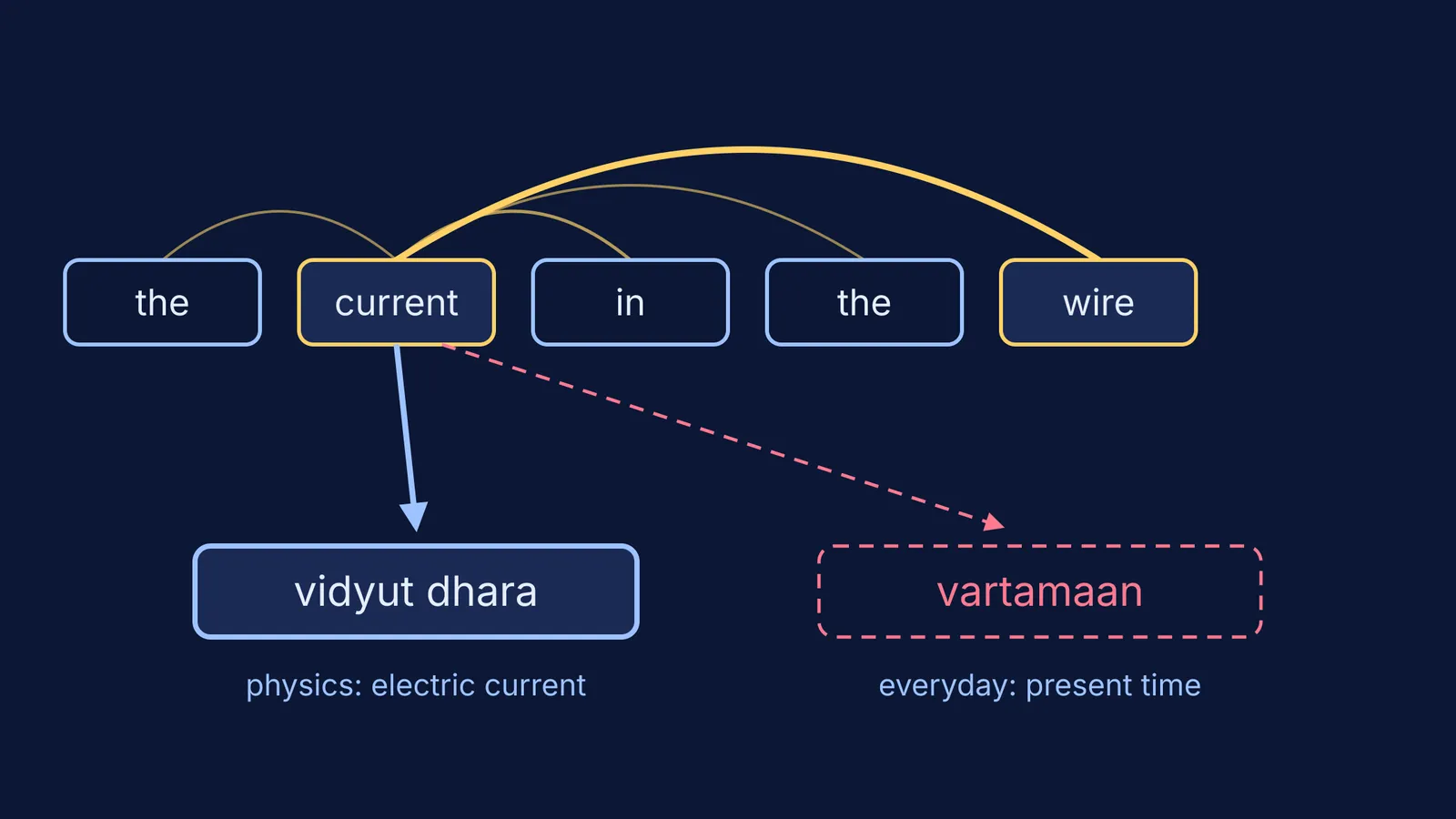
Words with two lives. "Current", "power", "work", "cell" and "field" each have an everyday meaning and a science meaning. The model picks one from context, and a short question or a single diagram label gives it little context to go on.
Terms the model has rarely seen. A model can only learn a term from examples. If the textbook word for a concept seldom appears in its training text, it may invent a word, spell out the English in Tamil or Devanagari script, or use a near-synonym that means something slightly different.
Standard terms exist, but the model may not use them. India has an official body for this: the Commission for Scientific and Technical Terminology "works to evolve technical terminology in all Indian Languages", according to a government reply published by PIB. At a national workshop on scientific terminology at ISI Kolkata, ISI's Dean of Studies, Prof. Biswabrata Pradhan, pointed out that direct translations often distort meanings, PIB reported.
A worked example: one word, two meanings
Take the English sentence "The current in the wire is 0.5 A."
NCERT's Hindi Class 10 science textbook calls electric current विद्युत धारा and defines it as the rate of flow of electric charge (NCERT, chapter 11, विद्युत). But Hindi also has वर्तमान, which means "current" in the sense of "present" or "present-day" (Wiktionary). If the model gives too little weight to "wire", it can choose वर्तमान, and the sentence now says "the present in the wire is 0.5 A". The number and the unit survive, so the error is easy to miss.
How do you check a translated science answer?
Run these five steps on any answer you plan to revise from.
Circle the key terms. Pick out the three to five science words the answer depends on.
Match them to your textbook. Find each term in your own Hindi, Tamil or other-medium textbook, or the glossary at the back. Your board's book uses the terms your teachers and exam papers are likely to use.
Translate it back. Paste the translated answer into a different tool and translate it into English. If "electric current" comes back as "present", you have found the slip. This catches big errors, not every error.
Check what should not change. Compare every number, unit, formula and sign with the original.
Ask for a term list. Get the tool to list each science term it used beside its English equivalent.
A prompt to copy for step 5:
"Explain this in Hindi using the terms from the NCERT Hindi-medium textbook. At the end, list every science term you used with its English equivalent."
What if the term checks out but the idea still does not make sense?
Then the gap is the concept, not the translation. The Fermi Concept Library has a lesson for every concept in physics, chemistry, biology, mathematics and computing. Fermi's AI tutor notices where you are stuck and decides whether to explain, ask or show, so you work through the idea instead of just reading another translation.
For more on learning science in your first language with AI, read our guide to studying with AI in your mother tongue.