

On this page
Type "why does a ball thrown up slow down?" into an AI search over your physics notes, and it may pull up your note titled "Projectile motion", even though the two share almost no words. That is the work of embeddings, and once you see how they work, you will also see why the note it finds is not always the one you need.
What is an embedding in AI?
An embedding is "a vector representation of data in embedding space", according to Google's Machine Learning Crash Course. A vector here is simply a list of numbers. Each word, sentence or note gets its own list, and that list works like coordinates: it places the text as a point in space.
The space has far more than three directions. For word embeddings, the number of dimensions "is often 256, 512, or 1024", the same Google course says. The key idea is that the distance between two points "can be interpreted as a measure of relative similarity" between the two items.
How does AI understand similar meaning of words?
It does not look words up in a dictionary. It learns from huge amounts of text which words turn up in similar company, and gives those words similar numbers. In 2013, Tomas Mikolov and colleagues at Google showed this could be done cheaply: their word2vec method learned high-quality word vectors from a 1.6 billion word data set in less than a day (Mikolov et al., 2013).
The vectors even captured relationships. In a 2013 paper by Mikolov, Yih and Zweig, the vector for "King" minus "Man" plus "Woman" landed very close to "Queen". The same paper is a useful reality check: on its syntactic analogy questions, the method answered almost 40% correctly. Useful patterns, then, but far from perfect.
How does AI measure that two notes are close?
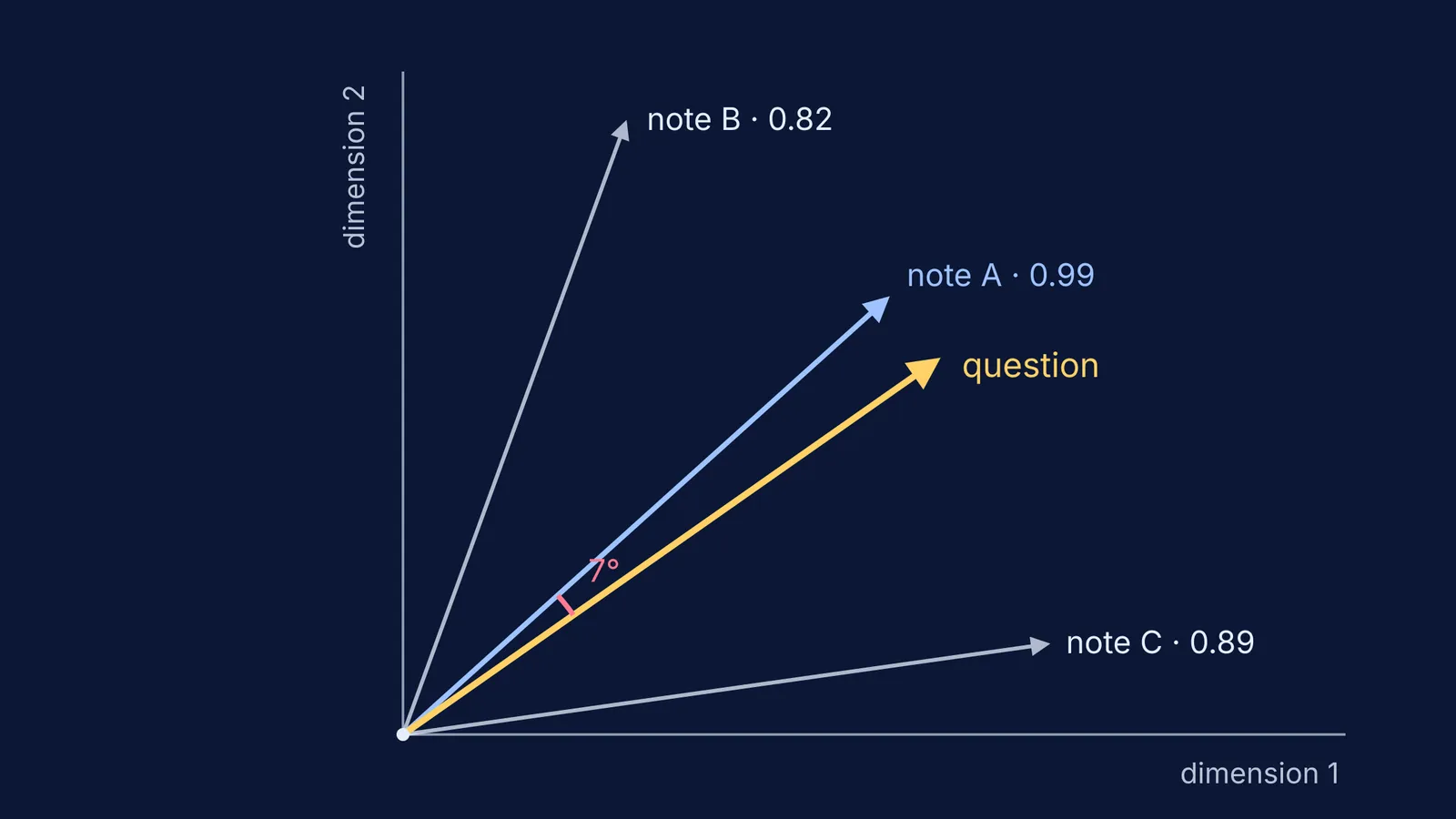
A common measure is cosine similarity: the cosine of the angle between two vectors, worked out as a·b divided by |a| times |b| (Google's similarity measures guide). Arrows pointing the same way score 1; the wider the angle between them, the lower the score. It is the same dot product you meet in JEE vector algebra.
Here is a worked example with toy numbers. Real embeddings are learned, and their dimensions have no names. To see the arithmetic, pretend there are three: motion, gravity and sport.
Your question, "why does a ball thrown up slow down?": (2, 2, 1). Its length is 3.
Note A, "projectile motion: gravity reduces upward velocity": (2, 2, 0). Dot product 8, length 2.83, cosine 8 ÷ (3 × 2.83) = 0.94.
Note B, "cricket ball swing, PE class": (1, 0, 2). Dot product 4, length 2.24, cosine 0.60.
Note C, "Newton's law of gravitation": (0, 2, 0). Dot product 4, length 2, cosine 0.67.
Note A wins, and it should. Notice that Note B shares the word "ball" with your question but still ranks last: the search is matching meaning, not spelling.
Why does AI find related notes but not the right answer?
Because close in meaning is not the same as correct. Three things go wrong often.
Small words that flip the meaning. Allyson Ettinger's 2020 study of the BERT language model found "clear insensitivity to the contextual impacts of negation" (Ettinger, 2020). Her study tested BERT's word predictions rather than search, but it is a reason for caution: a question like "Which of these is NOT a vector quantity?" may land right next to your notes on vector quantities.
Related is not the same as answering. Many AI tools first fetch the nearest passages, then write an answer from them. The research that named this approach, retrieval-augmented generation, paired a language model with "a dense vector index of Wikipedia" (Lewis et al., 2020). The answer can only be as good as the passages it was handed.
Your notes can be wrong. If you copied a sign error, the search will find it faithfully.
That is why it pays to check an AI's physics solution step by step and to check references when AI cites a source.
How should you use AI search on your notes?
A five-point check before you trust what comes back:
Ask in a full sentence that names the concept, such as "work done by friction on an incline", not "friction q".
Open the note it found and read it yourself; do not stop at the summary.
Rewrite NOT and EXCEPT questions in positive form, then search again.
Check formulas, units and signs against your NCERT textbook.
If the search keeps pulling the wrong chapter, you may have a concept gap rather than a search problem.
Search can find a note near your question, but it cannot see whether you understood it. Fermi's AI tutor holds a line of reasoning across a session, notices where you are stuck and checks understanding as it goes. For gaps, the Fermi Concept Library gives each concept in physics, chemistry, biology, mathematics and computing its own lesson.
Want the bigger picture of what happens after the search? Read our explainer on how large language models work, explained simply for students.


