On this page
Fill one glass with water and another with cooking oil. Lower a clear glass rod, or a small Pyrex test tube, into each. Before you look, write down a prediction for each: easy to see, faint, or gone?
Many people expect both to look the same. They don't. In water the rod keeps its outline; in many cooking oils a Pyrex rod's edges fade until it is close to invisible. The difference is one number per material: the refractive index.
Why does a glass rod disappear in oil?
The refractive index tells you how strongly a material slows and bends light. You see a clear object only because light bends or partly reflects where it crosses from one index to another. Remove the difference and the boundary sends no signal to your eye.
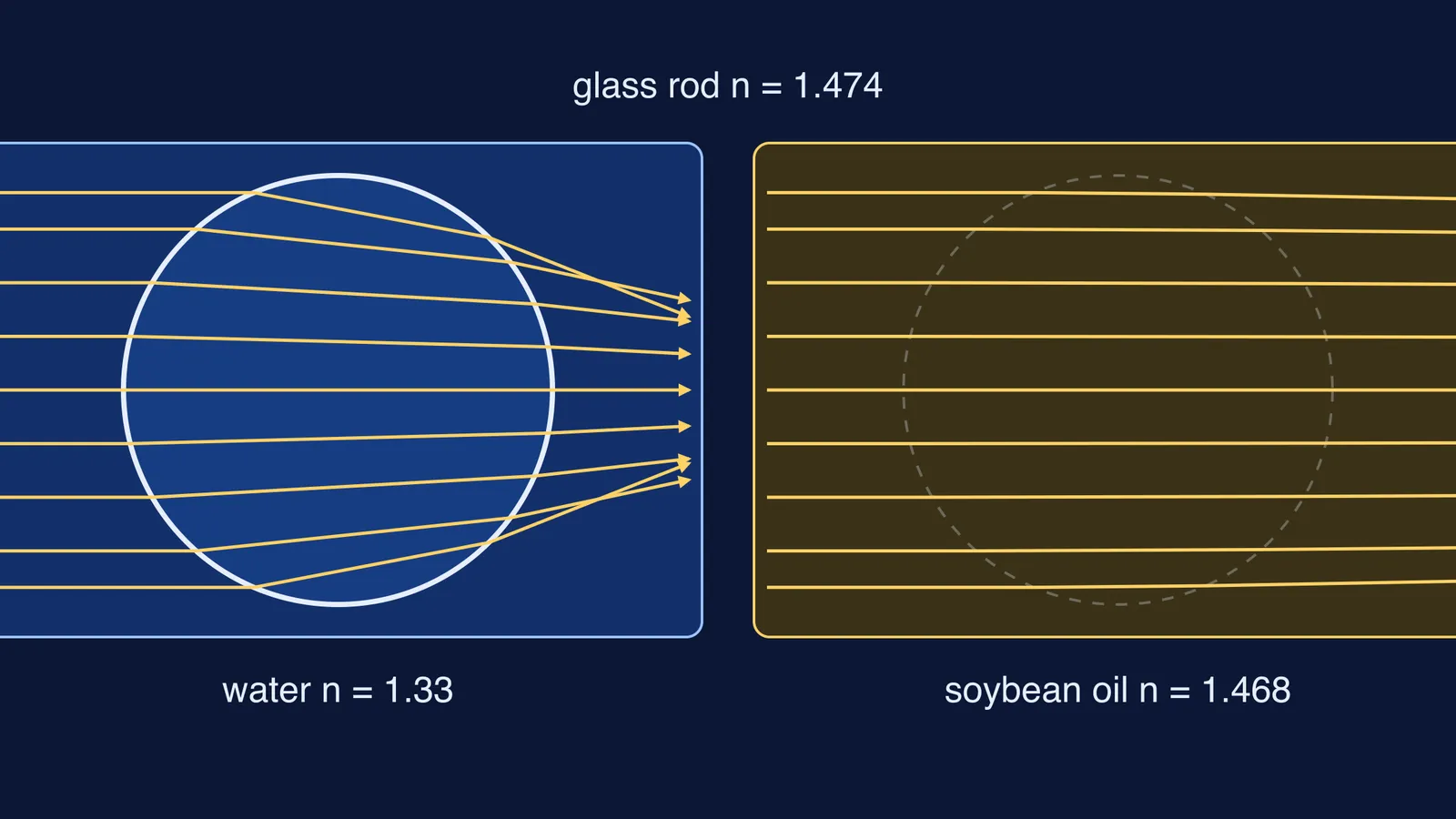
Pyrex 7740 borosilicate glass has a refractive index of 1.474 at 588 nm, according to a glass supplier's product page for Pyrex 7740. The Codex Alimentarius standard for named vegetable oils, from FAO and WHO, lists crude soybean oil at 1.466 to 1.470, sunflower oil at 1.461 to 1.468 and mustard oil at 1.461 to 1.469, all measured at 40°C. Water at 20°C has an index of 1.33, according to HyperPhysics' table of refractive indices.
So glass and oil differ by about 0.01 or less, while glass and water differ by about 0.14. Texas A&M's chemistry road-show notes explain the rest: when an object and the liquid around it have the same index, light neither reflects nor refracts at the interface, and the object appears invisible.
How much light does a glass rod reflect in water and in oil?
You can check your prediction with one formula. For light hitting a boundary head-on, the fraction reflected is R = ((n1 − n2)/(n1 + n2))², from the Fresnel equations, which note that ordinary glass in air reflects about 4% at each surface.
Worked example, using the Pyrex value of 1.474:
Rod in air (n = 1.00): (0.474/2.474)² ≈ 0.037, so about 3.7% of the light bounces off each surface. Clearly visible.
Rod in water (n = 1.33): (0.144/2.804)² ≈ 0.0026, about 0.26%. Fainter, but the edges still glint.
Rod in soybean oil (n = 1.468, the middle of the Codex range): (0.006/2.942)² ≈ 0.000004, about 0.0004%. That is roughly 600 times less than in water.
Reflection is half the story; bending is the other half. Snell's law says n1 sin θ1 = n2 sin θ2. Take a ray in the liquid striking the rod at 60° to the normal. Coming from water, it continues inside the glass at about 51.4°, turning by 8.6°. Coming from soybean oil, it continues at about 59.6°, turning by less than half a degree. The diagram at the top traces this through a round rod: in water the rays converge, in oil they pass almost straight.
Why can I still see my glass rod in oil?
If your rod stays faintly visible, check these:
It may not be borosilicate. Typical crown glass has an index of 1.52 on HyperPhysics' table. In soybean oil it reflects about 0.03%, far less than in water but enough to show an outline.
The oil may be a poorer match. Coconut oil is listed at 1.448 to 1.450 in the Codex table. Temperature matters too: the Codex values are for 40°C, and the University of Iowa demo notes list vegetable oil at 1.47 at 50°C.
Markings, scratches or bubbles. Printed scales, cloudy films and trapped air have their own indices, so they stay visible however well the glass matches.
Try glycerine. HyperPhysics lists glycerine at 1.473, almost exactly Pyrex's value.
How do you turn this into a prediction experiment?
Write three predictions (visible, faint or gone) for the rod in air, water and oil.
Look at each against a plain background, then against a striped one. Stripes show bending as a kink in the lines.
Work out R for each using the indices above.
Where a result surprised you, write one sentence explaining which index gap caused it.
Swap in an ordinary glass object and predict again before you look.
The Texas A&M demo simply uses vegetable oil, with no heating step in its method. Wipe the rod with soap and water afterwards.
Refraction is one of those ideas that is easier to see than to read. The Fermi Simulation Lab has interactive simulations built for exactly that kind of idea, and the Fermi Problem Library has worked problems with a step-by-step solver that explains the reasoning rather than printing an answer.
To go further, try predicting every ray in a Snell's law simulation, practise calculating relative refractive index without flipping it, or read how Katharine Burr Blodgett made glass that stopped reflecting.