On this page
A free chatbot can explain photosynthesis and quiz you on Newton's laws. So when an app asks for a monthly fee, ask what you would get that you don't already have. Usually it is higher limits, extra features, or material built around your syllabus. Whether that is worth money depends on how you study.
What does a paid AI study tool add over a free chatbot?
Higher limits. Free tiers usually ration the expensive parts, such as the strongest model, file uploads and memory. India's ChatGPT Go plan is a clear example: MediaNama reported that it adds extended access to GPT-5, image generation, file uploads, advanced data analysis and longer memory over the free plan. It launched at Rs 399 a month in August 2025 and was offered free for 12 months to users in India who claimed it from 4 November 2025; OpenAI did not say how long that offer would stay open.
Tutoring modes, often in free plans. A tutoring-style mode is not only a premium extra. OpenAI's study mode, which uses Socratic questions, hints and quizzes instead of handing over answers, launched on 31 July 2025 for logged-in Free, Plus, Pro and Team users, according to FutureFive's report of the launch. Google describes Gemini's Guided Learning as a mode "guiding you with questions and step-by-step support instead of just giving you the answer" (Google, August 2025).
Curriculum alignment. This is where specialised paid tools say they differ: lessons and practice sets mapped to Class 11 physics or a JEE Main chapter list, not whatever the chatbot decides to cover. It matters because syllabi change. CBSE publishes a fresh curriculum for the academic year 2026-27, and NCERT keeps a list of rationalised textbook content showing what was removed from its books. A tool that says it is "aligned" should match the current version.
Does paying make an AI tutor teach better?
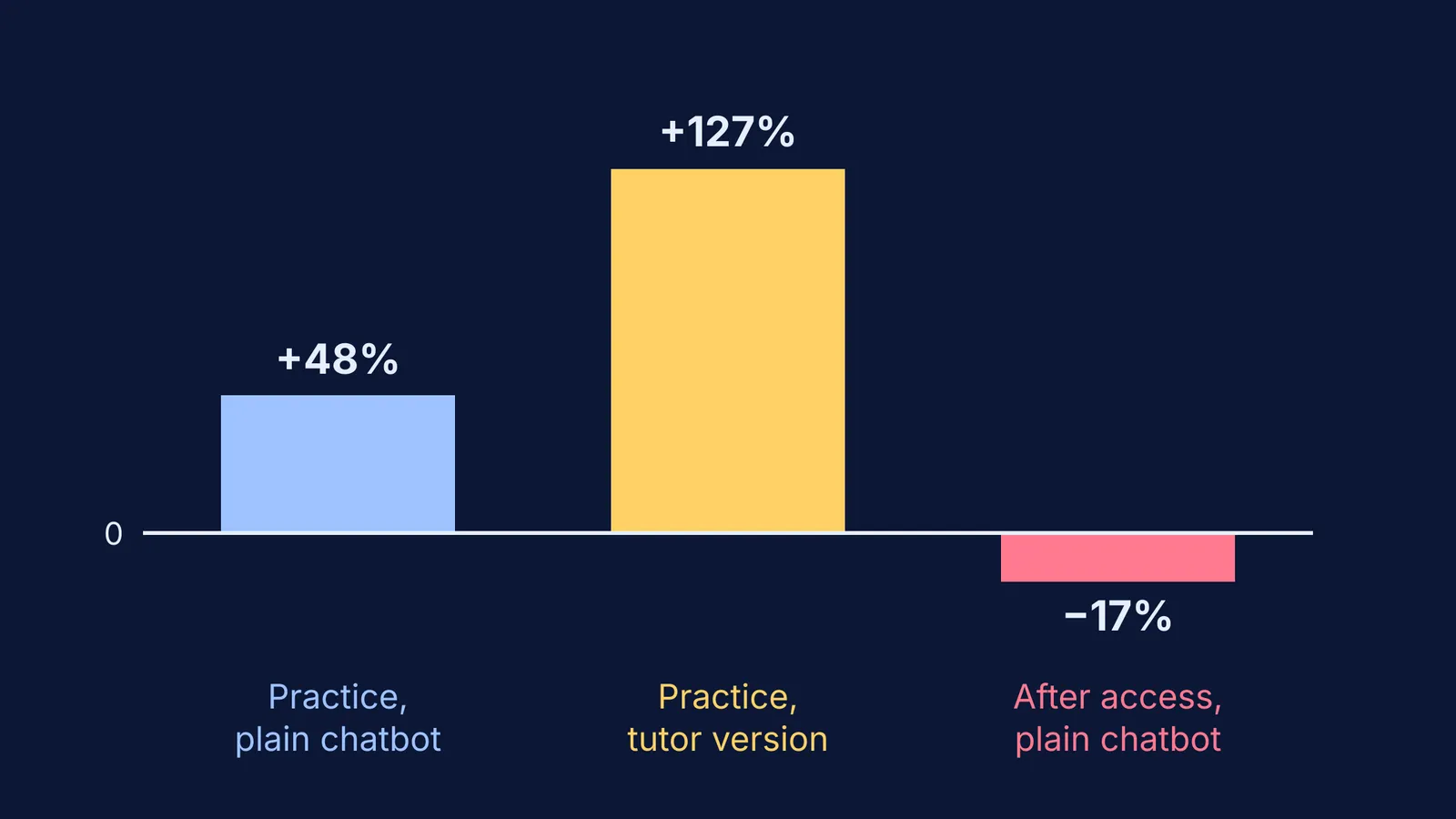
Not by itself. What helps is how the tool is designed. In a field experiment with nearly a thousand high school maths students, Hamsa Bastani and colleagues compared a plain ChatGPT-style interface with a version prompted to protect learning (PNAS, 2025). With access during practice, grades rose 48% with the plain version and 127% with the tutor version. When access was taken away, students who had used the plain version scored 17% lower than students who never had access. The tutor version's safeguards largely removed that harm.
The lesson for your wallet: a tool that does your thinking for you can leave you weaker when you work alone, free or paid. We compared the two styles in more detail in AI tutors versus chatbots that give answers.
What should you ask before paying for an AI tutor?
Which limit did I actually hit? Use the free version for one normal week and note every time you were blocked: out of messages, upload refused, chat forgot your earlier work. No blocks means no reason to pay yet.
Does it make me do the thinking? Run the one-line test above, plus the checks in our guide on how to evaluate an AI tutor in 20 minutes.
Does it match my syllabus? Pick three chapters from your current CBSE syllabus or exam information bulletin and check that the tool covers each one, without topics that have been dropped.
What happens to my data? Find out what it stores about you, especially photos of handwritten work. Our checklist on privacy in learning apps for Indian parents covers what to look for.
How do I stop paying? Before you hand over a card or UPI mandate, find the cancel button. Under the RBI's e-mandate framework, the issuer must send you a notification at least 24 hours before each recurring debit and let you withdraw the mandate at any time.
How should a family decide?
A worked example (an illustration, not a real student): Riya, in Class 11, uses a free chatbot every evening for physics. In her log week she hits the photo-upload limit twice, both while checking handwritten numericals. Nothing else blocks her, and the free tutoring mode already questions her before explaining.
That is a small gap. She can type out the problem instead, or try a paid plan for one month and cancel if nothing changes.
If your problem is not limits but not knowing where to start, look for a tutor that plans the session with you. Fermi's AI tutor works out what you already know and builds a plan for the session, so you sit down to a clear next step. If you keep getting numericals wrong by the method, not the arithmetic, the Fermi Problem Library has a step-by-step solver that explains the reasoning rather than printing an answer.
Start with the one-week log tonight. It costs nothing, and it will tell you more than any pricing page.