

On this page
A five-star review saying "Best faculty, my son cleared JEE!" might be real, paid for, or written by a chatbot in seconds. What works is checking the claims behind it.
Can you spot an AI-written review just by reading it?
Mostly, no. In two experiments with restaurant reviews, published in 2024, Balázs Kovács found that "humans cannot recognize AI-written reviews", even when participants were paid for accuracy (Kovács, Marketing Letters, 2024). GPT-4-written reviews were mistaken for human ones even more often than the other way round, and an additional study in the same paper found that AI detectors were fooled as well.
That changes the job. Instead of asking "does this sound fake?", ask "what would have to be true for this to be real, and can I check it?"
Regulators are acting on fake reviews too. The US Federal Trade Commission's final rule, announced in August 2024, covers fake reviews, including "AI-generated fake reviews" (FTC, August 2024). In India, the Bureau of Indian Standards published IS 19000:2022, a standard on how online consumer reviews should be collected, moderated and published (PIB, December 2022).
What are the warning signs of fake or paid coaching reviews?
No single sign proves anything, but several together should make you slow down:
A burst of reviews in a few days, often right after results come out.
Praise with no specifics: no teacher, batch, chapter, test series, or anything that went wrong.
The same phrases or the same story shape (struggling child, joined institute, big rank) across different reviewers.
Reviewer profiles with a single review, or reviews of coaching centres in several cities.
A "comparison" or "top institutes" site that ranks the institute first and does not say who runs it.
Pressure to pay now: "last few seats" or "fees go up tomorrow". India's coaching ad rules list creating a false sense of urgency or scarcity as misleading advertisement (CCPA guidelines).
Real parents also write short, glowing reviews, so use these signs to decide what to check. The same habits help with fake AI study tips on reels and posts.
What must a coaching ad disclose under India's rules?
On 13 November 2024 the Central Consumer Protection Authority notified the Guidelines for Prevention of Misleading Advertisement in Coaching Sector, 2024 (CCPA notification, PDF). They apply to all forms of advertisement by anyone engaged in coaching, including endorsers. The key points:
False claims about the number of selections, rank in an exam or success rate count as misleading advertisement.
So do claims of guaranteed selection, or ads that lead you to believe enrolling will ensure a good rank or high marks.
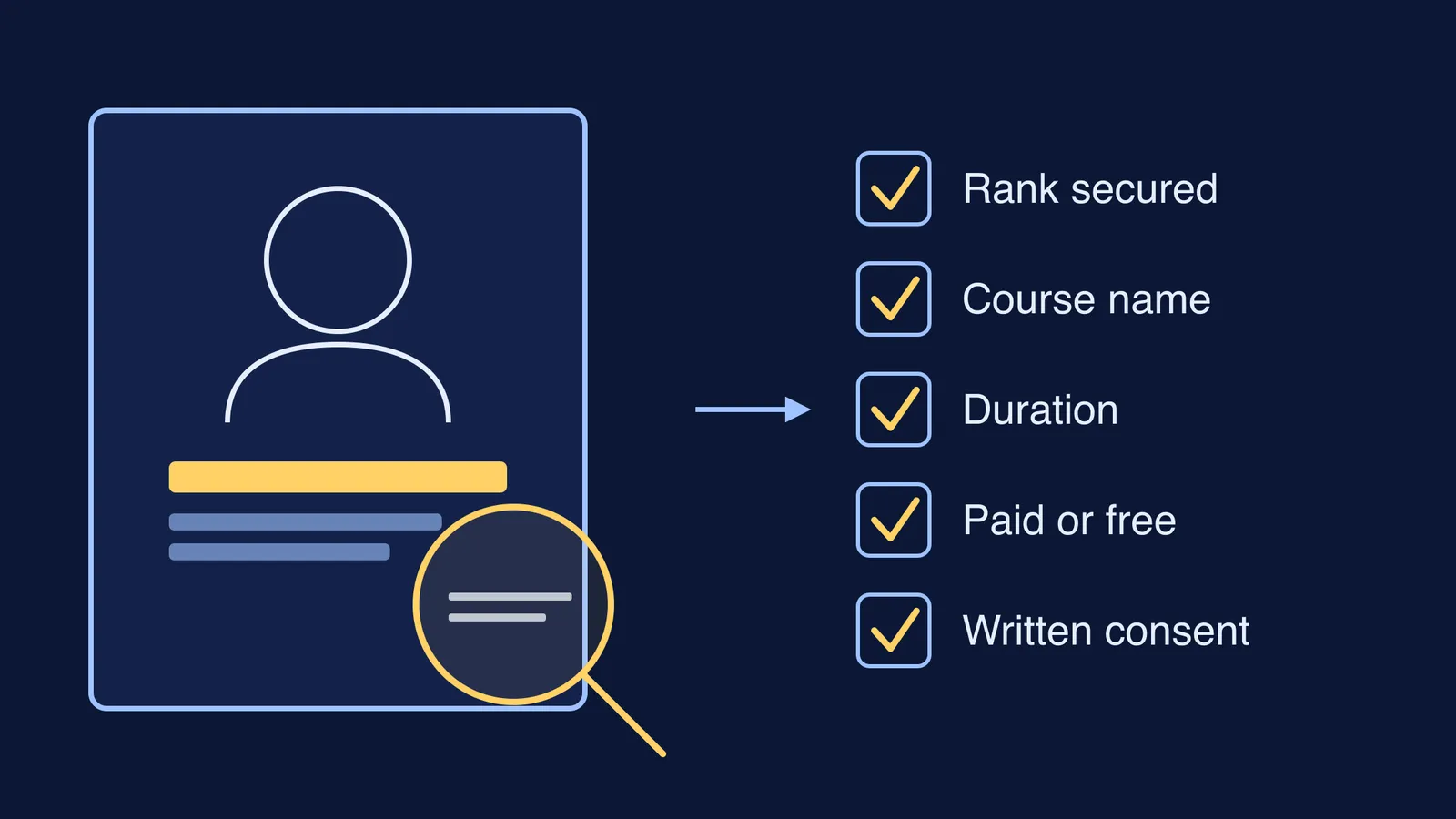
An ad that uses a candidate's photograph must disclose important information such as the rank secured, the name and duration of the course, and whether the course was paid.
Disclaimers and important information must be shown prominently, in the same font as the claim.
An institute cannot use a successful candidate's name, photo, testimonial or video without the candidate's written consent, taken after selection.
The CCPA has also acted against coaching ads. By December 2024 it had issued 45 notices to coaching centres for misleading advertisement and imposed penalties of Rs 61,60,000 on 19 coaching institutes (PIB, December 2024).
How do you verify a coaching institute's results claims?
Take a made-up example. A hoarding shows a student's photo, "AIR 87, JEE Advanced" and "500+ selections". Here is what to check before you pay:
Which course? A two-year classroom programme, a crash course or only a test series? The course name and duration should be on the ad.
Paid or free? The ad should say. If not, ask.
Out of how many? Ask how many students enrolled in that programme that year. Selections without that number say little about your child's chances.
Find families yourself. Talk to students from your child's school who attended, not names the institute supplies.
Get it in writing. Fees, refund terms and any results promise belong on paper; see how to read a coaching fee refund policy.
Report what is false. The National Consumer Helpline takes complaints on its toll-free number 1915 and at consumerhelpline.gov.in.
A script for the counsellor's desk: "How many students joined this exact course last year, and how many qualified? And which course were the toppers on your poster in, and for how long?" A clear answer is a good sign. A vague one is information too.
One topper's rank also contains luck; this skill-plus-luck model of why toppers often score lower next time shows why.
What about study app ratings?
App store stars can have the same problem, so try a question your child got wrong and see whether the app explains why or only prints an answer. For example, the Fermi Problem Library has worked problems with a step-by-step solver that explains the reasoning, so you can judge the explanation yourself instead of a star count.
Before you pay any coaching fee, go through the six checks above with your child.


