

On this page
Your textbook draws cyclohexane as a flat hexagon, but the real molecule is puckered. Once you can see its 3D shape, three exam questions get easier: which conformation is most stable, where the axial and equatorial positions are, and why big groups go equatorial. If conformations are new to you, start with conformations of ethane and Newman projections, which uses the same ideas of torsional and steric strain.
What do the chair and boat conformations look like in 3D?
A flat ring would need 120° bond angles, which is 10.5° larger than the ideal tetrahedral angle, so the ring puckers instead (LibreTexts, Sonoma State). In the chair, carbons 1, 3 and 5 sit slightly above the ring's average plane and carbons 2, 4 and 6 slightly below, so side-on it looks like a reclining chair with a headrest and a footrest. In the boat, carbons 1 and 4 both point up, like a boat's bow and stern.
Why is the chair more stable than the boat?
In the chair, every carbon has a 109.5° bond angle, so there is no angle strain (LibreTexts, Liu). The boat is about 30 kJ/mol higher in energy than the chair, according to the same source. Two things cause this: eclipsed C–H bonds, and the two "flagpole" hydrogens on C1 and C4, which point towards each other.
The ring is always moving. At room temperature, one chair flips into the other about a million times a second, over an energy barrier of about 45 kJ/mol (same source). The ring passes through boat-like shapes during each flip.
How do you find axial and equatorial positions?
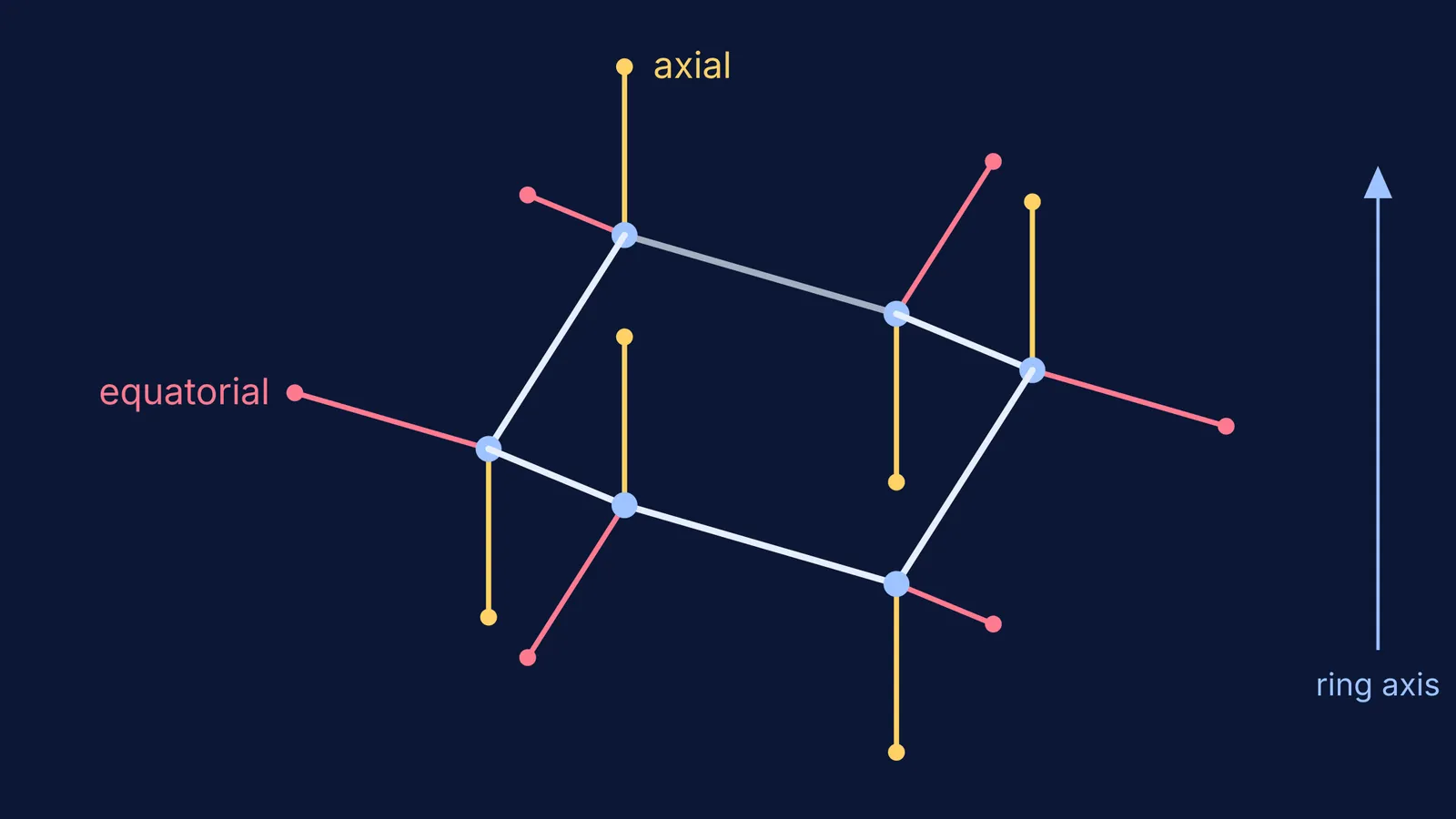
Each carbon carries two hydrogens, so a chair has 12: six axial and six equatorial (LibreTexts, Sonoma State). Use these rules:
Axial bonds run parallel to the ring axis. They point straight up on carbons that sit high and straight down on carbons that sit low, so three point up and three point down.
Equatorial bonds point outwards around the rim, each tilted slightly the opposite way from the axial bond on the same carbon.
Every carbon has exactly one axial bond and one equatorial bond.
A ring flip swaps them: every axial position becomes equatorial and every equatorial position becomes axial.
Why do bulky groups prefer equatorial?
An axial group sits right beside the two axial hydrogens on the same side of the ring, on carbons 3 and 5 counted from it. These clashes are 1,3-diaxial interactions. For a methyl group, each one adds about as much strain as gauche butane, 3.8 kJ/mol, so axial methylcyclohexane carries 2 × 3.8 = 7.6 kJ/mol of extra strain (LibreTexts, Morsch et al.). The same page says about 95% of methylcyclohexane molecules have the methyl equatorial at 25 °C. Bigger groups pay more: its table lists 1.7 kcal/mol (about 7.1 kJ/mol) for methyl and at least 5.0 kcal/mol for tert-butyl.
Worked example: what fraction of methylcyclohexane is equatorial? Use ΔG° = −RT ln K. At 25 °C (298 K), RT = 8.314 × 298 J/mol ≈ 2.48 kJ/mol.
The axial chair is 7.6 kJ/mol higher in energy, so K = [equatorial]/[axial] = e^(7.6/2.48) = e^3.06 ≈ 21.
The equatorial fraction is 21/(21 + 1) ≈ 0.955, about 95%, matching the source.
For tert-butyl, at least 5.0 kcal/mol is at least 20.9 kJ/mol. That makes K at least e^8.4, roughly 4,600, so fewer than 1 molecule in 4,000 has its tert-butyl group axial.
So the ring spends almost all its time in the chair that keeps tert-butyl equatorial. For rings with two substituents:
Draw both chairs.
In each chair, label every group as axial or equatorial.
Pick the chair where the larger group is equatorial. If one chair puts both groups equatorial, that chair is the more stable one.
In cis-1-tert-butyl-4-methylcyclohexane, one group must be axial, and it is the methyl, because tert-butyl's penalty is far bigger. For cis and trans labels, see stereoisomerism step by step.
How can you practise this with a 3D model?
Use a ball-and-stick kit or one of the tools in seeing molecules in 3D. Predict before each move, then check.
Hold the chair side-on and predict which three carbons sit high.
Count the axial bonds: three up, three down.
Do the look-down test.
Swap one axial hydrogen for a coloured ball (your "methyl") and find the two axial hydrogens it crowds.
Flip the ring by lifting the footrest and lowering the headrest. Your methyl should now be equatorial.
Explain out loud why the new chair is lower in energy, using 1,3-diaxial interactions.
If you don't have a kit, the Fermi Simulation Lab has interactive simulations for the ideas that are easier to see than to read. If gauche strain or Gibbs energy is still shaky, the Fermi Concept Library gives each concept in chemistry its own lesson, so you can fill that gap first.


