

On this page
If you draw August Kekulé's classic 1865 formula for benzene (C₆H₆), your pencil traces three single bonds and three alternating double bonds around a six-carbon ring. When chemistry students first learn this structure, a natural prediction follows: benzene should contain two distinct carbon-carbon bond lengths.
Would alternating bonds create two different carbon lengths?
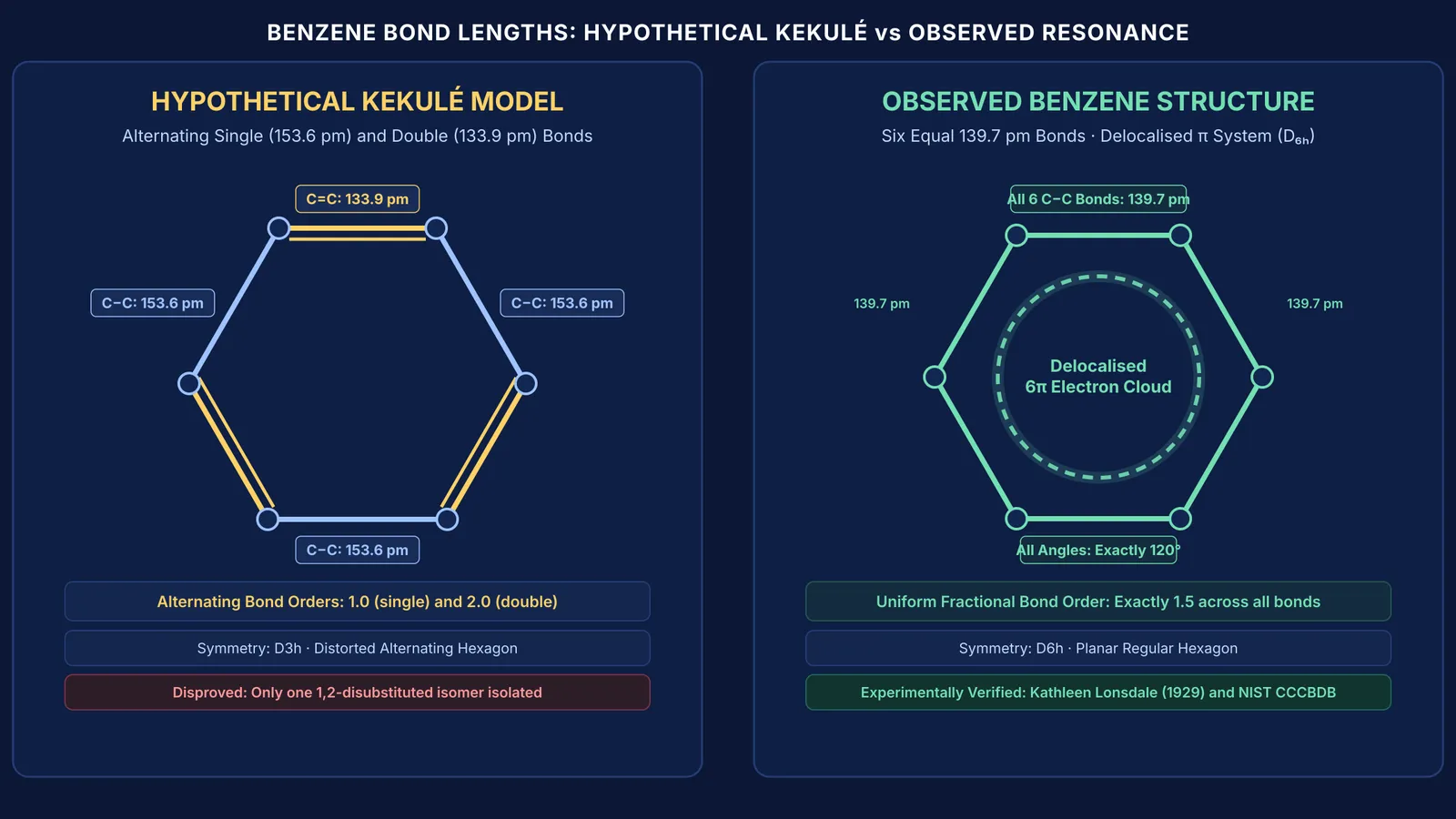
In standard organic molecules, single and double bonds are structurally distinct. According to benchmark measurements from the National Institute of Standards and Technology (NIST) CCCBDB, a standard carbon-carbon single bond in ethane (C₂H₆) measures 153.6 pm. By contrast, a carbon-carbon double bond in ethylene (C₂H₄) measures only 133.9 pm in NIST experimental geometry benchmarks. The extra pair of shared electrons in a double bond pulls the two carbon nuclei significantly closer together.
If benzene matched Kekulé's static drawing, its geometry would be a distorted, pulsating hexagon. Three edges would stretch to 153.6 pm while three alternate edges would shrink to 133.9 pm. Kekulé himself recognized the difficulty this posed: why did chemical experiments never reveal two different 1,2-disubstituted isomers? He proposed August Kekulé's oscillating ring model, suggesting that the single and double bonds rapidly swapped places back and forth.
What do experimental measurements tell us about benzene?
Modern physical experiments disproved the idea of rapid back-and-forth oscillation between unequal bonds. In 1929, crystallographer Kathleen Lonsdale analysed hexamethylbenzene crystals using X-ray diffraction, publishing the first definitive structural proof in the *Proceedings of the Royal Society of London* (Lonsdale, 1929). Her measurements proved that the aromatic ring is completely flat and forms a regular hexagon with equal carbon-carbon bond lengths. You can read more about Kathleen Lonsdale's crystal structure analysis and how Fourier analysis confirmed the ring's planarity.
Subsequent high-precision rotational spectroscopy compiled in the NIST CCCBDB database for benzene verified that every carbon-carbon bond in benzene measures exactly 139.7 pm. The molecule belongs to the D₆ₕ symmetry point group, with identical 120° bond angles at every vertex.
Notice where this value falls: 139.7 pm sits squarely between the 153.6 pm single bond and the 133.9 pm double bond. Linus Pauling, L. O. Brockway, and J. Y. Beach demonstrated in the *Journal of the American Chemical Society* that this intermediate distance is the hallmark of resonance, where bonding electrons are shared across multiple nuclei (Pauling, Brockway, and Beach, 1935).
How does 3D electron delocalisation explain equal bonds?
To see why benzene does not oscillate between two lengths, you must look at its three-dimensional orbital architecture. Each carbon atom in benzene is sp² hybridised. Three sp² hybrid orbitals lie in a plane oriented at 120° to one another, matching the bond angles documented in NIST CCCBDB experimental geometry benchmarks. These hybrid orbitals form strong, localized σ bonds with two adjacent carbon atoms and one hydrogen atom, creating a rigid, planar hexagonal skeleton.
Each carbon atom also retains one unhybridised 2p_z orbital pointing perpendicular to the molecular plane. Instead of pairing strictly with an immediate neighbour to create localized π bonds, all six 2p_z orbitals overlap sideways with both adjacent carbons simultaneously. This continuous overlap forms two continuous, ring-shaped clouds of delocalised π electrons—one floating above the molecular plane and one below it.
In 1933, Linus Pauling and G. W. Wheland published quantum mechanical calculations in *The Journal of Chemical Physics* showing that this delocalisation releases substantial resonance energy, locking the molecule into an energetically favoured symmetric state (Pauling and Wheland, 1933).
In resonance theory, the true molecule is a hybrid of two equivalent Kekulé contributors. As explained in our guide to calculating average bond orders from resonance, any given carbon-carbon bond is a single bond in one contributor and a double bond in the other. This gives an average bond order of 1.5 across all six positions: Bond order = (1 + 2) / 2 = 1.5. Because every position has the exact same bond order of 1.5, every bond has the exact same length of 139.7 pm.
How can students predict aromatic bond parameters?
When preparing for competitive exams like JEE Main, JEE Advanced, or NEET-UG, remembering the 139.7 pm figure from NIST experimental benchmarks is less valuable than mastering the predictive logic behind it. Working through the structural steps before checking an answer reinforces your mental models far more effectively than memorising individual numbers.
You can apply this 4-step diagnostic checklist to any conjugated ring system:
Identify orbital hybridisation: Count σ bonds and lone pairs to determine if the ring atoms are sp² hybridised and coplanar.
Check for continuous overlap: Verify that unhybridised p orbitals form an unbroken loop around the perimeter.
Calculate fractional bond order: Divide the total shared bonding electron pairs across all contributing resonance structures by the number of bonding positions.
Estimate intermediate bond distance: Use single and double bond benchmarks from the NIST CCCBDB database to bracket the bond length (for carbon, between 133.9 pm and 153.6 pm).
Visualising how unhybridised p orbitals merge into a continuous 3D cloud can be challenging on a flat sheet of paper. The Fermi Simulation Lab provides interactive simulations for the ideas that are easier to see than to read, allowing students to inspect the planar σ framework and rotating π clouds from any angle. When practicing challenging structural reasoning problems, the Fermi Problem Library offers worked problems with a step-by-step solver that explains the reasoning rather than printing an answer.


