

On this page
Pasting a tough physics numerical into an AI chatbot feels like instant relief. Within seconds, it prints a clean derivation and a boxed final answer. You nod along, assuming you understand it, only to draw a complete blank during your next mock test. This memory lapse is a predictable result of cognitive offloading: when AI eliminates the effort of finding the starting step, your brain skips the encoding needed for long-term recall.
Why does getting the full answer hurt your learning?
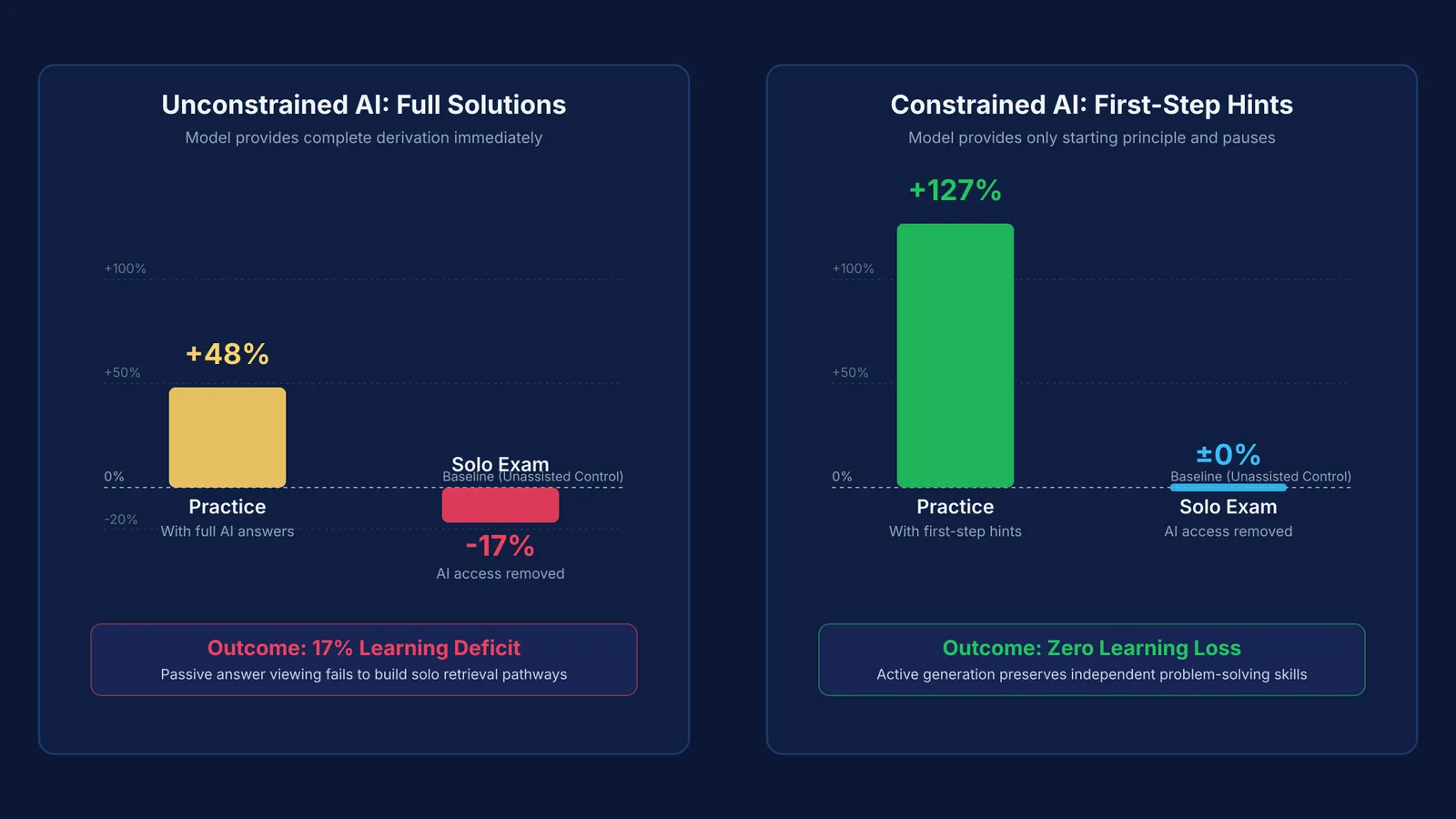
In a randomised controlled trial published in the *Proceedings of the National Academy of Sciences*, researchers tracked nearly 1,000 high school students solving mathematics problems Bastani et al., 2025. During practice, students with standard access to GPT-4 solved 48% more problems correctly than unassisted peers. However, on a subsequent solo exam without AI, those same students scored 17% worse than students who had practiced with no assistance at all. Meanwhile, students using an AI tutor constrained to provide hints avoided this learning loss.
Decades of cognitive science explain why unconstrained answers fail. The generation effect demonstrates that students recall information between 25% and 40% better when they actively generate an answer rather than reading it Slamecka & Graf, 1978. Furthermore, research on intelligent tutoring systems showed that when software provides sequential hint tiers, students rush through 68% of intermediate hints in less than one second to view the final answer Aleven & Koedinger, 2000.
How do you prompt an AI to give only the first step?
Commercial chatbots default to complete answers. To stop them from spoiling the solution, copy and paste this system prompt before entering your problem:
"You are a strict Socratic STEM tutor. Rules:
Do not solve the problem or reveal calculations or final answers.
Give only the first step: name the core physical principle, define the coordinate frame, or state the starting relation.
Keep your response under two sentences.
End with a question asking what mathematical expression comes next.
Stop generating immediately after asking the question."
This prompt forces the model to pause. For deeper comparisons of tutor designs, read our analysis of how answer chatbots compare with AI tutors.
What does a single-step hint look like in practice?
Consider a standard Class 11 mechanics problem: a block of mass m is projected up a rough incline of angle θ with speed v and kinetic friction coefficient μ; find the distance travelled before it stops.
Without constraints, an AI immediately writes out acceleration a = −g(sin θ + μ cos θ), applies v² = u² + 2as, and prints the distance formula. You do no thinking.
With the first-step prompt active, the AI responds: "Step 1: Draw a free-body diagram of the block moving up the incline. What two opposing forces act parallel to the slope against the motion?"
The intellectual challenge remains yours. You must recall that gravity (mg sin θ) and friction (μ mg cos θ) both oppose motion, and then solve the algebra.
What should you do when you are still stuck after step one?
If the first hint does not unblock you, do not ask for the full solution. Use this three-step escalation:
State your working hypothesis: Tell the AI what you suspect: "I know gravity pulls it down the slope, but I am unsure which way friction acts." Stating uncertainty activates prior knowledge, which our guide on what tutoring research shows about hints versus answers notes is vital for error repair.
Request a limiting-case check: Ask: "What happens if friction is zero or the incline is 90 degrees? Ask me a question about that boundary to check my signs."
Upload your rough work: Photograph your notebook page and ask the AI to identify where your derivation branched off. Our guide on getting AI feedback on handwritten rough work details how to get targeted feedback on working steps.
Purpose-built platforms automate this boundary. On Fermi's AI tutor, the tutor teaches rather than answers: it holds a line of reasoning across a session, notices where a student is stuck, and decides whether to explain, ask, or show. To practice on verified problems, the Fermi Problem Library provides worked problems with a step-by-step solver that explains the reasoning rather than printing an answer.
Demanding only the first step preserves the productive friction required for genuine understanding. By making the AI pause after step one, you turn a passive answer generator into an active study partner.


