On this page
You hear these words in class, in the news and in every AI app. If you know what they mean, you will use AI tools better and notice sooner when they are wrong.
What is an AI model, and what does training mean?
A model is "any mathematical construct that processes input data and returns output", in the words of Google's machine learning glossary.
Training is finding a model's ideal parameters: the system reads in examples and gradually adjusts them (same glossary).
Example: you take three readings in a lab, (1, 3), (2, 5) and (3, 7). Your model is a straight line, y = mx + c. Training means adjusting m and c until the line fits the points, which here gives m = 2 and c = 1. Using the trained model on a new input, so that x = 4 gives y = 9, is called inference.
A large language model (LLM) is a language model with many parameters, trained on vast amounts of text, that can generate human-like text (Anthropic's glossary). More in our explainer on how large language models work.
What is a parameter in AI?
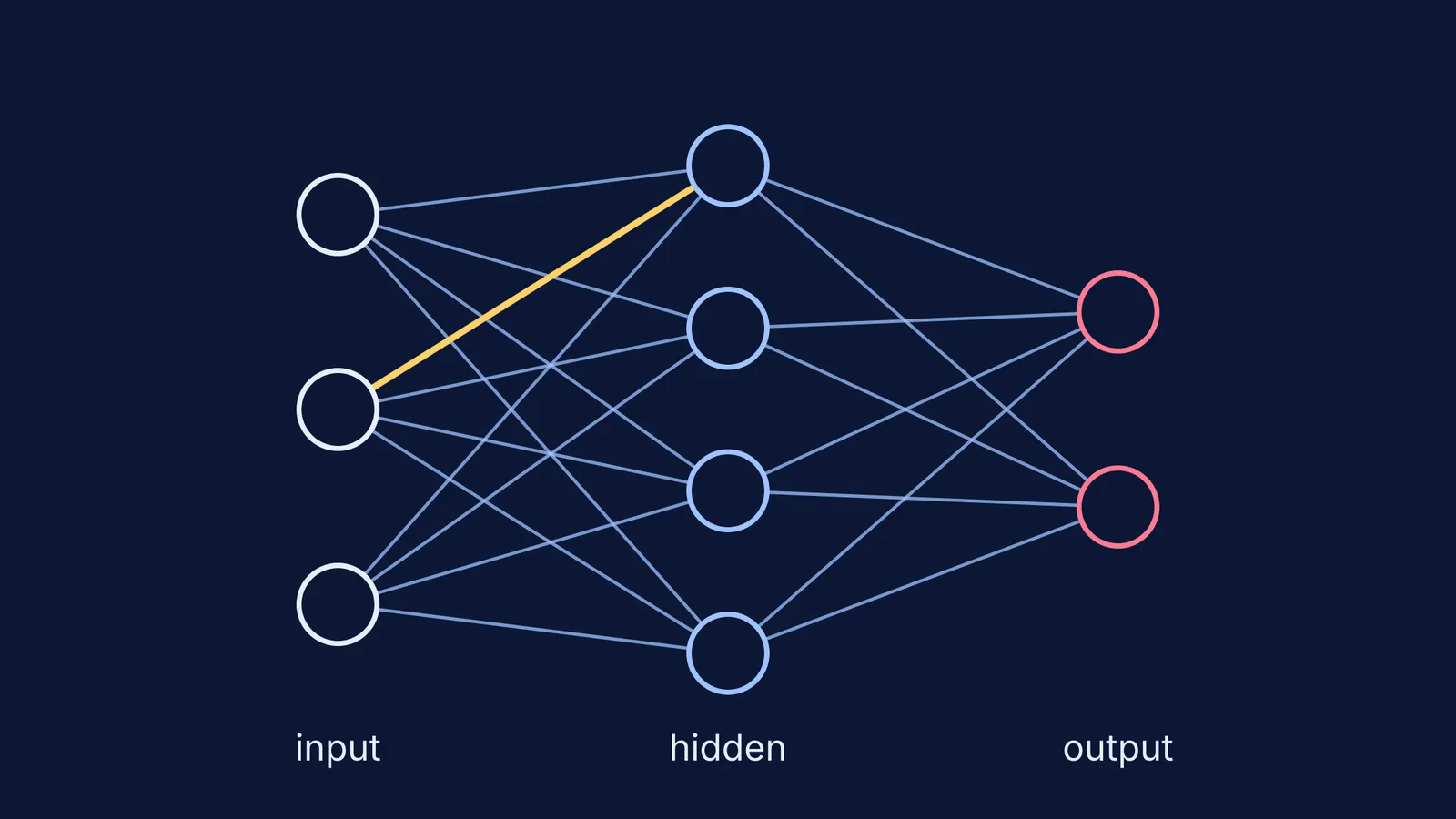
Parameters are the weights and biases that a model learns during training (Google's glossary). In the straight line above, m and c are the two parameters. In a neural network, most parameters are weights: numbers attached to the connections between units.
Example: the small network in the picture at the top has 3 inputs, 4 middle units and 2 outputs. That gives 3 × 4 + 4 × 2 = 20 weights, plus one extra number (a bias) for each of the 6 non-input units, so 26 parameters in all. GPT-3 has 175 billion parameters, which its 2020 paper called 10 times more than any previous non-sparse language model (Brown et al., arXiv). A parameter is a tuned number, not a stored fact.
What is a token in AI, and why do tokens matter?
In a language model, a token is the basic unit the model trains on and makes predictions on, usually a word, a single character or a piece of a word (Google's glossary). Tokens can even be bytes (Anthropic's glossary).
Example: a word can be one token or several; smaller tokens let a model handle unfamiliar words. On Claude models before Claude 4.7 a token was about 3.5 English characters, and Anthropic says the newer tokenizer produces about 30 percent more tokens for the same text (Anthropic's glossary).
Why it matters: a model's context window, how much it can process in one prompt, is counted in tokens (Google's glossary). Language matters too: a NeurIPS 2023 study found that the same text translated into different languages can need up to 15 times as many tokens in some cases (Petrov et al., arXiv).
What is a prompt?
A prompt is any text you give a large language model to get it to behave in a certain way, from a short phrase to the entire text of a novel (Google's glossary).
Example of a weak prompt: "Explain Newton's third law." A stronger one: "I'm in Class 11. Explain Newton's third law using a person pushing a wall, then ask me one question to check I understood. Don't solve my homework." The second says who you are, which example to use and what not to do.
Why does AI hallucinate?
A hallucination is plausible-seeming but factually incorrect output from a generative AI model (Google's glossary). A 2023 survey notes that deep-learning text generation is "prone to hallucinate unintended text", in tasks from summarising to question answering (Ji et al., ACM Computing Surveys).
Example: you ask for three papers on spaced repetition and one of the neat references does not exist. Our guide to checking references AI has made up shows how to catch this.
Why? A 2025 paper by Adam Tauman Kalai and colleagues argues that "language models hallucinate because the training and evaluation procedures reward guessing over acknowledging uncertainty" (Kalai et al., arXiv). They compare models to students facing hard exam questions: most tests only mark answers right or wrong, so guessing when unsure improves the score. Negative marking would change that. For calculations, see why AI chatbots get maths wrong.
How can you check you really know these AI terms?
Try this short self-test alone, or with a parent asking:
Cover the definitions and say one sentence aloud for each word.
Give your own example for each. For parameter, try the slope of a best-fit line from a physics practical.
Explain why "175 billion parameters" does not mean 175 billion facts.
Ask a chatbot for a formula you know and check it against your NCERT textbook. If it is wrong, that is a hallucination.
Rewrite a prompt you often use so it says who you are, what you want and what the AI should not do.
If a term still feels shaky, the Fermi Concept Library gives each computing concept its own lesson. Fermi's AI tutor works out what you already know and builds a plan for the session, so you start from your gaps.