

On this page
When secondary school students look for an Artificial Intelligence practical project, they often get caught between two extremes: attempting an overly complex chatbot from scratch or copying code they cannot explain. Under CBSE Skill Education guidelines for Subject Code 417, practical assessment carries 50 marks in Classes 9 and 10—including 10 marks for a project and 5 marks for an oral viva voce based on the AI Project Cycle.
A plant leaf classifier solves this problem cleanly. It addresses Sustainable Development Goal 2 (Zero Hunger), runs directly in a web browser, and produces tangible visual results. Before exploring deep neural networks, simpler concepts like fitting a line with linear regression help build foundational intuition. A computer vision classifier then provides an accessible, working demonstration of how machines learn visual patterns.
What do you need to build a plant leaf classifier?
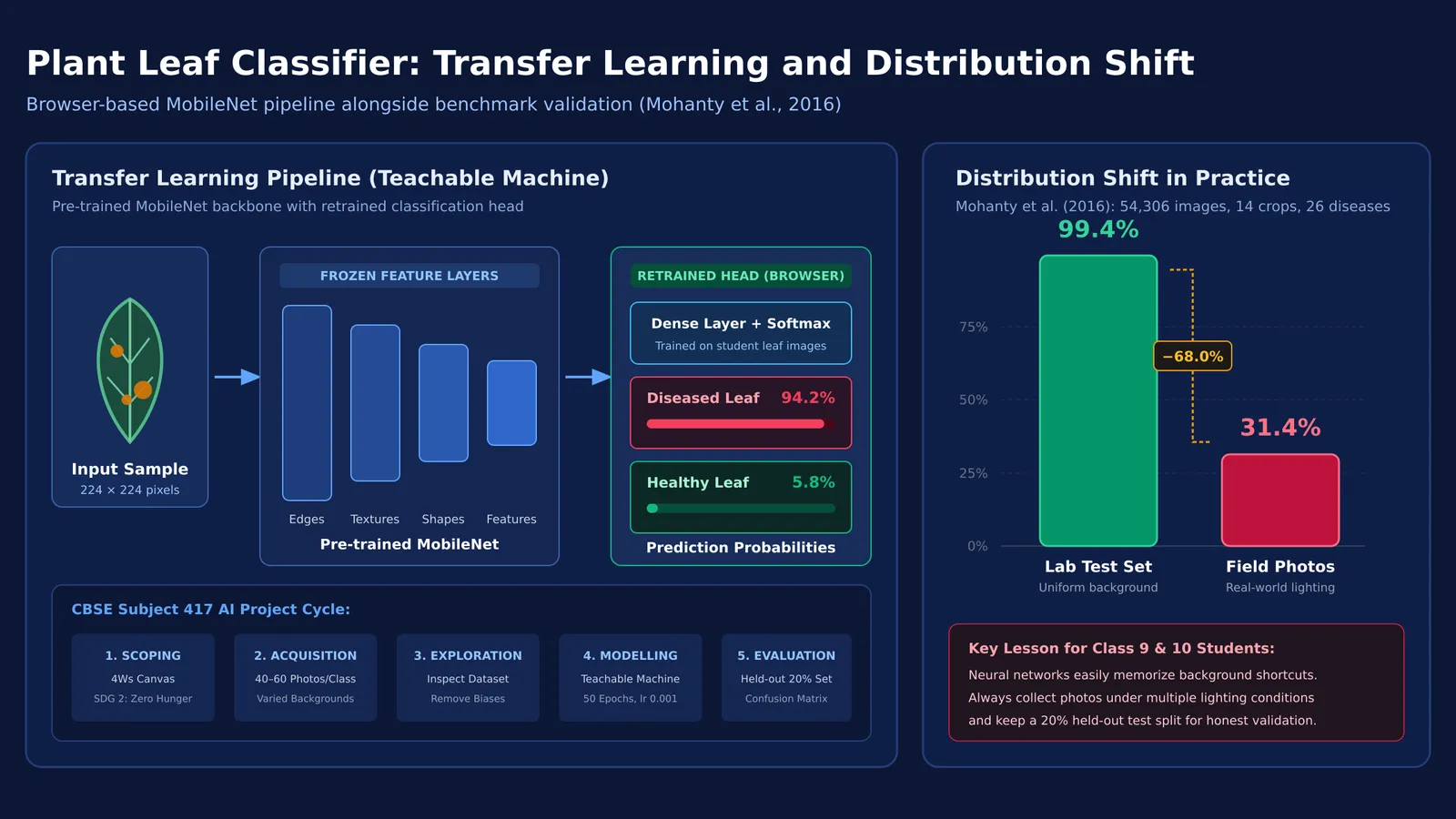
You do not need an expensive graphics card or advanced coding experience. As Michelle Carney and colleagues at Google showed, browser-based environments let students explore machine learning classification through direct visual feedback. With Teachable Machine, you can apply transfer learning using a pre-trained MobileNet model that runs locally on your device.
To build a classifier separating healthy tomato leaves from diseased specimens, you need:
A smartphone camera or webcam to photograph leaves.
40 to 60 sample images per category photographed against varied backgrounds, as recommended on Teachable Machine.
A web browser to train the model and export weights.
Understanding the difference between machine learning and deep learning helps you document why pre-trained convolutional neural networks detect edges and leaf textures far more effectively than manual rules.
How do you train and test the model?
Follow the official five-stage sequence:
Problem Scoping: Use the 4Ws Canvas to outline who faces the problem (farmers or gardeners), what needs detecting (leaf infections), where the tool works, and why early detection protects crop yields.
Data Acquisition: Gather at least 40 photos of healthy leaves and 40 photos of diseased leaves using Teachable Machine.
Data Exploration: Inspect your dataset to ensure backgrounds do not introduce accidental bias, such as all healthy leaves photographed on grass and diseased leaves on tables.
Modelling: Upload images to Teachable Machine and train with default parameters (50 epochs, learning rate 0.001) to fit a new classification head over frozen feature layers.
Evaluation: Test the model with held-out photos or your live webcam, recording confidence scores for each class.
You can also export your trained model to create an interactive interface following our guide to building your first student app.
Why does your model fail on new images?
A model showing perfect accuracy during classroom training can still fail when tested by an examiner. This performance drop comes from distribution shift—when test conditions differ from training data.
In a benchmark study in *Frontiers in Plant Science*, Sharada P. Mohanty, David P. Hughes, and Marcel Salathé trained convolutional neural networks on 54,306 images across 14 crops and 26 diseases. Their model achieved 99.35% accuracy on held-out laboratory images with uniform backgrounds, but accuracy plummeted to 31.4% on real-world field photos. The neural network had learned background cues instead of biological symptoms.
To avoid this failure, introduce deliberate variation during data collection:
Photograph leaves under direct sunlight, overcast skies, and artificial room light.
Vary angles, leaf orientation, and distance from the lens.
Capture leaves resting on natural soil, held by hand, and placed on neutral paper.
How do you explain your AI project in the viva?
The 5-mark viva voce under the CBSE Skill Education framework assesses whether you understand how your model makes predictions. Examiners look for conceptual clarity rather than rehearsed jargon.
Organise your response around three core points:
Problem context: Explain how early identification supports plant health under Sustainable Development Goal 2.
Transfer learning mechanism: State that instead of training an entire neural network from scratch, your project uses MobileNet feature layers trained on general visual patterns, adding a retrained classification head for leaf categories.
Evaluation and trade-offs: Present a confusion matrix showing true and false predictions. Clarify why false negatives (missing a diseased leaf) carry greater real-world risk than false positives.
The Fermi Concept Library maps computing and mathematical concepts step by step, helping you connect matrix operations to neural network layers. Practising your explanation out loud reveals gaps before the examiner asks a single question. Fermi's AI tutor can work out what you already know and build a plan for the session, holding a line of reasoning across practice questions so you learn to defend your design choices calmly.


