On this page
In Class 9 mathematics, polynomial factorisation is a core skill, but it is also where many students drop marks. A single misplaced negative sign or an incorrectly split middle term can derail an entire page of working. The National Curriculum Framework (NCF) 2023 addresses the resulting mathematics anxiety directly. The framework notes that students often fear math because of how mistakes are handled, and it advocates creating safe spaces where errors are treated as essential learning steps rather than failures.
One of the best ways to learn from your mistakes is to catch them yourself. Instead of looking up the correct answer at the back of the book, you can use an AI tutor to verify your work and show you exactly where you went wrong.
What are the most common mistakes in algebra?
Before you can fix an error, you have to know what to look for. Students often miss the greatest common factor (GCF) before attempting to split the middle term. For example, trying to factor 4x² - 16 directly instead of pulling out the 4 first.
However, the majority of points are lost to sign errors during the grouping stage. When you split the middle term and factor by grouping, you might write x(x - 3) - 1(x + 3) instead of factoring out the negative sign correctly to get -1(x - 3). According to a study cited in the International Journal of Scientific Research and Management, static sign errors account for up to 80% of the mistakes students make in algebra.
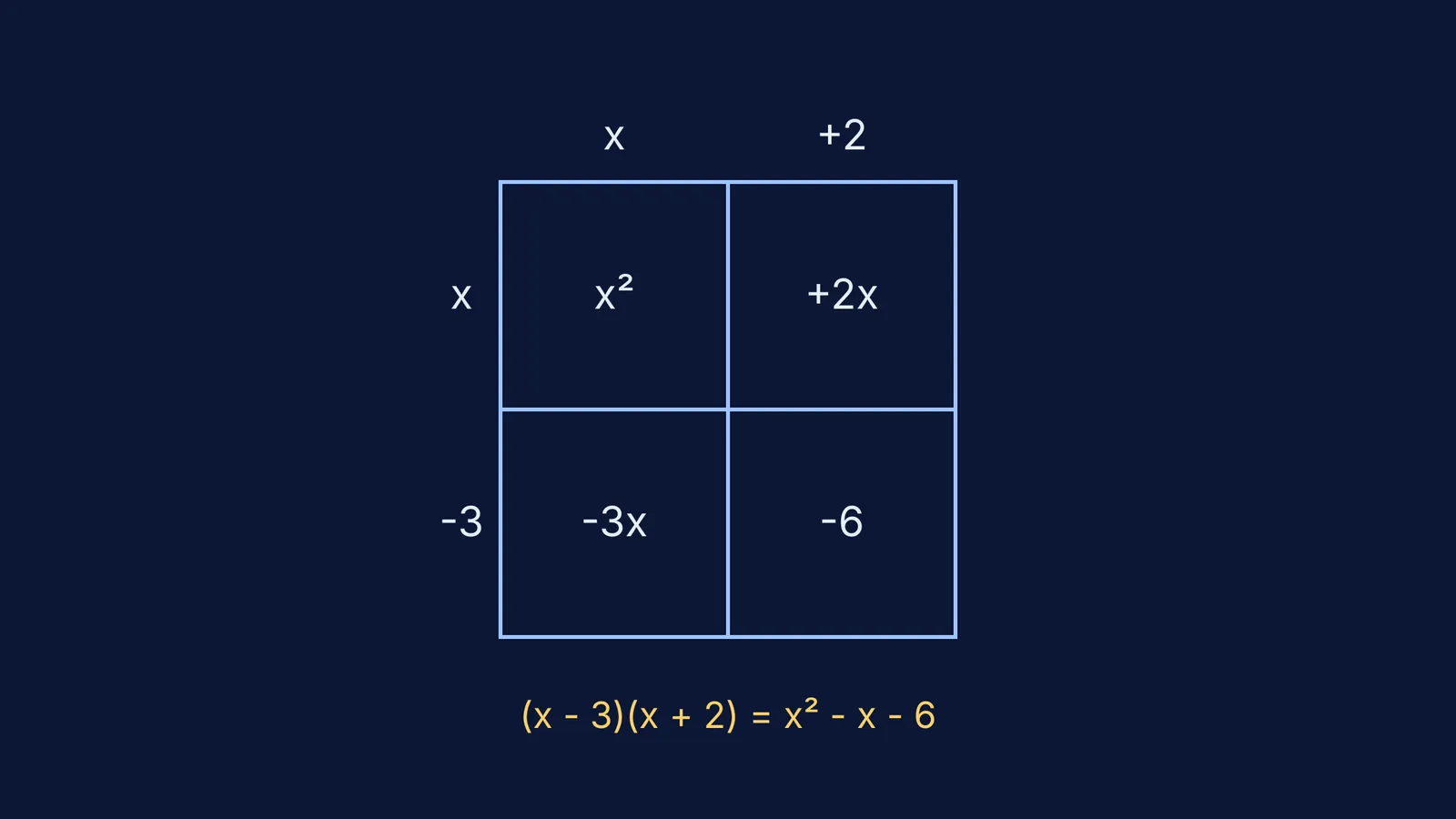
If you only see a red cross on your homework, you do not learn which sign you flipped. You need a method to prove your own work. "Multiplying back"—expanding the brackets you just formed—is the standard method for checking answers in polynomial factorisation. Because factoring is just multiplication in reverse, the product of your factors must equal the original polynomial.
How do you use the factor theorem to check?
In Class 9, you also learn the Factor Theorem. It states that if a linear polynomial (x - a) is a factor of a polynomial p(x), then p(a) = 0.
This gives you a second, independent way to check your working. If you believe (x - 3) is a factor of p(x) = x² - x - 6, you can substitute x = 3 into the original expression. Calculating p(3) = 3² - 3 - 6 gives 9 - 9 = 0. Because the result is zero, (x - 3) is definitely a correct factor.
You can also check the other factor, (x + 2). Setting x = -2, you calculate p(-2) = (-2)² - (-2) - 6. This becomes 4 + 2 - 6, which also equals zero. Using both the multiplying back method and the factor theorem together ensures you have not missed a hidden sign error, giving you total confidence in your answer before you move on to the next question.
How to ask AI to check polynomial factorisation class 9?
The next time you finish a page of factoring, do not ask an AI for the solutions. Instead, paste your own attempt and ask it to verify your steps.
Here is a script you can use:
"I factored x² - x - 6 as (x-3)(x+2). Please check my answer by multiplying it back out, and show me the factor theorem step it uses."
This forces the AI to show you the expansion. If you made a sign error, you will see exactly where your terms failed to cancel out in the grid. For instance, if you had accidentally written (x+3)(x-2), the AI would show you that this expands to x² + x - 6, highlighting that your middle term has the wrong sign.
This active approach is where a dedicated teaching platform helps. Fermi's AI tutor teaches rather than answers: it holds a line of reasoning across a session, notices where a student is stuck, and decides whether to explain, ask, or show. It works out what you already know and builds a plan for the session, so if you repeatedly mess up the middle term, it will guide you through what a good step-by-step AI explanation looks like.
Why build a habit of checking your work?
Checking your work by multiplying back is not just for homework; it is a habit that saves marks in high-stakes exams. By actively asking an AI to find patterns in your mistakes, you turn your errors into an asset. Catching your own mistakes builds confidence and mathematical intuition, exactly as the NCF 2023 recommends.