

On this page
In senior biology, chapters on human health and disease introduce a long list of bacterial, viral, fungal, protozoan and helminthic infections. Remembering which pathogen causes which disease, along with their specific symptoms, is a classic challenge for board exams and competitive tests.
Reading the textbook repeatedly gives a false sense of fluency. Instead, you can use an AI to build a study table, but with a twist: the real learning happens when you check the AI's work.
Why use an AI to make a disease pathogen symptom table?
When you study from a dense biology chapter, the facts are buried in paragraphs. Translating these paragraphs into a structured matrix—a table—makes them easier to digest. A 1995 study by Robinson and Kiewra found that studying graphic organisers like matrices provides a measurable achievement advantage over reading linear text outlines [[1]](https://doi.org/10.1037/0022-0663.87.3.455).
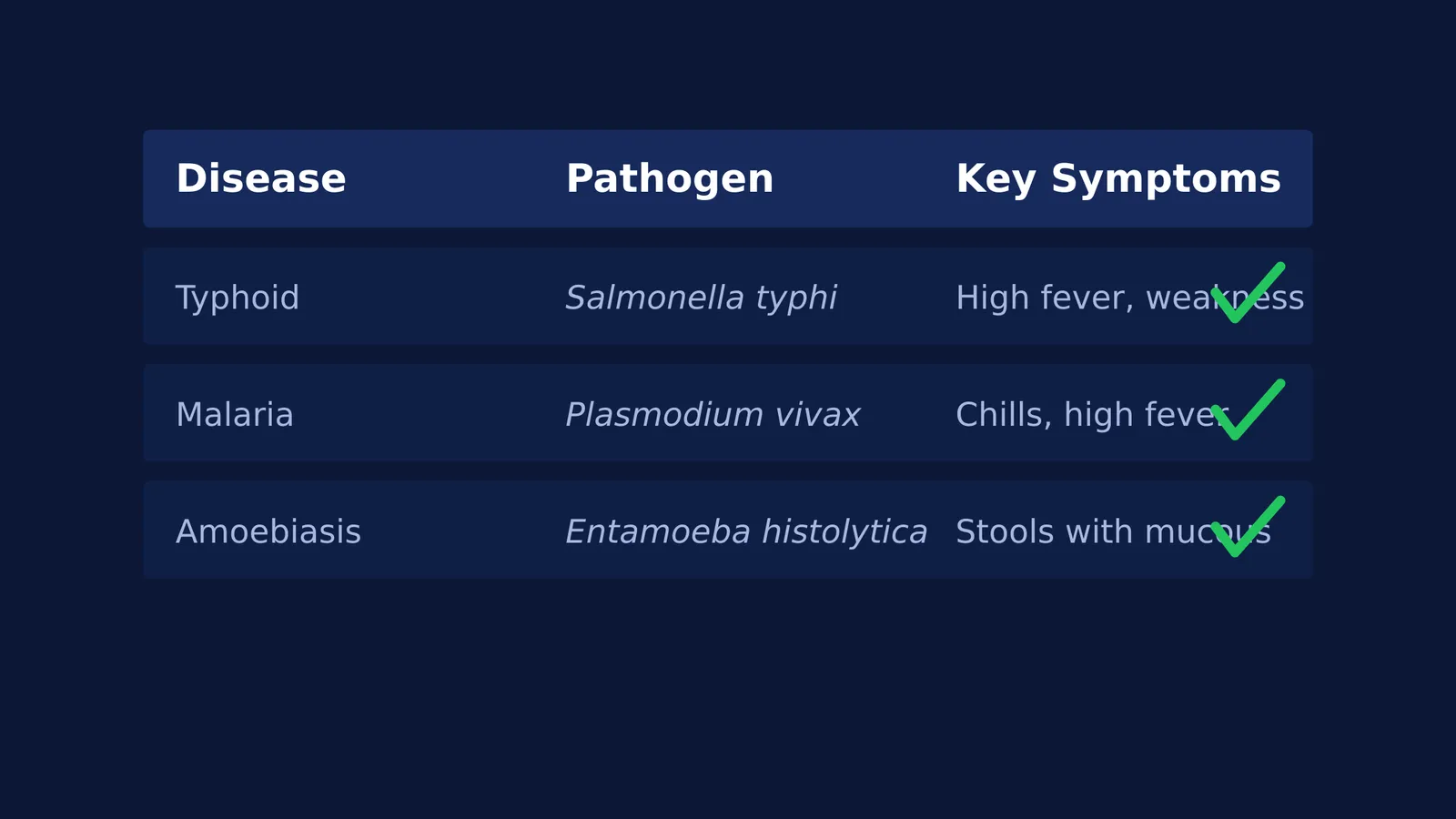
Instead of drawing the table from scratch, you can ask an AI to generate the first draft. Give the AI a prompt like: *"Create a table of the common human diseases listed in the Class 12 biology syllabus. Include columns for Disease Name, Pathogen (with scientific name), Vector (if any), and Key Symptoms."*
The AI will instantly produce a matrix. However, AI models can occasionally include extra information from outside your syllabus or miss a specific term your examiners want to see. This leads to the most important step in the process.
How do you verify AI entries against NCERT?
The AI's table is not your final study material; it is merely a draft. You must open your NCERT textbook and verify every single cell.
Check the pathogen: Did the AI list the exact scientific name for the pathogen causing pneumonia? Are the spellings correct?
Refine the symptoms: The AI might list generic symptoms for amoebiasis, but your textbook might specify phrases like "stools with excess mucous and blood clots". Update your table with the exact textbook phrases.
Add missing vectors: Ensure that the specific mosquito vector is noted for malaria, and the correct lymphatic vessels are mentioned for elephantiasis.
When you bring a topic to Fermi's AI tutor, it works out what you already know and builds a plan for the session. You can ask it to start by helping you build a draft table of diseases, and it will teach through the material rather than just handing you a final answer.
How does table-making improve active learning?
The act of verifying the table is a form of active learning. By actively hunting for specific facts in the text to confirm the AI's output, you process the information much more deeply than if you simply read the chapter from start to finish. This method works well for any topic with dense details, whether you are memorising the formed elements of blood or comparing viruses, viroids and lichens.
Once your table is verified, it becomes a powerful tool for self-testing. You can cover the "Pathogen" and "Symptoms" columns and try to recall them from just the disease name. This practice of active retrieval is highly effective; a 2006 study by Roediger and Karpicke demonstrated that prior testing produces substantially greater long-term retention than repeatedly studying the material [[2]](https://doi.org/10.1111/j.1467-9280.2006.01693.x).
By combining the speed of AI generation with the rigour of manual verification, you create a highly accurate, exam-ready resource that you have already partly memorised just by building it.


