

On this page
Why does AI mix up sodium and potassium movements?
When you ask a general artificial intelligence tool to explain nerve impulses, the text often sounds polished and authoritative. Yet conversational chatbots regularly stumble on directional transport across membranes. A 2025 study in *Advances in Physiology Education* by Volodymyr Mavrych and colleagues evaluated four prominent large language models on neuroscience assessments and discovered that while AI models retrieve definitions reliably, they frequently generate errors on multi-step physiological dynamics and directional distractors. Because language models predict probable words rather than simulate physical cells, they easily invert whether an ion flows into the axoplasm or out into extracellular fluid.
In neurophysiology, direction is everything. If an AI claims that sodium leaves the neuron to bring voltage back down after an electrical spike, or that potassium rushes in to depolarise the membrane, it reverses the biology. Such errors are especially risky for students preparing for examinations like NEET-UG, which follow the NCERT Class 11 Biology curriculum. You can spot these hallucinations quickly once you know the exact ionic rules.
How do ions actually move during an action potential?
The foundation of electrical excitability rests on two distinct mechanisms: long-term active transport and millisecond-scale passive diffusion. In 1957, Danish physiologist Jens Chr. Skou90343-8) discovered the sodium-potassium pump (Na⁺/K⁺-ATPase) in nerve tissue, demonstrating that this enzyme hydrolyses ATP in the presence of sodium and potassium. We now know this active transport system exports 3 Na⁺ ions while importing 2 K⁺ ions against their concentration gradients, maintaining high potassium inside the resting axoplasm and high sodium outside.
However, an action potential does not use the pump to fire its spike. In 1952 in *The Journal of Physiology*, Alan L. Hodgkin and Andrew F. Huxley proved that nerve impulses arise from transient, voltage-dependent changes in membrane conductances. As Carolyn L. Powell and Angus M. Brown highlighted in *Advances in Physiology Education*, membrane potential at each instant tracks the equilibrium potential of the ion to which the membrane is most permeable:
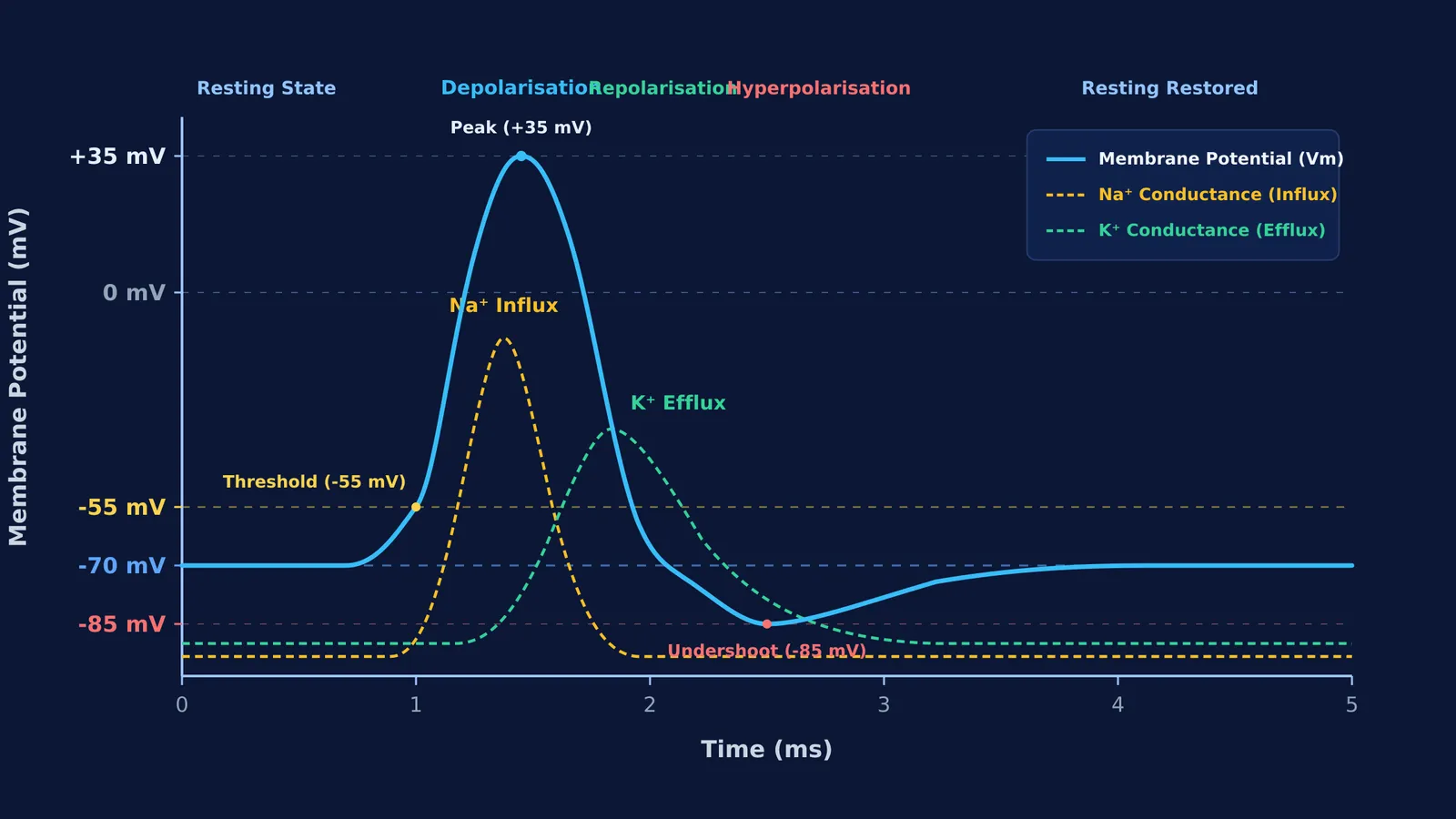
Resting state: The resting membrane is 20 to 100 times more permeable to potassium than to sodium through resting leak channels. Potassium diffuses down its concentration gradient out of the cell, leaving behind impermeant negative proteins and maintaining a polarised resting potential of -70 mV.
Depolarisation: When an incoming stimulus reaches the threshold of -55 mV, voltage-gated sodium channels open. Driven by concentration and electrical gradients, Na⁺ rushes into the axoplasm, as shown by Alan L. Hodgkin and Bernard Katz in 1949. This sodium influx reverses membrane polarity, peaking at roughly +30 mV.
Repolarisation: Within a fraction of a millisecond, sodium channels inactivate. Voltage-gated potassium channels open, allowing K⁺ to rush outward into the extracellular fluid. This outward potassium efflux brings the electrical potential back down toward negative values.
Hyperpolarisation: Because potassium gates close slowly, an efflux undershoot drives the membrane to roughly -85 mV before resting leak channels re-establish -70 mV.
What happens to calcium at the synapse?
When an action potential reaches the axon terminal, the electrical signal triggers chemical transmission. AI chatbots often omit the essential intermediary ion: calcium. In 1967 in *The Journal of Physiology*, Bernard Katz and Ricardo Miledi proved that neurotransmitter release requires external calcium entering the presynaptic terminal during membrane depolarisation.
Depolarisation opens presynaptic voltage-gated Ca²⁺ channels. Because extracellular calcium concentration is roughly 10,000 times higher than free intracellular levels, Ca²⁺ rushes into the terminal. This rapid calcium influx causes synaptic vesicles containing neurotransmitters such as acetylcholine to fuse with the presynaptic membrane and release their contents into the synaptic cleft by exocytosis. The transmitter molecules then diffuse across the 20-nanometre gap to bind ligand-gated receptors on the postsynaptic neuron.
How do you verify an AI explanation step by step?
To avoid memorising faulty AI descriptions, apply this four-checkpoint verification rubric based on the biophysical principles established by Alan L. Hodgkin and Andrew F. Huxley whenever you review an AI-generated study summary:
Check 1 (Resting potential): Did the AI specify active transport pumping 3 Na⁺ outward and 2 K⁺ inward, paired with passive potassium leak out?
Check 2 (Depolarisation): Did it identify passive sodium influx through open voltage-gated channels as the driver of the spike to roughly +30 mV?
Check 3 (Repolarisation): Did it confirm that repolarisation occurs through passive potassium efflux while voltage-gated sodium channels inactivate?
Check 4 (Synaptic transmission): Did it state that calcium enters the presynaptic terminal down its steep electrochemical gradient, rather than exiting it?
If you spot a contradiction, prompt the model specifically: "List each phase of the action potential, specify whether ion flow is active or passive, and state the exact direction (influx or efflux) of Na⁺, K⁺, and Ca²⁺." If the tool continues to mix up directions, compare its answers with our action potential simulation guide or our step-by-step neuron diagram guide. Keep in mind why AI can agree with a wrong answer if your prompt accidentally suggests an incorrect direction.
Rather than relying on chatbots that merely generate text answers, Fermi's AI tutor teaches rather than answers: it holds a line of reasoning across a session, notices where a student is stuck, and decides whether to explain, ask, or show. When you want to review biophysical foundations, explore the Fermi Concept Library, where every concept in biology, physics, chemistry, and mathematics has its own lesson and its place in the topic map. For membrane dynamics that are easier to see than to read, the Fermi Simulation Lab provides interactive simulations to make complex ion movements intuitive.


