

On this page
Look at a shark, a tuna and a frog. Which two are most closely related? Many people would pair the two fish. The German biologist Willi Hennig showed why that answer can mislead, and his method, cladistics, is how the branching trees in today's textbooks are drawn. His rule: group organisms only by features that are new to their own common ancestor, not features the whole wider family already had.
Who was Willi Hennig?
According to the Willi Hennig Society, Hennig was born on 20 April 1913 in Dürrhennersdorf, Upper Lusatia, Germany, and died on 5 November 1976 in Ludwigsburg. As a volunteer at the Dresden museum he came under the influence of the dipterist Fritz van Emden. The same biography records that he was severely wounded in Russia in 1942 and held as a prisoner of war from May to October 1945.
He set out his theory in 1950 in a German book, *Grundzüge einer Theorie der phylogenetischen Systematik*. His ideas reached English-speaking biologists through his 1965 article "Phylogenetic Systematics" in the Annual Review of Entomology and a revised English book of the same name in 1966. As a taxonomist he specialised in Diptera, the true flies, and he coined the terms synapomorphy, symplesiomorphy and paraphyly, as this summary of his life and work notes.
What are shared derived characters?
A synapomorphy is a shared derived character: a feature that arose in a common ancestor and was passed on to its descendants, as the University of California Museum of Paleontology (UCMP) introduction to cladistics explains. A plesiomorphy is the original, or "primitive", state of a feature.
The UCMP gives an example. A jellyfish and a starfish both live in water, have radial symmetry and lack a backbone, yet the starfish is more closely related to you. Those traits were already present in distant animal ancestors, so they cannot tell you who split from whom.
That is Hennig's insight: only a feature that is new to a branch marks that branch. The UCMP methods page puts it plainly: group taxa by synapomorphies, not plesiomorphies. To decide which state of a feature is the older one, you look at an outgroup, a related organism outside the group you are sorting.
Why did cladistics change how we classify life?
Once you group only by shared derived traits, every group you name should contain an ancestor and all of its descendants. The Paleontological Research Institution's Digital Atlas of Ancient Life calls this a monophyletic group. A paraphyletic group includes an ancestor and only some of its descendants.
The classic case is reptiles. The same Digital Atlas page explains that older schemes treated reptiles and birds as separate classes, which made "reptiles" paraphyletic, because birds descend from reptile ancestors. Accepting birds as a subgroup of reptiles makes the group monophyletic again.
A second trap is features that look alike without shared ancestry; our explainer on homologous vs analogous organs shows how to tell them apart.
How do you build a cladogram from shared derived traits?
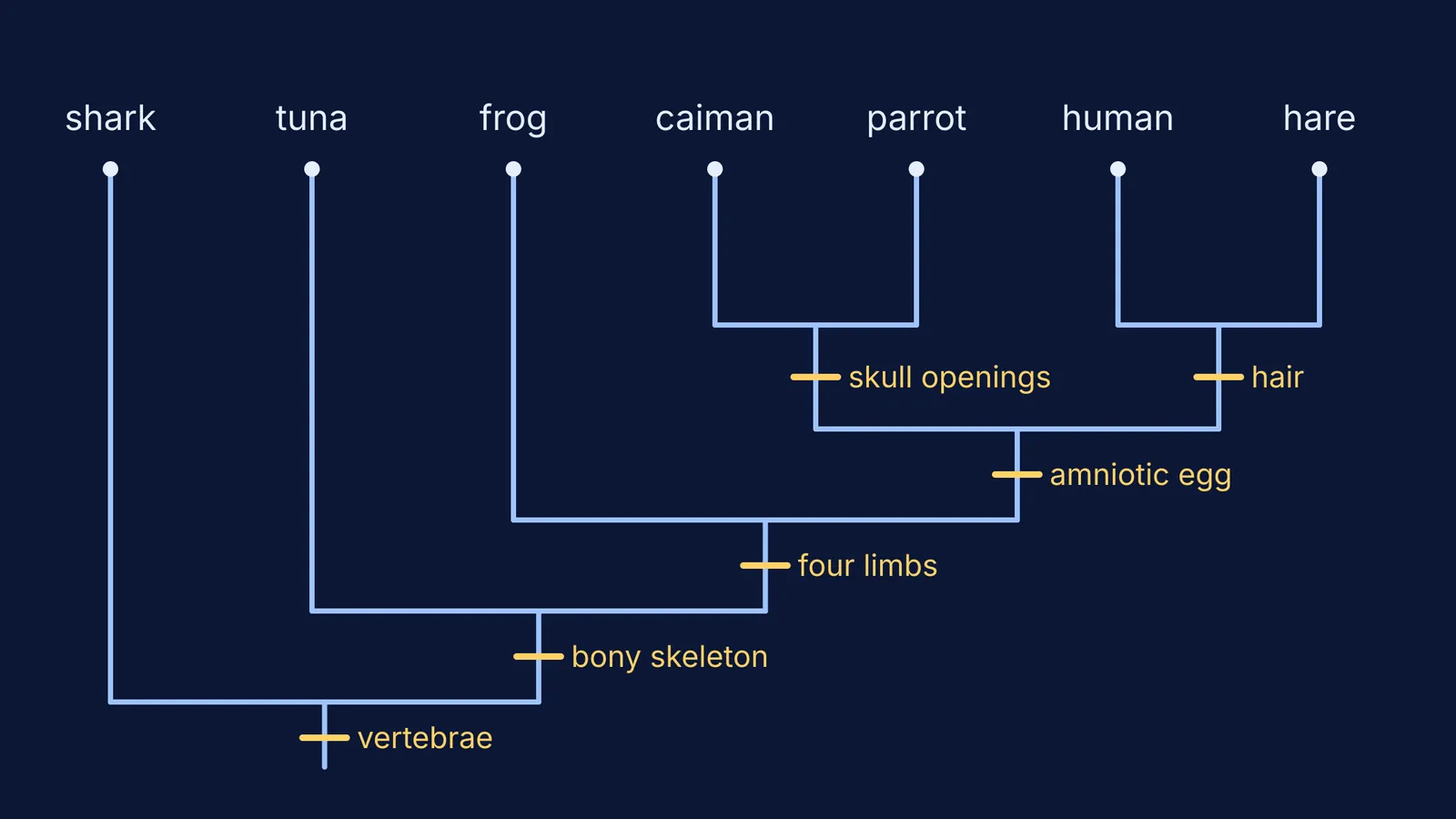
Here is a worked example using the seven animals and six characters in a UCMP teaching module on cladograms: shark, tuna, frog, human, hare, caiman and parrot. The diagram at the top shows the finished tree.
List each feature and who has it. Vertebrae: all seven. Bony skeleton: all but the shark. Four limbs: frog, human, hare, caiman, parrot. Amniotic egg: human, hare, caiman, parrot. Two skull openings: caiman and parrot. Hair: human and hare.
Set aside any feature every animal has. Vertebrae unite the set but sort no one inside it.
Nest the rest from largest group to smallest, each group sitting wholly inside a larger one.
Draw the tree. Animals go only at the tips, and each branch point carries the features shared by everything above it, as the UCMP methods page requires.
Read it back. The tuna sits with the frog and you, not the shark, because they share a bony skeleton. The caiman sits with the parrot because, in this set, only those two share the two skull openings.
So the answer to the opening question may surprise you: on this tree the tuna is closer to the frog than to the shark.
How can you practise drawing cladograms?
Try this with four to six organisms from your biology chapter:
Write the traits first, then drop any shared by everyone.
Check that your groups nest. If two traits cut across each other, one is probably convergent.
Say each branch point as a sentence: "These share X because their common ancestor had it."
Our guide to reading a phylogenetic tree or cladogram covers the questions asked about a finished tree, and our explainer on taxonomy, systematics and classification sorts out three words textbooks blur. If homology, outgroup or monophyly still run together, the Fermi Concept Library gives every concept in biology its own lesson and its place in the map, so you can see how the ideas connect.
That is all Hennig asked of a tree: show your evidence on every branch.


