

On this page
In 1887 Heinrich Hertz noticed that ultraviolet light made electric sparks jump more easily (NCERT Class 12 Physics), but his set-up was too complicated to show why. A year later in Leipzig, Wilhelm Hallwachs (Encyclopedia.com biography) stripped the puzzle down to a metal plate, a lamp and an electroscope. His set-up is the one you still meet in Class 12 physics, and his own numbers show why it works.
What did Hallwachs do in 1888?
Hallwachs described the experiment in "Ueber den Einfluss des Lichtes auf electrostatisch geladene Körper" (On the influence of light on electrostatically charged bodies), published in Annalen der Physik, volume 33, pages 301-312. The German text is free to read in the Internet Archive scan of the 1888 volume. He opens by citing Hertz's spark experiments and explains that their complicated conditions left the cause unclear, so he looked for related effects under simpler ones.
His set-up, from the paper:
a freshly polished, round zinc plate about 8 cm across, hung from an insulating stand
a wire joining the plate to a gold-leaf electroscope, shielded from the light
a Siemens arc lamp shining on the plate through a clear mineral window in a zinc screen about 70 cm wide
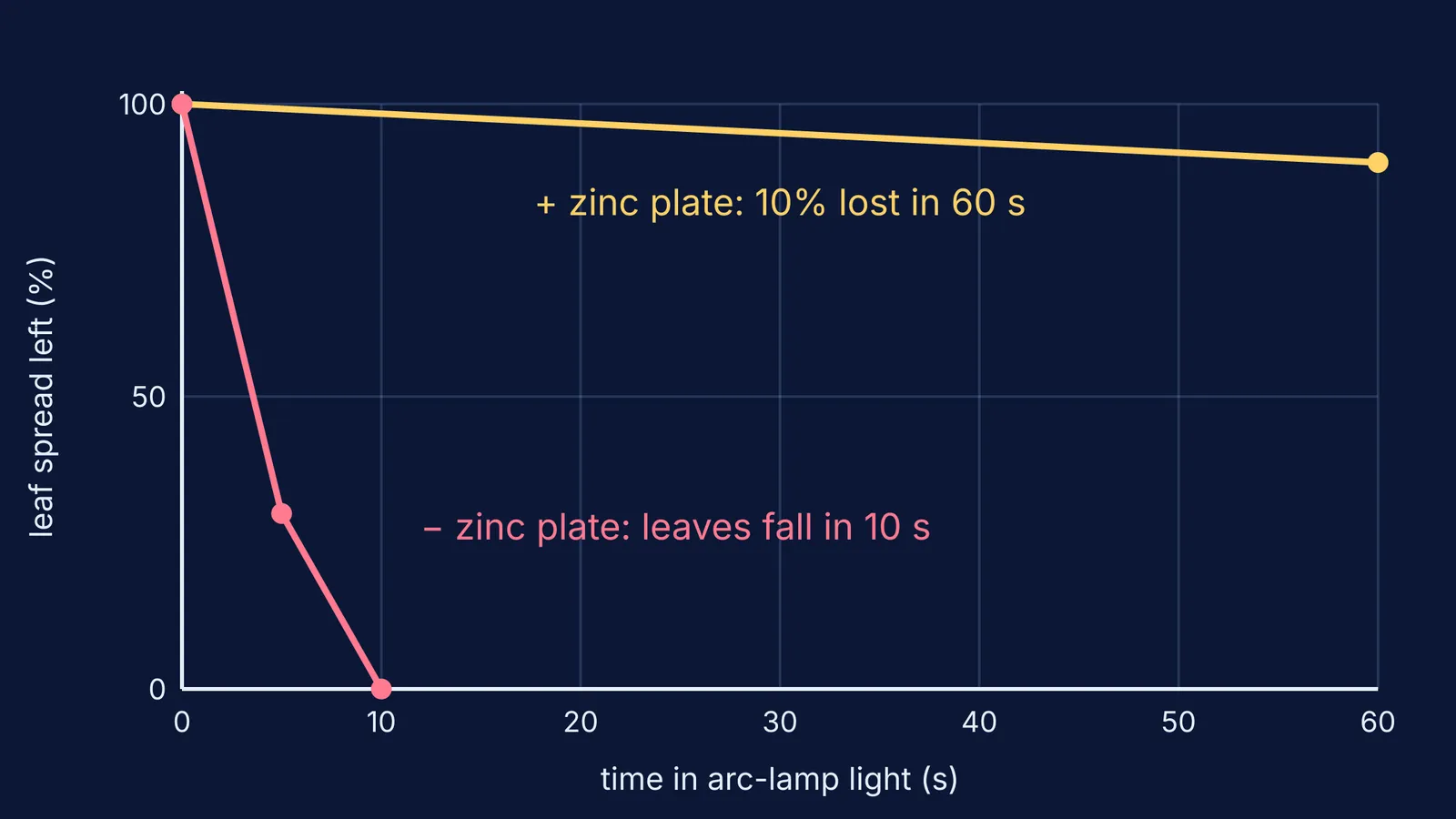
With the plate 70 cm from the arc and charged negatively, the gold leaves lost 70% of their spread in 5 seconds and collapsed completely within 10 seconds (Hallwachs 1888, p. 303). Charged positively, the same plate lost only 10% of its spread in 60 seconds. He could still see the effect with the lamp 3 m away.
Why does only a negative charge leak away?
Hallwachs tested the rival explanations one by one (Annalen der Physik 1888).
Not leaky insulation. That would drain positive and negative charge alike.
Not heat. Through a quartz prism, red and infrared light did nothing. With the plate just beyond the violet end, the leaves lost 85% of their spread in 50 seconds; the whole visible spectrum managed only 15% in a minute.
Not particles thrown off the arc. Glass 2.5 mm thick, which absorbs ultraviolet, stopped the effect: no change in 120 seconds.
A surface effect. He estimated the effect on a freshly polished zinc face at 40 to 50 times that on a face left dull in air. Iron reacted more weakly than zinc, and aluminium more strongly.
He concluded that ultraviolet light makes negative electricity leave a clean metal surface and follow the electric field around it. Nobody yet knew what that negative electricity was. The NCERT Class 12 Physics chapter on the dual nature of radiation and matter notes that J. J. Thomson identified the electron only in 1897, after which it became clear that the light knocks electrons out. NCERT also notes that an uncharged zinc plate becomes positively charged under ultraviolet light.
How do you predict what the electroscope will do?
Treat the demo as a prediction test. Cover the answers, say what you expect and why, then check. Each answer comes from Hallwachs's measurements or the NCERT chapter linked above.
Negative plate, ultraviolet light: the leaves fall quickly. Electrons are freed and pushed away.
Positive plate, ultraviolet light: the leaves barely move. Freed electrons are pulled back.
Neutral plate, ultraviolet light: the plate becomes slightly positive.
Negative plate, ultraviolet light through ordinary glass: nothing happens. The glass absorbs the ultraviolet.
Negative plate, a much brighter visible lamp: the leaves fall slowly, if at all. Zinc responds to ultraviolet, not to more visible light.
Negative plate with a dull, old surface: the leaves fall far more slowly. Polish it with fine emery paper first.
If you got 4 and 5 right, you already have the idea of threshold frequency. Brightness cannot stand in for frequency, the puzzle Philipp Lenard took further. In a school lab, let your teacher handle the ultraviolet lamp, and never look into it.
If electrons leaving a metal are hard to picture, the Fermi Simulation Lab has interactive simulations for ideas that are easier to see than to read.
Why does the zinc plate experiment matter for Class 12 and JEE?
NCERT's photoelectric effect section moves from Hertz to Hallwachs and Lenard (NCERT Class 12 Physics, Chapter 11), so you may be asked to describe these observations in a board exam. Keep the order clear: Hertz saw the effect, Hallwachs showed it removes negative charge and needs ultraviolet, and Lenard measured how the emitted particles behave. Einstein explained it in 1905, and his 1921 Nobel Prize cites "his discovery of the law of the photoelectric effect" (Nobel Prize in Physics 1921).
If work function and threshold frequency still feel shaky, the Fermi Concept Library gives each concept its own lesson and shows its place in the map. Then try the six predictions again from memory.


