On this page
In 1967, a quiet young mathematics graduate arrived at the Tata Institute of Fundamental Research (TIFR) in Bombay. Born on 12 March 1945 in Guna, Madhya Pradesh, Vijay Kumar Patodi had completed his master's degree at Banaras Hindu University in 1966 before joining TIFR under M. S. Narasimhan and S. Ramanan. Differential geometry was then focused on the Atiyah-Singer index theorem, proved in 1963. The theorem connected analysis—counting solutions of differential equations—to topology, the study of shapes invariant under continuous deformation. Yet early proofs relied on complex global topology, leaving open whether a direct link existed through local calculus.
Why did mathematicians turn to the heat equation?
In 1967, Henry P. McKean, Jr. and Isadore M. Singer proposed in the *Journal of Differential Geometry* (McKean & Singer, 1967) that diffusion could illuminate topology. They examined the heat equation, ∂u/∂t + Δu = 0, where Δ is the Laplace-Beltrami operator on a compact Riemannian manifold. The heat operator e^(−tΔ) describes heat spreading across curved space over time t.
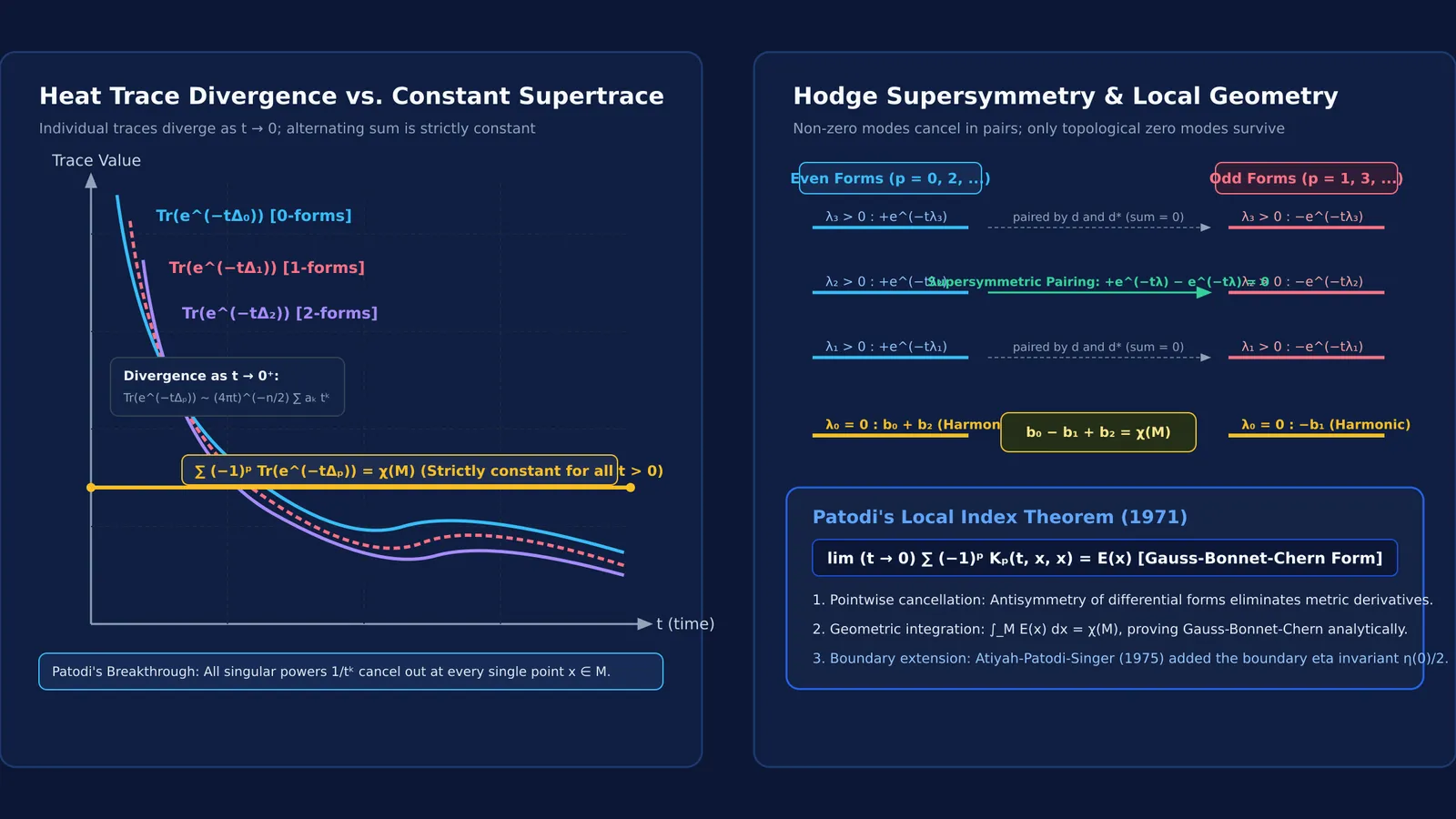
McKean and Singer proved that the alternating sum of heat kernel traces over differential forms of degree p is strictly constant for all t > 0:
∑ (−1)ᵖ Tr(e^(−tΔₚ)) = χ(M)
Here, χ(M) is the Euler characteristic. But a paradox arose. As t approaches zero, the asymptotic expansion of each heat trace produces singular negative powers of t and complex metric derivatives. McKean and Singer showed these cancel on 2D surfaces and conjectured a "fantastic cancellation" in all dimensions: higher derivatives would vanish pointwise, leaving the Gauss-Bonnet-Chern density. In higher dimensions, the algebra appeared insurmountable.
How did V. K. Patodi prove the fantastic cancellation?
For his doctoral thesis at TIFR, Patodi tackled this conjecture. In 1971, at age 26, he published his breakthrough paper in the *Journal of Differential Geometry* (Patodi, 1971).
Patodi proved the fantastic cancellation occurs at every point x on the manifold. Through intricate tensor calculations, he showed that differential form antisymmetry forces all higher metric derivatives to cancel. His mentor S. Ramanan recalled in *Bhāvanā* magazine that Patodi's early notes were overwhelmingly dense until an algebraic simplification clarified the geometric core.
Sir Michael Atiyah later compared Patodi's mathematical intuition to that of Ramanujan, noting an extraordinary ability to uncover hidden cancellations in complex formulas. In a companion 1971 paper in the same journal, Patodi extended this method to Kähler manifolds, providing an analytic proof of the Riemann-Roch-Hirzebruch theorem.
How does the heat equation extract topological invariants?
Patodi's method bridges analysis and topology through four clear steps:
Laplacian spectrum: The Hodge Laplacian Δ on a compact manifold has discrete non-negative eigenvalues: 0 ≤ λ₀ ≤ λ₁ ≤ λ₂...
Heat trace: For time t > 0, the heat operator trace sums exponential decay terms, Tr(e^(−tΔ)) = ∑ e^(−tλᵢ).
Supersymmetric cancellation: The exterior derivative d pairs every eigenvalue λ > 0 of even forms with an identical eigenvalue of odd forms. In the alternating sum ∑ (−1)ᵖ Tr(e^(−tΔₚ)), positive e^(−tλ) and negative −e^(−tλ) terms cancel identically. Non-zero modes vanish.
Two limits: As t → ∞, only zero modes (harmonic forms) remain, giving Betti numbers: b₀ − b₁ + b₂... = χ(M). As t → 0, Patodi showed that the local heat kernel converges point by point to the curvature integrand E(x) (Patodi, 1971). Equating the limits gives ∫_M E(x) dx = χ(M).
What is the Atiyah-Patodi-Singer index theorem?
Patodi's work earned an invitation to the Institute for Advanced Study in Princeton (1971–1973) to collaborate with Michael Atiyah, Raoul Bott, and Isadore Singer. Their 1973 paper in *Inventiones Mathematicae* (Atiyah, Bott, & Patodi, 1973) established the heat equation as a central engine of index theory.
Atiyah, Patodi, and Singer next studied manifolds with boundary ∂M. In their 1975 paper in the *Mathematical Proceedings of the Cambridge Philosophical Society* (Atiyah, Patodi, & Singer, 1975), they proved the index requires a boundary correction:
index(D) = ∫_M α(x) dx − (h + η(0))/2
Here, η(s) = ∑ sign(λ)/|λ|ˢ is the eta function, measuring boundary spectral asymmetry. The Atiyah-Patodi-Singer (APS) theorem and eta invariant became essential in theoretical physics, from quantum anomalies to topological insulators.
Patodi battled severe kidney disease throughout his career. Promoted to full professor at TIFR in 1976, he died on 21 December 1976 at age 31 after surgery (MacTutor History of Mathematics).
What does Patodi's journey teach modern students?
Patodi's work shows how combining distinct areas can resolve deep problems. Just as exponential models in differential equations govern physical cooling, they yield global topology when paired with algebraic symmetry. Similar links between geometry and physics appear in Amal Raychaudhuri's focusing equation and Grigori Perelman's work on the Poincaré conjecture.
When students learn advanced calculus and linear algebra, breaking complex expressions down step by step prevents computational overwhelm. The Fermi Problem Library has worked problems with a step-by-step solver that explains the reasoning rather than printing an answer. To explore how differential forms and operators connect across mathematics and physics, the Fermi Concept Library covers every concept in physics, chemistry, biology, mathematics and computing, each with its own lesson and its place in the map.