On this page
In the 1920s, a mineralogist in Oslo asked a simple question: why do some elements turn up inside minerals that are named after other elements? Victor Moritz Goldschmidt answered it by working out how big ions are. The Geochemical Society notes that he used X-ray diffraction to build the new science of crystal chemistry, and published nine monographs, the *Geochemische Verteilungsgesetze der Elemente* (geochemical laws of distribution of the elements), between 1923 and 1938.
Who was Victor Goldschmidt?
According to his Wikipedia biography, Goldschmidt was born in Zürich on 27 January 1888, earned his doctorate in Kristiania (now Oslo) in 1911 at the age of 23, and took the chair of mineralogy at Göttingen in 1929. He resigned and returned to Oslo in 1935 because of the Nazi treatment of non-Aryans. In 1942 he was arrested and nearly deported to Auschwitz; he escaped to Sweden and then England, and died in Oslo in 1947. The Geochemical Society records that he was made a Foreign Member of the Royal Society in 1943 and received 11 Nobel Prize nominations.
How did Goldschmidt measure ionic radii?
X-ray diffraction does not measure an ion directly. It measures the distance between the centres of two neighbouring ions in a crystal, which is the sum of two radii. To split that sum, you need to fix one radius first.
Goldschmidt extended earlier radius estimates by Wasastjerna, and both men took the oxide ion O²⁻ to have a radius of 132 pm, as the Wikipedia article on ionic radius explains. Subtract 132 pm from a measured metal–oxygen distance and you have the metal ion's radius. Repeat across many crystals and you have a table. He set out the resulting laws in "Die Gesetze der Krystallochemie", published in *Die Naturwissenschaften* in 1926.
Later chemists refined his numbers. Linus Pauling used 140 pm for oxide, and R. D. Shannon's 1976 review in *Acta Crystallographica* published revised radii that change with the number of neighbours an ion has. Shannon's "effective" radii keep Pauling's 140 pm for oxide.
What are Goldschmidt's rules of substitution?
As summarised by Geoclassroom's mineralogy notes, two factors control whether one ion can take another's place:
Size: free substitution can occur when the radii differ by less than about 15%; limited substitution when they differ by 15 to 30%; little or none above 30%.
Charge: the charges cannot differ by more than one, and the crystal must stay electrically neutral overall.
Goldschmidt presented these principles in English in his 1937 Hugo Müller Lecture to the Chemical Society, "The principles of distribution of chemical elements in minerals and rocks".
Worked example: will these two ions swap?
Here is a four-step check you can run on any pair. The radii are Shannon's effective ionic radii for ions with six neighbours, taken from the table in the Wikipedia article on ionic radius.
Look up both radii in the same table, at the same coordination number.
Divide the difference by the smaller radius and multiply by 100.
Compare the charges.
Give a verdict: free, limited or unlikely.
Now try it:
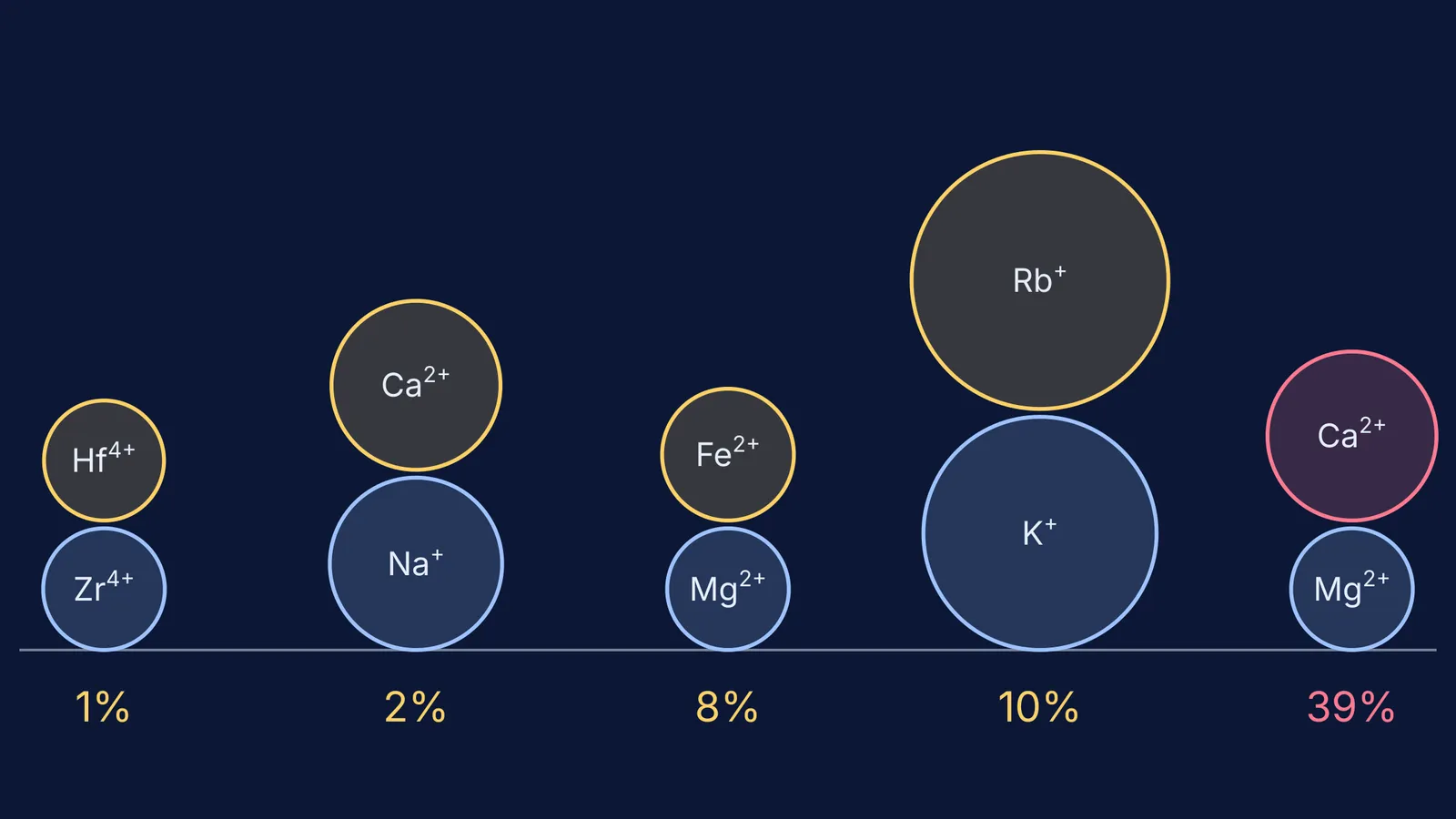
Fe²⁺ (78 pm) and Mg²⁺ (72 pm): 6 ÷ 72 × 100 = 8%, same charge. Free substitution. That is why olivine is a complete series from magnesium-rich forsterite to iron-rich fayalite, as Geoclassroom describes.
Na⁺ (102 pm) and Ca²⁺ (100 pm): 2 ÷ 100 × 100 = 2%, charges differ by one. Allowed, but only if something else balances the charge. In plagioclase feldspar, each Ca²⁺ that replaces Na⁺ is paired with Al³⁺ replacing Si⁴⁺ (Geoclassroom).
Hf⁴⁺ (71 pm) and Zr⁴⁺ (72 pm): 1 ÷ 71 × 100 = 1.4%, same charge. Almost perfect twins. Hafnium was only discovered in 1923, when Coster and Hevesy separated it from zirconium; Los Alamos National Laboratory notes that zirconium ores are usually about 5% hafnium and that the two are hard to separate.
K⁺ (138 pm) and Rb⁺ (152 pm): 14 ÷ 138 × 100 = 10%, same charge. The rule predicts that rubidium can hide in potassium minerals.
Ca²⁺ (100 pm) and Mg²⁺ (72 pm): 28 ÷ 72 × 100 = 39%, same charge. Above 30%, so the rule predicts little swapping, even though both are Group 2 ions.
How can you use this in school chemistry?
Class 11 ionic radius trends stop being a list to memorise once you see what they decide. For one study session, pick five pairs from a radius table, run the four-step check, and write one sentence per pair explaining the verdict using size and charge.
If the trend itself feels shaky, the Fermi Concept Library has a lesson for every concept in chemistry, each with its place in the map, so you can see what periodic trends connect to. When you want to check your working on a numerical, the Fermi Problem Library has a step-by-step solver that explains the reasoning rather than printing an answer.
Next time you see a mineral formula written as (Mg,Fe)₂SiO₄, you will know what the comma means: two ions close enough in size to share a seat.